What Is LLM Training Data?
LLM training data is the information used to teach a large language model how to understand language, identify patterns, and generate useful responses. While text is the most common type, datasets can also include documents, conversations, product information, reviews, code, technical content, and other structured or unstructured information.
The type of data required depends on what the model is expected to do. A customer service model may need support conversations, FAQs, product information, and knowledge-base articles. A coding model may require source code, technical documentation, and programming examples.
The goal is not simply to collect as much information as possible. Effective Training Data for Large Language Models should be relevant, accurate, diverse, clean, and suitable for the intended application.
Types of LLM Training Data
Different stages of LLM development require different types of data. Common categories include:
- Pretraining data: Large collections of text and other information used to teach general language patterns and knowledge.
- Fine-tuning data: More focused datasets used to improve a model for a specific task or domain.
- Instruction-response data: Examples showing how a model should respond to specific instructions.
- Conversational data: User and assistant interactions used to improve dialogue capabilities.
- Preference data: Examples that help models learn which responses are more useful or appropriate.
- Domain-specific data: Specialized information from areas such as finance, healthcare, technology, legal services, or retail.
- Synthetic data: Artificially generated examples that can supplement real-world data when suitable.
Understanding the purpose of the dataset helps determine which sources and collection methods should be used.
Why Does Data Quality Matter for LLMs?
The quality of LLM Training Data directly affects the quality of the resulting model. Poor-quality datasets can introduce inaccurate information, repetitive content, bias, formatting problems, and other issues that may influence model behavior.
Low-quality datasets may contain:
- Duplicate content
- Incorrect or misleading information
- Spam and irrelevant pages
- Broken text
- Outdated information
- Biased or harmful content
- Poor formatting
- Incorrect labels
- Personally identifiable information
High-quality data can help models learn more useful patterns while reducing unnecessary processing during later stages of development. Since LLM training can require substantial computing resources, removing irrelevant data before training can also improve efficiency.
What Makes Training Data High-Quality?
There is no single metric that defines good training data. Quality usually depends on several factors working together.
High-quality training data should be:
- Relevant: Closely related to the model's intended purpose.
- Accurate: Based on reliable and trustworthy information.
- Diverse: Covers appropriate topics, writing styles, languages, and use cases.
- Complete: Contains enough information to represent the required scenarios.
- Consistent: Follows clear formatting and labeling standards.
- Fresh: Updated when the application depends on changing information.
- Clean: Free from unnecessary duplication, spam, and corrupted content.
- Legally usable: Collected and processed according to applicable licensing, privacy, and legal requirements.
These criteria should be defined before collection begins so quality can be measured throughout the workflow.
How to Collect Training Data for LLMs: Step-by-Step Process
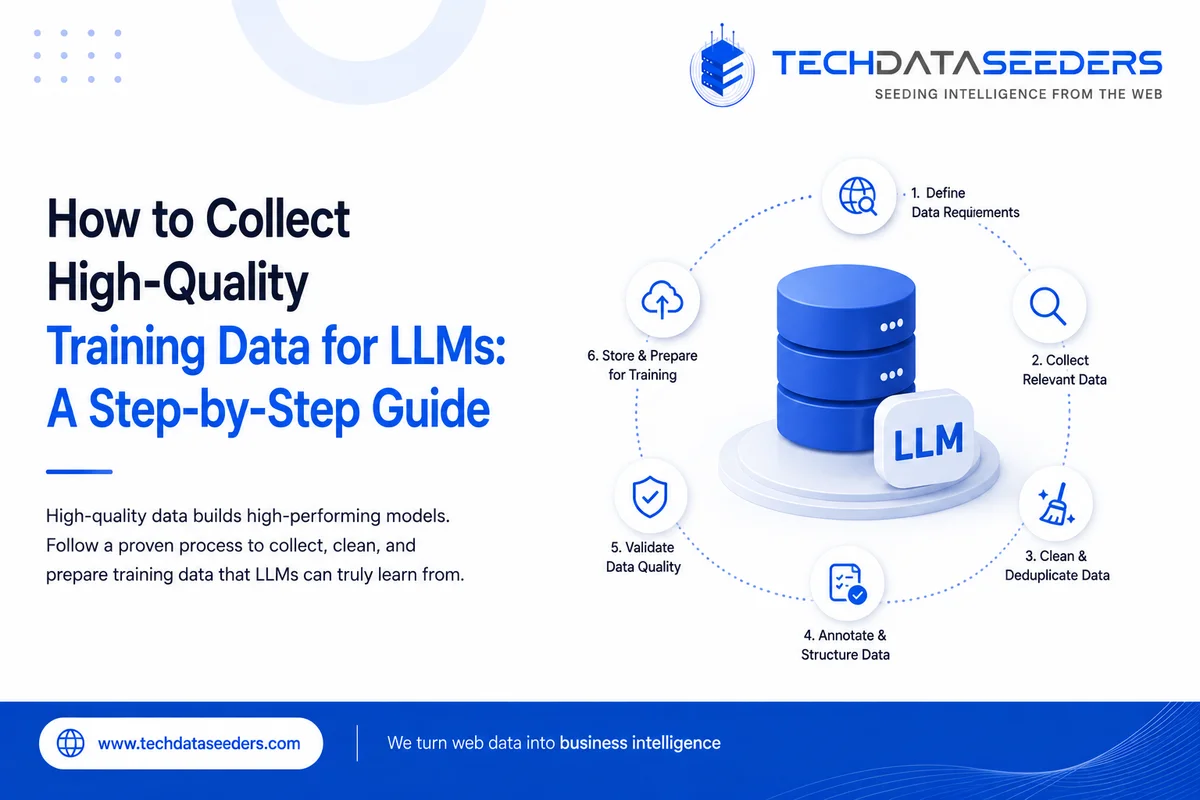
Building a reliable dataset requires more than gathering information. A structured LLM Training Data Collection process helps teams maintain quality from the first source to the final dataset.
1. Define the Purpose of the LLM
Start by identifying what the model needs to accomplish.
Consider questions such as:
- What industry will the model serve?
- Who will use it?
- What tasks should it perform?
- What types of questions should it answer?
- Which languages should it support?
- Will it require general or domain-specific knowledge?
- Is the data intended for pretraining, fine-tuning, or evaluation?
- What level of accuracy is required?
For example, a customer service LLM may need product information, FAQs, support conversations, and technical documentation. Defining these requirements early helps determine which information should be collected and which should be excluded.
2. Identify the Right Data Sources
The next step is to find reliable sources that match the model's requirements.
Potential sources include:
- Public websites
- Public datasets
- Company documents
- Product catalogs
- Research papers
- Technical documentation
- Customer support conversations
- Reviews and feedback
- Licensed databases
- Internal business data
- APIs
Source selection should consider relevance, accuracy, freshness, accessibility, licensing, and expected data volume.
For large projects, AI Training Data Collection can involve multiple sources and automated workflows. However, automation should always be combined with quality checks.
3. Collect the Data
Once suitable sources have been identified, the collection process can begin. Data may be gathered manually, through APIs, databases, automated extraction systems, or web scraping.
For large online datasets, Web Scraping for AI Training can help collect publicly available information from relevant websites. Depending on the use case, this could include articles, FAQs, product descriptions, reviews, technical documentation, or other useful content.
A strong collection process should track:
- Source information
- Collection dates
- Required fields
- Data formats
- Collection frequency
- Duplicate records
- Failed records
- Applicable usage restrictions
Organizations should also review website terms, privacy requirements, copyright considerations, and other applicable rules before collecting and using web data.
4. Organize and Structure the Dataset
Raw data is rarely ready for model training. Information collected from different sources may use completely different formats.
For example, one source may provide HTML, another JSON, and another PDF documents.
LLM Data Preparation involves converting these different inputs into a consistent structure.
This may include:
- Standardizing text formats
- Removing unnecessary HTML
- Separating documents into sections
- Creating consistent fields
- Normalizing metadata
- Converting files into machine-readable formats
- Preserving source information
Good structure makes cleaning, annotation, validation, and later dataset management much easier.
5. Perform LLM Data Cleaning
Raw datasets often contain unnecessary or low-quality information. LLM Data Cleaning removes content that could negatively affect model training.
Common cleaning tasks include:
- Removing duplicate records
- Eliminating spam
- Fixing encoding problems
- Removing broken text
- Filtering irrelevant content
- Removing unnecessary boilerplate
- Standardizing formatting
- Identifying outdated information
- Detecting inappropriate content
Deduplication is especially important when data comes from multiple sources. The same article or information may appear on several websites, and excessive repetition can reduce dataset diversity.
Cleaning rules should always be based on the purpose of the model. Data that is useful for one application may not be useful for another.
6. Remove Sensitive and Unwanted Information
Privacy and responsible data use should be considered throughout the collection process.
Datasets can contain names, email addresses, phone numbers, account information, or other sensitive details. Organizations should identify and handle such information according to applicable privacy requirements and internal data policies.
It is also important to review the licensing and usage rights associated with collected content.
Good Data Collection for Machine Learning is therefore not just a technical process. It also requires appropriate attention to privacy, security, licensing, and responsible data usage.
7. Annotate and Label the Data
Not every LLM project requires manual annotation. However, labeled data can be valuable for fine-tuning, classification, instruction tuning, and other specialized tasks.
LLM Data Annotation may involve:
- Assigning categories
- Identifying user intent
- Marking entities
- Ranking responses
- Creating question-and-answer pairs
- Evaluating response quality
- Creating instruction-response examples
For example, customer support conversations could be categorized as product inquiries, order tracking, refund requests, technical support, or complaints.
Clear annotation guidelines are essential when multiple people are involved. Human reviewers can also help resolve ambiguous examples and improve consistency.
8. Validate the Dataset
After cleaning and annotation, the dataset should be checked before training.
LLM Data Validation can evaluate:
- Accuracy
- Completeness
- Relevance
- Consistency
- Duplicate rates
- Formatting
- Label accuracy
- Source quality
- Language quality
- Privacy issues
Automated validation can process large volumes quickly, while human review can identify problems that automated systems may overlook.
Sample-based quality checks are also useful. Teams can review representative records and measure whether the dataset meets predefined quality standards.
9. Improve Data Diversity
A strong dataset should represent the situations the model is expected to encounter.
Depending on the application, diversity may include:
- Different content types
- Different writing styles
- Multiple languages
- Different industries
- Different user scenarios
- Different levels of technical complexity
- Different relevant perspectives
However, diversity does not mean adding random information. Every data category should have a clear connection to the model's intended purpose.
10. Build a Balanced Dataset
More data does not automatically mean better data. When you build an LLM training dataset, make sure the distribution reflects realistic use cases.
For example, a customer service dataset should not contain thousands of examples about simple product questions while having very few examples involving returns, complaints, delivery problems, or technical issues.
A balanced dataset gives the model exposure to a broader range of relevant scenarios.
11. Document the Data Collection Process
Documentation becomes increasingly important as datasets grow.
Keep records of:
- Where the data came from
- When it was collected
- How it was processed
- Which filters were applied
- What cleaning methods were used
- How data was annotated
- How quality was measured
- Which dataset version was created
This makes it easier to identify problems, reproduce the workflow, update the dataset, and understand how changes affect model performance.
12. Continuously Update the Dataset
Training data should not always be treated as a one-time project. Websites publish new content, products change, customer preferences evolve, and industry information becomes outdated. Models working with fast-changing information may therefore benefit from recurring data collection and validation.
Automated data collection for machine learning can support these workflows by collecting new information according to predefined rules and sending it through established cleaning and validation processes.
Manual vs. Automated Data Collection
The right collection method depends on the size and requirements of the project.
| Method | Best For | Main Advantage |
|---|---|---|
| Manual collection | Small datasets | High level of control |
| APIs | Structured sources | Consistent data access |
| Web scraping | Large web datasets | Scalable collection |
| Internal databases | Proprietary information | Highly relevant business data |
| Synthetic data | Specialized examples | Can expand specific scenarios |
For large-scale projects, automated collection can significantly reduce repetitive work. However, automation should not replace quality control.
How Much Training Data Do LLMs Need?
There is no universal amount of data required for an LLM.
The requirement depends on factors such as:
- Model size
- Training objective
- Domain
- Task complexity
- Fine-tuning versus pretraining
- Number of languages
- Data quality
- Expected model performance
A smaller, highly relevant dataset may be more useful for a specialized fine-tuning task than a much larger dataset filled with irrelevant information.
The focus should therefore be on data quality, relevance, and coverage, rather than volume alone.
How to Measure Training Data Quality
Before using a dataset, establish measurable quality criteria.
Useful metrics may include:
- Duplicate rate
- Missing-data rate
- Annotation accuracy
- Relevance rate
- Error rate
- Source diversity
- Language distribution
- PII detection rate
- Toxic or harmful content rate
- Formatting error rate
These measurements can be tracked across dataset versions to identify improvements or emerging problems.
Common Challenges in LLM Training Data Collection
Large Data Volumes
Collecting millions of records creates challenges related to storage, processing, extraction, and quality control. Scalable infrastructure and automated workflows may be required.
Inconsistent Data
Different sources may use different formats, structures, terminology, and languages. Standardization is necessary before the information can be used effectively.
Duplicate Content
The same information may appear across multiple sources. Effective deduplication helps reduce repetition and improve dataset quality.
Data Bias
If a dataset does not adequately represent relevant use cases or perspectives, the model may inherit those limitations.
Outdated Information
Old information can reduce model usefulness, particularly when the application depends on current industry or business information.
Privacy and Licensing
Organizations need to understand how data was collected and whether it can legally and appropriately be used for training.
How Web Scraping Supports LLM Training Data Collection
The web contains a large amount of publicly available information, making it an important source for many AI projects.
Web Scraping for AI Training can help organizations collect selected information from relevant websites at scale. Instead of manually copying individual records, automated systems can extract specific fields and organize them for further processing.
For example, a business may collect product descriptions, technical documentation, reviews, FAQs, or industry information and then apply filtering, cleaning, and validation rules before including suitable records in its dataset.
Web scraping should always be performed responsibly, with consideration for website terms, copyright, privacy requirements, robots directives where applicable, and other relevant legal obligations.
When Should You Consider LLM Training Data Services?
Building an internal data pipeline can require considerable technology, infrastructure, time, and quality-control resources.
Businesses that need large or specialized datasets may consider LLM Training Data Services for activities such as:
- Data collection
- Web scraping
- Data extraction
- Data cleaning
- Data annotation
- Data validation
- Dataset structuring
- Ongoing data updates
A specialized provider can help create a repeatable data workflow while allowing internal AI teams to focus more on model development, testing, and deployment.
Best Practices for High-Quality LLM Training Data
Keep these practices in mind when developing your dataset:
1. Start with a clear model objective.
2. Choose relevant and reliable sources.
3. Collect only the data required for the project.
4. Remove duplicates and irrelevant content.
5. Standardize formats and metadata.
6. Apply consistent annotation guidelines.
7. Validate data before training.
8. Check for bias and missing information.
9. Review privacy and licensing requirements.
10. Document dataset versions and processing steps.
11. Monitor data quality over time.
12. Update the dataset when information changes.
Conclusion
High-quality data is one of the most important foundations of a reliable LLM. Collecting large amounts of information is only the beginning. Businesses need to select appropriate sources, structure the data, perform LLM Data Preparation, remove unwanted content, annotate relevant records, and complete thorough validation.
A structured LLM Training Data Collection process can help organizations create datasets that are more accurate, relevant, diverse, and useful for their AI objectives. It also makes it easier to maintain and update the dataset as requirements change.
If your business needs scalable data collection, web scraping, cleaning, annotation, or dataset preparation, Techdataseeders can help build a data pipeline aligned with your AI and machine learning requirements. Contact Techdataseeders today to discuss your LLM training data needs and build a reliable dataset for your next AI project.
FAQs About LLM Training Data
LLM training data is the collection of information used to teach a large language model how to understand language, recognize patterns, and generate responses.
Data can be collected from websites, APIs, public datasets, internal databases, documents, licensed sources, customer interactions, and other relevant sources. The collected information should then be filtered, cleaned, structured, and validated.
High-quality training data is relevant, accurate, diverse, consistent, complete, clean, appropriately sourced, and suitable for the intended model and use case.
Yes. Web scraping can be used to collect publicly available information for suitable AI projects. However, organizations should consider website terms, copyright, privacy, and other applicable requirements before using scraped information for training.
Data cleaning may involve removing duplicates, spam, irrelevant information, broken text, unnecessary HTML, formatting problems, and other unwanted content.
There is no fixed amount. Requirements depend on the model, training objective, domain, task complexity, and whether the project involves pretraining or fine-tuning.