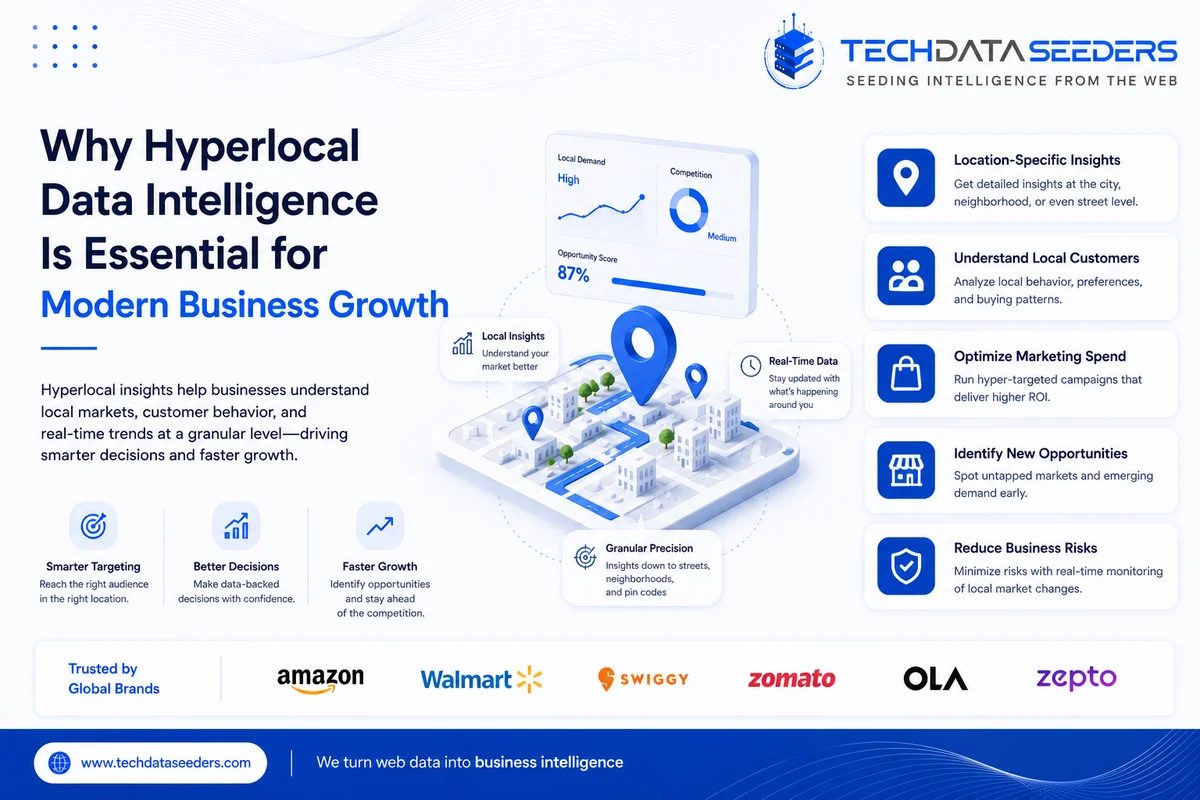
"National trends provide direction. Hyperlocal insights reveal where the real opportunities exist."
Why Local Markets Matter More Than Ever
Many organizations rely on broad industry reports and national datasets when making strategic decisions.
The problem?
Customers don't behave the same way everywhere.
A product that performs exceptionally well in one city may struggle in another. Consumer spending habits, pricing expectations, competition levels, and demand patterns often vary by location.
Businesses that understand these differences can allocate resources more effectively and uncover growth opportunities that competitors miss.
What Is Hyperlocal Data Intelligence?
Hyperlocal Data Intelligence refers to the collection and analysis of highly localized information that helps businesses understand specific markets.
This can include:
- Local business activity
- Consumer demand patterns
- Pricing trends
- Competitor presence
- Demographic indicators
- Customer reviews
- Delivery coverage
- Footfall patterns
- Market saturation levels
The goal is to move beyond general assumptions and make decisions based on actual market conditions.
How Different Industries Benefit
Retail & E-Commerce
Retailers use hyperlocal intelligence to understand regional buying behavior, competitor pricing, and inventory demand.
This helps improve product availability, pricing strategies, and marketing effectiveness.
Restaurants & Food Delivery
Restaurant operators analyze local cuisine preferences, competitor activity, delivery demand, and customer reviews to improve performance and identify expansion opportunities.
Real Estate
Property developers and agencies use neighborhood-level intelligence to evaluate market demand, rental trends, pricing patterns, and investment potential.
Travel & Hospitality
Hotels and travel brands monitor local tourism activity, seasonal demand, and competitor pricing to improve occupancy and revenue management.
Logistics & Last-Mile Delivery
Delivery providers use hyperlocal insights to optimize routes, reduce operational costs, and improve service coverage.
Healthcare
Healthcare organizations analyze population trends, service demand, and facility accessibility to improve planning and patient outreach.
How TechdataseedersDelivers Hyperlocal Intelligence
At Techdataseeders, we help organizations collect and analyze large-scale location-based datasets from publicly available digital sources.
Our solutions provide visibility into:
- Local business ecosystems
- Competitor activity
- Customer sentiment
- Pricing intelligence
- Demand signals
- Marketplace trends
- Location-specific opportunities
By combining data extraction with advanced analytics, businesses gain access to insights that support smarter decision-making.
A Practical Example
A national retail brand planned to expand into several new metropolitan markets.
Rather than relying solely on population data, the company analyzed:
- Local competitor density
- Consumer review trends
- Pricing patterns
- Demand indicators
- Category performance
The analysis revealed that some smaller cities offered stronger growth potential than larger metropolitan areas due to lower competition and increasing consumer demand.
As a result, the company adjusted its expansion strategy and prioritized markets with stronger long-term opportunities.
Why Traditional Market Research Isn't Enough
Traditional reports often provide broad industry insights but fail to capture local market dynamics.
By the time many reports are published:
Market conditions may have changed.
New competitors may have entered the market.
Consumer behavior may have shifted.
Pricing trends may have evolved.
Hyperlocal intelligence provides a more current and actionable view of the marketplace.
The Role of Data in Future Business Decisions
As businesses become increasingly data-driven, location intelligence is playing a larger role in:
- Site selection
- Market expansion
- Competitor analysis
- Pricing optimization
- Demand forecasting
- Customer acquisition
- Resource allocation
Organizations that understand local market dynamics can respond faster and make more confident strategic decisions.
Where Businesses See the Biggest Impact
Companies leveraging hyperlocal intelligence often improve their ability to:
- ✔ Identify growth opportunities
- ✔ Understand customer behavior
- ✔ Strengthen market positioning
- ✔ Optimize pricing strategies
- ✔ Improve expansion planning
- ✔ Monitor competitors more effectively
- ✔ Allocate resources efficiently
- ✔ Reduce decision-making risks
Conclusion
Growth strategies built solely on national trends often overlook the factors that truly influence business performance at the local level.
Hyperlocal Data Intelligence provides businesses with a deeper understanding of the markets they serve, helping them identify opportunities, reduce uncertainty, and make smarter decisions.
At Techdataseeders, we help organizations transform location-based data into meaningful business intelligence through scalable extraction, monitoring, and analytics solutions.
In an increasingly competitive environment, understanding local markets is no longer optional it's essential for sustainable business growth.
FAQs About Hyperlocal Data Intelligence for Business Growth
Hyperlocal data intelligence is the process of collecting and analyzing highly specific location-based data, such as local prices, products, customer behavior, competitor activity, and market trends. Businesses use this data to understand individual markets, identify opportunities, improve decisions, and create strategies tailored to specific cities, neighborhoods, or regions.
Hyperlocal data intelligence helps businesses identify local demand, monitor competitors, understand pricing, and discover market gaps. These insights support better location planning, targeted marketing, pricing decisions, and expansion strategies. Instead of relying only on broad market data, companies can make decisions based on what is actually happening in specific local markets.
Retailers, e-commerce companies, real estate firms, restaurants, travel businesses, FMCG brands, and location-based service providers can benefit from hyperlocal data intelligence. It is especially useful for businesses operating across multiple cities or regions because it helps compare local markets and identify differences in customer demand, competition, pricing, and product availability.
Businesses can collect data such as local product availability, competitor prices, customer reviews, promotions, search trends, store locations, ratings, and market activity. The exact data depends on business goals. Combining multiple local data points gives companies a clearer view of market conditions and helps them make more informed commercial decisions.
Traditional market research often provides broad regional, national, or industry-level insights. Hyperlocal data focuses on smaller geographic areas and captures differences between individual locations. This makes it more useful when customer behavior, pricing, competition, or product demand varies significantly from one city, neighborhood, or market to another.
Businesses can use hyperlocal data to monitor competitor pricing, product availability, promotions, ratings, reviews, locations, and market activity. Comparing these factors across specific locations helps identify competitive advantages and gaps. Companies can then adjust pricing, product offerings, marketing campaigns, or expansion plans according to local market conditions.
Techdataseeders helps businesses turn location-specific data into actionable market intelligence. The right data collection approach can be aligned with business objectives, target locations, and required data points. When evaluating a provider, buyers should consider data accuracy, coverage, scalability, freshness, quality controls, and the ability to deliver data in a usable format.
Businesses should first define their target locations, required data points, update frequency, and intended use. They should also evaluate data accuracy, coverage, scalability, compliance, and quality assurance. A reliable solution should provide consistent, decision-ready data rather than simply delivering large volumes of unverified information.