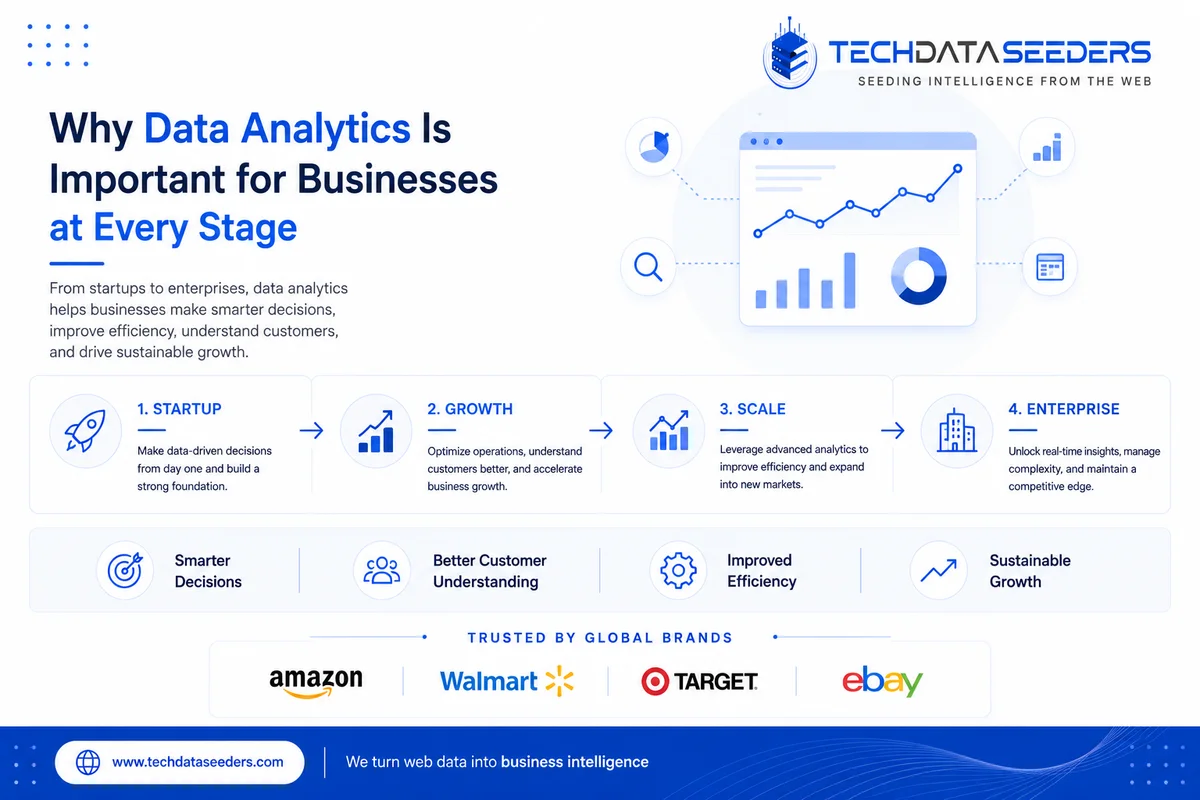
"Data tells you what happened. Analytics helps you understand why it happened and what to do next."
The Startup Phase: Finding Product-Market Fit
The early stages of a business are filled with assumptions.
Founders often believe they know their customers, understand demand, and have identified the right growth strategy.
Reality is usually more complicated.
A startup may discover that:
Its most profitable customers aren't the ones initially targeted.
One marketing channel outperforms all others.
Customers use the product differently than expected.
Certain features drive adoption while others go untouched.
Without analytics, these insights often remain hidden.
The businesses that identify them early typically waste less time, spend marketing budgets more efficiently, and reach product-market fit faster.
Growth Stage: Scaling Without Guesswork
As businesses grow, complexity increases.
New products are launched.
Marketing budgets expand.
Customer expectations evolve.
Teams become larger.
At this stage, decisions become more expensive.
For example, opening a new office, entering a new market, or launching a new product line based on assumptions can result in significant financial losses.
Analytics provides visibility into:
- Customer acquisition costs
- Revenue trends
- Product performance
- Regional demand
- Customer retention patterns
This allows leaders to invest resources where they are most likely to generate returns.
Mature Businesses Face a Different Challenge
Established companies rarely struggle with a lack of information.
Their challenge is usually the opposite.
They have:
- Sales data
- Customer data
- Operational data
- Market data
- Financial data
Yet important opportunities can still be missed when information remains disconnected.
Analytics helps organizations connect these datasets to answer bigger strategic questions.
Questions like:
Why are some customers significantly more profitable?
Which products drive long-term loyalty?
Which regions offer the greatest growth potential?
Where are operational inefficiencies reducing profitability?
The answers often reshape business strategy.
The Companies Growing Fastest Aren't Always the Biggest
Consider two companies selling similar products.
Both have access to the same market.
Both serve similar customers.
Both face the same competitors.
Yet one consistently grows faster.
Why?
Because it recognizes changes sooner.
It notices shifts in customer behavior.
It identifies declining product performance before sales drop.
It detects emerging demand before competitors enter the market.
Analytics creates this visibility.
And visibility creates opportunities.
Why Data Alone Isn't Enough
Many organizations invest heavily in collecting information.
However, collecting data and understanding data are two very different things.
Thousands of spreadsheets won't automatically reveal:
- Why customers leave
- Why conversion rates change
- Why some campaigns succeed
- Why certain products outperform others
Analytics bridges the gap between information and action.
The goal isn't more dashboards.
The goal is better decisions.
How Techdataseeders Supports Data-Driven Growth
At Techdataseeders, we help organizations transform large volumes of business data into meaningful intelligence.
Our capabilities support:
- Market intelligence
- Pricing analytics
- Competitor monitoring
- Customer behavior analysis
- Trend forecasting
- Business intelligence reporting
- Data enrichment
- Custom analytics solutions
Rather than focusing only on historical reporting, we help businesses uncover patterns that support future growth.
A Practical Example
A retail company planned to expand into three new cities.
Initial decisions were based primarily on population size and income levels.
After analyzing additional data points such as competitor density, local demand patterns, pricing trends, customer reviews, and purchasing behavior, the findings told a different story.
Two mid-sized cities showed stronger long-term growth potential than a larger metropolitan market.
The company adjusted its expansion strategy accordingly.
The result wasn't just a better decision it was a lower-risk investment backed by evidence rather than assumptions.
Why Analytics Matters Even More in 2026
Markets are changing faster than ever.
Customer expectations evolve quickly.
Competition appears from unexpected places.
Digital channels create massive volumes of information every day.
Businesses that wait for quarterly reports often discover problems after they have already impacted performance.
Analytics helps organizations move from reactive decision-making to proactive planning.
That's becoming increasingly important across every industry.
What Businesses Gain From Analytics
Organizations that embrace analytics often improve their ability to:
- ✔ Understand customer behavior
- ✔ Identify growth opportunities
- ✔ Improve forecasting accuracy
- ✔ Optimize operations
- ✔ Reduce business risks
- ✔ Increase profitability
- ✔ Allocate resources effectively
- ✔ Make decisions with greater confidence
These advantages become more valuable as businesses scale.
Final Thoughts
Every stage of business growth presents new challenges.
Startups need clarity.
Growing companies need direction.
Established organizations need visibility.
Data analytics provides all three.
The organizations that thrive in the coming years won't necessarily be the ones collecting the most information. They'll be the ones that know how to turn information into action.
At Techdataseeders, we help businesses uncover the stories hidden inside their data so they can make smarter decisions, move faster, and build sustainable growth in an increasingly competitive world.
FAQs About Data Analytics for Businesses
Data analytics for businesses is the process of collecting, organizing, and analyzing data to identify patterns, trends, and actionable insights. Companies use it to understand customers, measure performance, improve operations, control costs, and make informed decisions. It helps businesses replace assumptions with reliable data when planning and executing strategies.
Data analytics supports businesses from startup to enterprise level. Startups can use it to understand markets and customers, growing companies can track performance and improve processes, while established businesses can identify inefficiencies and new opportunities. Using analytics throughout the business lifecycle helps companies make faster, more informed, and measurable decisions.
Key benefits include better decision-making, improved operational efficiency, deeper customer insights, accurate performance measurement, cost optimization, and improved forecasting. Data analytics can also help businesses identify potential problems early and discover new opportunities. By turning raw data into actionable insights, companies can improve performance and make better use of their resources.
Data analytics gives decision-makers measurable evidence about business performance, customer behavior, market trends, and operational results. Instead of relying only on assumptions or intuition, businesses can compare historical and current data to identify patterns. This allows leaders to evaluate risks, prioritize opportunities, allocate resources, and make more confident strategic decisions.
Businesses can analyze sales transactions, customer information, website traffic, marketing campaigns, financial records, operational data, product performance, customer feedback, and more. The right data depends on the business objective. Combining information from different sources can provide a complete view of customer behavior, operational performance, revenue, and overall business health.
Data analytics helps businesses understand customer preferences, purchasing behavior, feedback, engagement, and interactions across different channels. These insights can be used to personalize experiences, improve products and services, identify customer problems, and create more relevant marketing campaigns. Businesses can also measure customer satisfaction and determine whether improvements are delivering better results.
Yes, small businesses can benefit from data analytics without investing in complex enterprise systems. They can start by analyzing sales, customer behavior, website performance, marketing results, and operational costs. As the business grows, analytics can become more advanced, supporting customer segmentation, forecasting, automation, performance dashboards, and data-driven growth strategies.
Traditional reporting generally explains what happened by presenting historical data and performance figures. Data analytics goes further by identifying patterns, relationships, and potential reasons behind those results. Advanced analytics can also help businesses predict future outcomes and recommend actions. This makes analytics more useful for strategic planning and proactive decision-making.
Techdataseeders helps businesses turn raw and complex data into useful insights for decision-making. Analytics solutions can support areas such as business performance, customer behavior, operational efficiency, reporting, and strategic planning. Businesses can work with Techdataseeders to identify relevant data sources, define analytics objectives, and develop solutions aligned with their business requirements.
Businesses should evaluate a provider's technical expertise, industry experience, data security practices, integration capabilities, scalability, reporting quality, and ongoing support. It is also important to understand how the provider delivers actionable insights from business data. The right partner should focus on measurable business objectives and provide an analytics solution that can grow with the organization.