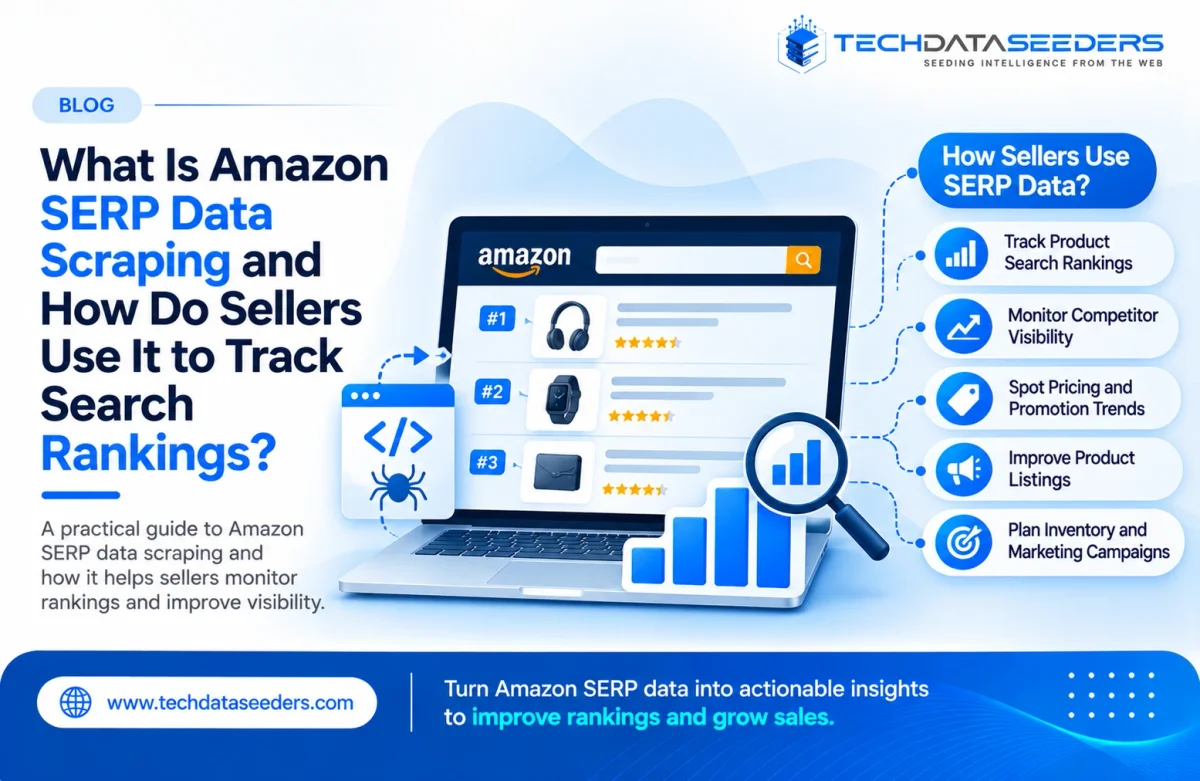
What Is Amazon SERP Data Scraping?
Amazon SERP Data Scraping involves extracting relevant information from Amazon search results for selected keywords, product categories, and marketplace locations. It helps sellers understand which products appear for particular searches, where their listings rank, and how competing products are positioned. The collected information can be organized into datasets for keyword tracking, competitor research, and product visibility analysis.
An Amazon search results page can contain several types of information, including:
- Organic product listings
- Sponsored product placements
- Product titles and ASINs
- Product prices and discounts
- Star ratings and review counts
- Prime availability indicators
- Product images
- Brand names
- Search result positions
- Promotional labels and badges
For sellers, this information provides a broader view of the search environment than checking a single product's ranking manually. If the seller wants to scrape the pricing of the product then start using Amazon price monitoring tool.
What Information Can Amazon SERP Data Extraction Collect?
Amazon SERP data extraction can collect different fields depending on the search query, marketplace, page structure, and project requirements.
| Data field | How sellers use it |
|---|---|
| Search keyword | Identify the query used to retrieve results |
| Organic position | Track where a product appears in organic results |
| Sponsored position | Monitor paid product placements |
| Product title | Compare listing titles and keyword relevance |
| ASIN | Identify and match individual products |
| Brand name | Analyze competing brands |
| Product price | Compare prices across search results |
| Rating | Understand customer rating patterns |
| Review count | Compare review volume |
| Product URL | Access the corresponding listing |
| Availability | Monitor visible stock or availability information |
| Collection timestamp | Compare rankings at different times |
Not every field appears consistently across all Amazon search results. Extraction workflows should account for missing, changing, or unavailable attributes.
How Do Sellers Use Amazon Search Ranking Data to Track Product Visibility?
Amazon search ranking data for sellers helps them understand where their products appear for important search queries and how visibility changes over time. By comparing keyword positions across repeated collection periods, sellers can identify ranking improvements, visibility losses, and competitor movements. This information supports listing optimization and more informed decisions about advertising and product positioning.
1. Monitor Organic Keyword Rankings
Sellers can track how their products appear for relevant search terms over time.
For example, a US seller selling ergonomic office chairs may monitor keywords such as:
- Ergonomic office chair
- Adjustable desk chair
- Office chair with lumbar support
- Mesh office chair
If a product moves from position 18 to position 9 for a target keyword, the seller can investigate what changed during that period.
Possible factors to review include:
- Product title and listing content
- Pricing and promotional activity
- Customer ratings and reviews
- Product availability
- Advertising activity
- Competitor listing changes
A ranking movement does not automatically identify its cause. Sellers should compare multiple data points before making conclusions.
2. Identify Competitors Appearing for the Same Keywords
Amazon SERP data scraping helps sellers identify which competing products repeatedly appear for their target search terms.
For example, a seller offering premium kitchen blenders in the US may discover that the same competing brands appear across several high-priority searches.
By collecting competitor ASINs, titles, prices, ratings, and positions, sellers can evaluate:
- Which brands have strong search visibility
- Which products appear across multiple keywords
- How competitors position their listings
- Whether new products are entering important search results
- How competing prices and ratings compare
This creates a more detailed picture of the competitive environment.
3. Separate Organic Visibility From Sponsored Visibility
A product may appear near the top of an Amazon search page because of an advertisement rather than its organic ranking.
Amazon SERP data collection allows sellers to examine both types of placements separately.
For example, a US electronics seller may notice that its product appears in a sponsored position near the top of the results but has a lower organic position further down the page.
This distinction helps the seller evaluate paid visibility separately from organic search performance.
4. Track Ranking Changes Over Time
A single search result provides only a snapshot. Historical Amazon SERP data helps sellers understand whether a product's visibility is improving, declining, or fluctuating.
Consider this illustrative example:
| Collection date | Keyword | Organic position |
|---|---|---|
| October 1 | Wireless headphones | 18 |
| October 8 | Wireless headphones | 14 |
| October 15 | Wireless headphones | 11 |
| October 22 | Wireless headphones | 8 |
Illustrative ranking history for one product and keyword.
This type of tracking helps sellers evaluate changes after listing updates, promotional campaigns, or other optimization activities.
5. Discover New Competitor Products
Amazon search results can introduce sellers to competing products they may not have included in their original competitor lists.
By repeatedly collecting search results, sellers can identify new ASINs appearing for their target keywords.
This can help them:
- Expand competitor tracking lists
- Identify new brands entering a category
- Compare product specifications
- Monitor pricing differences
- Discover changes in category competition
Why Is Amazon Search Data Collection Important for Sellers?
Amazon search data collection gives sellers structured information about how products appear across relevant search queries. Instead of relying only on occasional manual searches, sellers can build historical datasets to examine organic visibility, sponsored placements, competitor listings, and product-level changes. This helps teams make decisions using repeated observations rather than isolated search results.
Understand Keyword-Level Search Visibility
A product may perform well for one search term but have limited visibility for another. Tracking multiple keywords helps sellers understand where their products are appearing and which queries may need further attention.
For example, a US seller selling coffee makers might have stronger visibility for "single serve coffee maker" than for "compact coffee machine." Comparing both queries helps the seller identify differences in search performance.
Evaluate Listing Optimization Efforts
Sellers regularly update product titles, bullet points, images, and other listing elements. Tracking Amazon SERP positions before and after these changes can help them observe whether visibility changed.
However, sellers should avoid assuming that a ranking improvement was caused by one listing update alone. Other factors, including search conditions and marketplace competition, may also influence the results.
Understand Competitor Pricing and Positioning
Amazon search results contain useful competitive information beyond rankings.
For example, a seller can compare the prices, review counts, ratings, and promotional indicators of products appearing for the same keyword.
Combining these attributes with ranking history helps sellers understand the competitive context surrounding their listings.
Support Advertising and Organic Search Analysis
Sponsored placements and organic listings represent different visibility opportunities. Collecting both types of information can help sellers compare their advertising presence with their organic search positions.
This can support discussions between advertising and SEO teams when reviewing keyword performance, listing visibility, and competitive activity.
How Can Sellers Build an Effective Amazon SERP Data Tracking Workflow?
An effective Amazon SERP data tracking workflow starts with a defined keyword list and consistent collection settings. Sellers should collect relevant search results, distinguish organic and sponsored positions, validate product information, and store timestamped records. The resulting dataset can then support ranking reports, competitor comparisons, and listing performance reviews.
A practical workflow includes:
- Define target keywords: Select relevant search queries based on product categories and customer search intent.
- Choose marketplaces: Identify the Amazon marketplaces and locations relevant to the business.
- Set collection frequency: Decide how often rankings should be recorded based on business requirements.
- Collect SERP information: Extract product positions, ASINs, prices, ratings, and other required fields.
- Separate placement types: Record organic and sponsored results independently.
- Validate product records: Check ASINs, duplicate listings, missing attributes, and position accuracy.
- Store historical records: Save timestamped results for future comparison.
- Analyze ranking movements: Identify visibility changes and recurring competitor patterns.
- Prepare reports: Share keyword-level and product-level insights with relevant teams.
Example: Tracking Amazon Search Rankings for a US Seller
Imagine a US-based seller offering fitness equipment on Amazon.com. The seller wants to track the visibility of an adjustable dumbbell product across five search terms. The seller can use Amazon product data extraction and the data collection workflow could record:
| Keyword | Product ASIN | Organic position | Sponsored position | Price |
|---|---|---|---|---|
| Adjustable dumbbells | B0EXAMPLE01 | 8 | 3 | $149.99 |
| Home workout weights | B0EXAMPLE01 | 15 | Not found | $149.99 |
| Adjustable weight set | B0EXAMPLE01 | 11 | 5 | $149.99 |
| Compact dumbbells | B0EXAMPLE01 | 20 | Not found | $149.99 |
| Dumbbells for home gym | B0EXAMPLE01 | 12 | 7 | $149.99 |
Illustrative data only. The ASIN and ranking positions are placeholders, not verified Amazon listings.
The seller can use this dataset to identify which queries currently provide stronger organic visibility and where sponsored placements are contributing additional exposure.
Conclusion: Use Amazon Search Results Scraping Data to Make Better Search Visibility Decisions
Amazon SERP Data Scraping helps sellers understand how their products appear across relevant Amazon search queries. By collecting organic positions, sponsored placements, product details, prices, ratings, and competitor information, businesses can build a clearer picture of their search visibility and competitive environment.
For US Amazon sellers, consistent Amazon search data collection can support keyword monitoring, competitor research, listing optimization, and advertising analysis. The most useful approach is to maintain historical records, compare results under consistent conditions, and interpret ranking changes alongside other product and marketplace factors.
At Techdataseeders, we support business data requirements with 100M+ pages crawled daily and 75+ platforms monitored. Our web scraping and data extraction capabilities help businesses collect structured ecommerce information for competitive research and analytics.
Need structured Amazon search data for your business? Request a free sample dataset or schedule a consultation call with Techdataseeders to discuss your Amazon SERP data collection requirements.
FAQs for Amazon search results scraping
Amazon SERP data helps sellers understand how products appear for specific search queries. Through Amazon SERP Data Scraping, businesses can collect organic positions, sponsored placements, product details, prices, and competitor information to evaluate search visibility and monitor ranking changes.
Sellers can track keyword rankings by collecting Amazon search results for selected queries at regular intervals. Amazon search ranking data for sellers can include product ASINs, organic positions, sponsored placements, and timestamps, allowing teams to compare visibility changes over time.
Organic results are product placements that appear naturally in Amazon search results, while sponsored results are paid advertising placements. Amazon search results scraping should identify these separately so sellers can evaluate organic search visibility without confusing it with paid advertising exposure.
Yes. Amazon SERP data extraction can collect competitor ASINs, product titles, prices, ratings, review counts, and search positions. Sellers can use this information to identify competing products and compare their visibility across relevant search terms.
The collection frequency depends on how frequently sellers need ranking updates and how competitive their product categories are. Amazon search data collection may be scheduled daily, weekly, or at another suitable interval, provided the chosen approach follows applicable access conditions and data-use requirements.
An Amazon SERP API may provide structured search result information such as product titles, ASINs, prices, ratings, review counts, organic positions, and sponsored placements. The exact fields depend on the API provider, supported marketplace, and extraction configuration.
Amazon SERP Data Scraping can help sellers examine which products appear across related search queries and identify keywords where competitors have stronger visibility. Comparing search result patterns across multiple terms can reveal additional product-related queries worth investigating for listing optimization and advertising research.