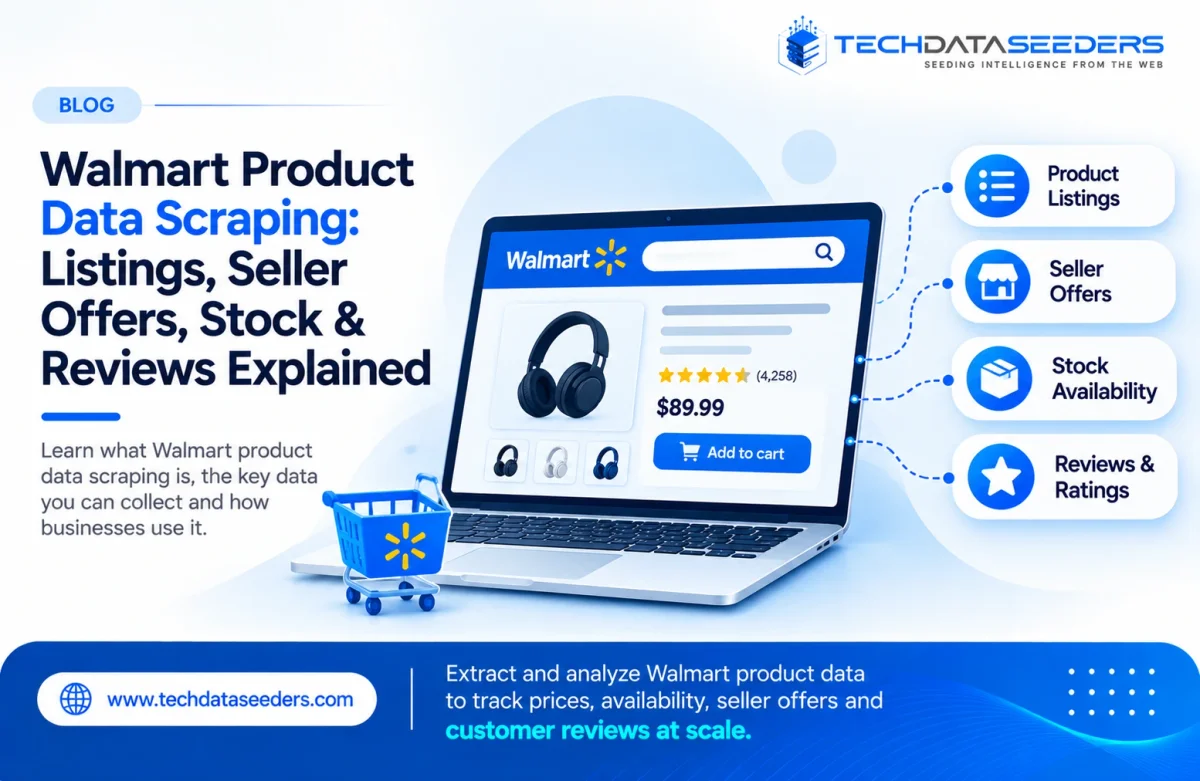
Instead of checking individual product pages manually, businesses can use structured Walmart product data collection workflows to organize information across multiple products and categories.
What Is Walmart Product Data Scraping?
Walmart Product Data Scraping involves extracting relevant product and marketplace information from Walmart's online listings and organizing it into a structured dataset. Depending on the project requirements and available source data, businesses can collect product titles, descriptions, prices, SKUs, seller details, inventory indicators, ratings, reviews, and product URLs.
This information can support several business activities, including:
- Competitor price monitoring
- Product catalog research
- Marketplace seller analysis
- Inventory and availability monitoring
- Customer feedback analysis
- Product assortment planning
- Ecommerce market research
For businesses operating in the US retail market, Walmart product information can provide useful context about competitor positioning and marketplace activity.
What Product Information Can Businesses Collect From Walmart?
The information available for collection depends on the product page, marketplace structure, source access, and extraction requirements.
| Data Attribute | What It Includes | Business Use |
|---|---|---|
| Product title | Product name and listing title | Product identification and comparison |
| Product ID or SKU | Available product identifiers | Catalog matching |
| Product description | Features and product details | Product research |
| Brand | Listed brand information | Brand-level competitor analysis |
| Product price | Displayed selling price | Price comparison |
| Original or reference price | Available reference pricing | Promotional analysis |
| Seller information | Marketplace seller details | Seller research |
| Product availability | Displayed stock or availability status | Inventory monitoring |
| Product variants | Available sizes, colors, or models | Variant comparison |
| Product rating | Average customer rating | Customer sentiment analysis |
| Review count | Number of displayed reviews | Review volume comparison |
| Review content | Available customer feedback | Product feedback analysis |
| Product URL | Source listing address | Record verification |
| Collection timestamp | Date and time of collection | Historical tracking |
Not every product listing provides every attribute. A reliable extraction process should preserve missing values rather than assume that unavailable information does not exist.
How Does Walmart Product Data Scraping Work?
Walmart Product Data Scraping generally follows a structured process: identify the required products or categories, collect relevant listing information, extract additional marketplace attributes, validate the records, and deliver the data in a usable format. The workflow can be configured for one-time research or recurring data collection, depending on business needs and permitted source access.
Step 1: Identify Products and Categories
The first step is deciding which Walmart products the business needs to monitor.
A US retailer may focus on categories such as:
- Electronics and accessories
- Home and kitchen products
- Beauty and personal care
- Grocery and household essentials
- Toys and baby products
- Sports and outdoor equipment
Businesses can identify target products through product URLs, search terms, categories, or available product identifiers.
A clearly defined product list helps avoid collecting irrelevant information.
Step 2: Scrape Walmart Product Listing Data
Once the target products are identified, the extraction workflow collects relevant information from their product listings.
This may include product titles, brands, descriptions, prices, images, specifications, and product URLs.
For example, a US home appliance brand may want to compare its air fryers with competing products listed on Walmart.com. Scraping Walmart product listing data can help organize product specifications, displayed prices, ratings, and other available attributes in a common format.
This makes it easier to compare products without repeatedly opening individual listings.
Step 3: Extract Walmart Marketplace Seller Offers
Some Walmart product listings may include marketplace seller information or multiple purchasing offers. Businesses can extract Walmart marketplace seller offers to understand how different sellers present the same or comparable products.
Depending on the available listing information, relevant fields may include:
- Seller name
- Displayed selling price
- Offer or purchase option
- Shipping information
- Fulfillment information, where available
- Product identifier
- Product availability
For example, a US electronics seller may want to compare offers for a particular laptop model across different marketplace sellers. This information can help identify price differences and understand the competitive offer landscape.
Sellers offer information that should be associated with the correct product identifier to prevent comparisons between different models or product variants.
Step 4: Collect Inventory and Availability Information
The next step is to collect the available stock and product availability indicators.
Walmart inventory data scraping can help businesses monitor visible availability information across selected products. Depending on the source and access conditions, the collected data may include:
- In-stock or out-of-stock indicators
- Displayed availability status
- Available purchasing options
- Delivery availability information
- Pickup availability information, where displayed
- Product availability changes over time
For example, a US retailer selling home appliances may monitor whether selected competing products remain available during a major promotional period.
Availability information should be interpreted carefully. A displayed stock status does not necessarily reveal the exact inventory quantity held by Walmart or an individual seller.
What Is Walmart Inventory Data Scraping and How Does It Help Retailers?
Walmart inventory data scraping involves collecting available stock and product availability indicators from selected Walmart listings. Retailers use this information to monitor changes in product availability, identify competing products that become unavailable, and understand how stock visibility changes during promotional periods.
Monitor Product Availability
Businesses can collect displayed availability information to understand whether selected products appear available for purchase.
For example, a US retailer selling kitchen appliances may monitor the availability of competing air fryers and coffee makers. If a product changes from available to unavailable, the retailer can record the change and review its potential impact on the competitive landscape.
Compare Availability Across Product Variants
A product may be available in one size or color but unavailable in another.
Tracking variants separately helps businesses avoid treating the entire product listing as either available or unavailable.
Relevant fields may include:
- Variant name
- Size or configuration
- Product identifier
- Displayed availability
- Collection timestamp
Track Availability During Promotional Periods
Product availability can change during major shopping events and promotional campaigns.
For example, a US retailer monitoring Walmart listings during Black Friday may want to observe which competing products remain available and which listings display an unavailable status.
Historical availability records can help businesses identify recurring patterns, although they should not be treated as exact inventory counts.
How Does Walmart Product Review Data Collection Support Customer Research?
Walmart product review data collection involves gathering available customer ratings, review counts, review text, and related feedback information from product listings. Businesses use these records to understand customer opinions, identify recurring product complaints, compare customer satisfaction signals, and support product research.
Collect Customer Ratings and Review Counts
Ratings and review counts provide a useful overview of customer feedback.
For example, a US brand selling kitchen appliances may compare its product ratings with competing products on Walmart.com.
A structured dataset can include:
- Average product rating
- Total review count
- Product identifier
- Product URL
- Collection timestamp
These fields help businesses compare customer feedback across similar products.
Analyze Customer Review Content
Where review text is available and its collection and use are permitted, businesses can organize customer comments to identify recurring themes.
Common areas of feedback may include:
- Product quality
- Ease of use
- Durability
- Packaging
- Product performance
- Delivery experience
- Value for money
For example, a US seller of home fitness equipment may discover that customers frequently mention assembly difficulties or unclear instructions in reviews of competing products.
These observations can help product teams investigate areas where their own product information, design, or customer support may need improvement.
Identify Changes in Customer Feedback
Collecting review information at different points in time can help businesses observe changes in ratings, review volume, and recurring feedback themes.
However, review analysis should account for changes in the number of reviews and the time period being compared. A small number of new reviews may not represent the overall customer experience.
How Techdataseeders Supports Walmart Product Data Scraping
Techdataseeders helps businesses collect and organize website data for ecommerce research, competitive intelligence, and business analytics. Its web scraping and data extraction capabilities can support projects involving product listings, marketplace information, pricing, seller details, and other relevant ecommerce data.
Depending on project requirements, the workflow can include:
- Walmart product listing extraction: Collect product titles, descriptions, brands, prices, and available specifications.
- Marketplace seller offer extraction: Organize available seller and offer information for product-level comparisons.
- Walmart SKU data scraping: Structure product identifiers to support catalog matching and competitor research.
- Inventory data collection: Capture displayed availability information for selected products.
- Product review data collection: Organize available ratings, review counts, and permitted customer feedback.
- Structured data delivery: Prepare extracted information for databases, spreadsheets, dashboards, and analytics systems.
- Data validation: Review collected records for missing fields, duplicates, and inconsistencies.
Conclusion: Turn Walmart Marketplace Data Into Better Business Decisions
Walmart Product Data Scraping helps businesses understand marketplace activity by collecting product listings, seller offers, SKU information, inventory indicators, and customer reviews. Instead of relying on manual checks, retailers and brands can organize this information into structured datasets for competitor research, pricing analysis, product matching, and customer feedback analysis.
For US ecommerce businesses, consistent Walmart product data collection can provide useful insights into competing product assortments, seller pricing, availability changes, and customer opinions. The key is to collect relevant fields, match products accurately, validate the information, and maintain historical records for meaningful comparisons.
At Techdataseeders, we support business data requirements with 100M+ pages crawled daily and 75+ platforms monitored. Our web scraping and data extraction capabilities help businesses collect structured ecommerce information for competitive research and analytics.
Need structured Walmart marketplace data for your business? Request a free sample dataset or schedule a consultation call with Techdataseeders to discuss your Walmart Product Data Scraping requirements.
FAQs
Walmart Product Data Scraping can collect product titles, descriptions, brands, prices, identifiers, seller offers, displayed availability, ratings, review counts, and other available listing attributes. The exact fields depend on the product page, source access, and project requirements.
Businesses can scrape Walmart product listing data by identifying relevant product URLs, categories, or search terms and collecting fields such as titles, brands, prices, specifications, and product identifiers. Organizing these records helps retailers compare competing products and understand marketplace assortments.
Walmart SKU data scraping helps businesses organize product records using available identifiers and specifications. It supports accurate catalog matching, price comparison, seller offer analysis, and product-level inventory monitoring while reducing confusion between similar models and variants.
Yes. Businesses can extract Walmart marketplace seller offers when the relevant seller and offer information is available and permitted for collection. Fields such as seller names, displayed prices, and offer details can help retailers compare marketplace positioning and understand price differences.
Walmart inventory data scraping helps retailers collect displayed availability indicators and monitor changes across selected products. Historical availability records can support competitor research and stock visibility analysis, although displayed availability should not be treated as an exact inventory quantity.
Walmart product review data collection can help businesses analyze available customer ratings, review counts, and feedback themes. Product teams can use this information to investigate recurring complaints, understand customer expectations, and identify potential product improvement opportunities, subject to applicable data-use requirements.
Businesses should evaluate field coverage, product matching accuracy, seller offer handling, inventory data availability, review collection capabilities, update frequency, output formats, and data validation processes. They should also confirm that the collection method complies with applicable access terms and data-use requirements.