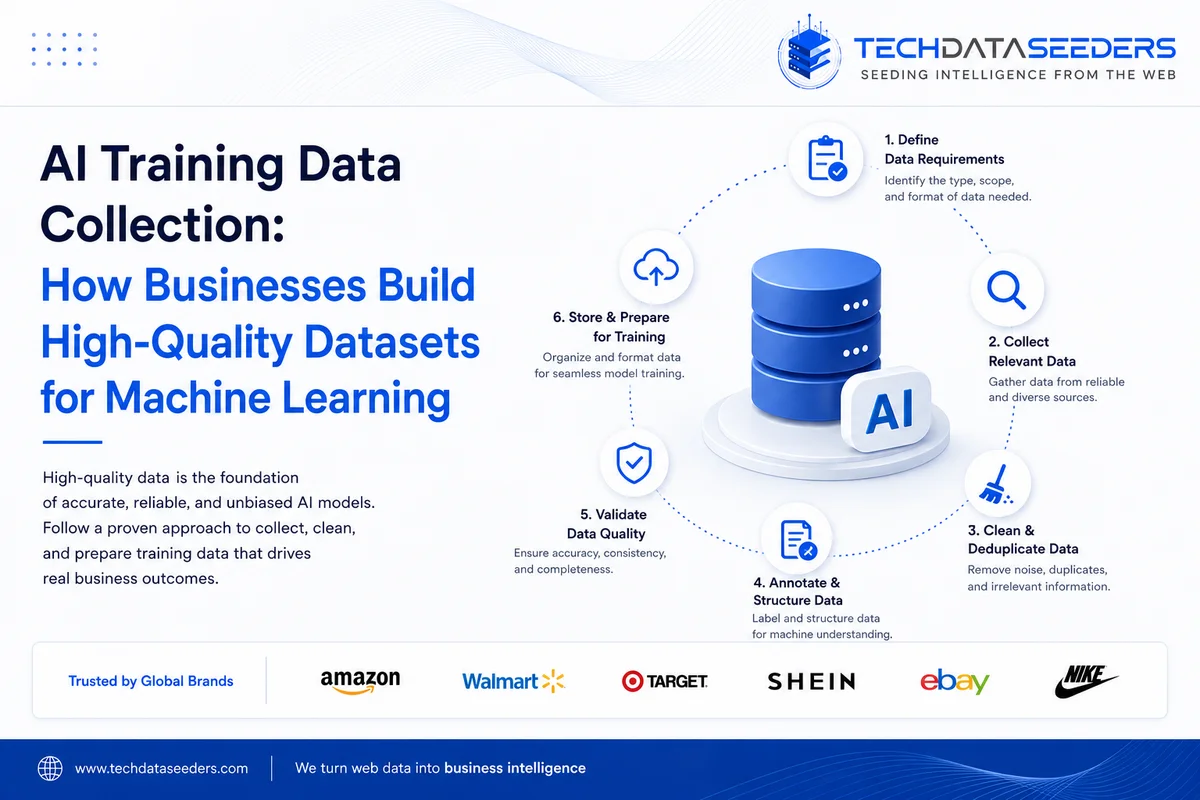
What Is AI Training Data Collection?
AI Training Data Collection is the process of gathering information that can be used to train, test, validate, and improve an artificial intelligence or machine learning model.
Depending on the application, the data may include:
- Text and documents
- Images and photographs
- Audio recordings
- Video
- Product information
- Customer interactions
- Sensor data
- Web content
- Transaction data
- Structured business information
- Human-generated labels and annotations
For example, a computer vision model may require thousands of labeled images to recognize products or objects. A natural language model may need large amounts of relevant text, while a recommendation system may use product information combined with historical user behavior.
The goal is to create a dataset that accurately represents the situations and patterns the AI model will encounter.
Why High-Quality Training Data Matters
Machine learning models learn from examples. If those examples contain inaccurate, incomplete, duplicated, irrelevant, or biased information, the model can learn unreliable patterns.
High-quality training data can help businesses achieve:
- Better model accuracy
- More reliable predictions
- Improved generalization
- More consistent AI outputs
- Better performance in real-world scenarios
- More efficient model training
A large dataset is not automatically a good dataset. A smaller collection of relevant, well-structured, and validated records can often be more useful than millions of low-quality records.
How AI Training Data Is Collected
There is no single method for collecting AI training data. The right approach depends on the model, industry, data requirements, source availability, and intended application.
1. First-Party Data Collection
Businesses can collect data directly from their own systems and customer interactions.
Examples include:
- Website interactions
- Mobile applications
- Customer support conversations
- Surveys
- Transactions
- IoT devices
- Internal databases
- Product usage data
First-party data can be valuable because the organization understands its source and business context. However, appropriate privacy, security, consent, and data governance processes are still required.
2. Public and Licensed Data Sources
Public datasets, research repositories, government databases, licensed data sources, and permitted web content can also contribute to AI datasets.
The suitability of each source depends on its relevance, reliability, freshness, accessibility, licensing, and applicable legal requirements.
3. Web Scraping for AI Training
The web contains large amounts of information that can potentially support machine learning projects. Where collection is permitted, businesses can use automated extraction to gather relevant information and convert it into structured datasets.
Web Scraping for AI Training may be useful for collecting:
- Product details
- Publicly available specifications
- Category information
- Market information
- Articles and documents
- Public listings
- Other permitted content
A typical workflow can involve:
Source identification → Data extraction → Cleaning → Normalization → Validation → Dataset delivery
Extraction is only one part of the process. Raw web data usually requires additional processing before it becomes suitable for machine learning.
Data Collection for Machine Learning: A Practical Process
A reliable approach to Data Collection for Machine Learning generally follows several stages.
Step 1: Define the AI Objective
Before collecting data, businesses should understand exactly what the model needs to accomplish.
For example:
- A sentiment model needs appropriately labeled text.
- A product recognition model needs relevant product images.
- A recommendation system needs product and behavioral data.
- A forecasting model needs historical records with relevant variables.
The objective determines what information should be collected and what quality standards the dataset needs to meet.
Step 2: Define the Required Data Fields
Businesses should identify the exact fields required for the model.
For an e-commerce AI application, these could include:
- Product name
- Brand
- Category
- Product ID
- Price
- Discount
- Seller
- Availability
- Rating
- Product attributes
- Collection timestamp
Defining these requirements early helps prevent unnecessary data collection.
Step 3: Identify Suitable Sources
Data may come from internal databases, APIs, licensed sources, public datasets, permitted websites, surveys, sensors, or other relevant channels.
Sources should be evaluated based on relevance, quality, coverage, freshness, consistency, accessibility, and applicable legal requirements.
Step 4: Collect the Data
Businesses may use APIs, automated extraction systems, web scraping, internal data pipelines, manual collection, or a combination of methods.
For complex projects, a Custom Web Scraping Service can be useful when data needs to be collected from multiple sources with different structures and formats.
The objective should be to create a repeatable process rather than relying on one-time manual downloads.
Step 5: Clean and Normalize the Data
Raw data is rarely ready for model training. It may contain:
- Duplicate records
- Missing values
- Inconsistent naming
- Different units
- Incorrect formats
- Irrelevant information
- Outdated records
Cleaning removes obvious errors, while normalization makes information from different sources consistent.
For example, two marketplaces may list the same product under different names. Prices may also appear in different formats or currencies. Before these records can be compared or used for machine learning, they need to be standardized.
Step 6: Label and Annotate Data
Many machine learning projects require labeled data.
For image-based AI, labels may identify objects, products, or specific areas within an image. For natural language processing, labels can identify sentiment, intent, topics, entities, or categories.
Annotation may be performed manually or supported by automated processes. Consistent labeling is important because incorrect labels can affect model performance.
Step 7: Validate the Dataset
Validation helps identify problems that may not be discovered during extraction or cleaning.
Businesses can check:
- Required fields
- Data completeness
- Duplicate rates
- Value formats
- Label accuracy
- Data consistency
- Outliers
- Unexpected source changes
Automated validation rules can flag records that need further review before the dataset enters the machine learning pipeline.
Practical Example: Collecting E-Commerce Data for an AI Model
Consider an e-commerce company developing an AI-powered pricing or product recommendation model. The business wants information from multiple online marketplaces, including product names, categories, sellers, prices, discounts, ratings, availability, and product attributes.
The challenge is that each source may structure this information differently. Product names can vary, seller information may use different formats, and some fields may be missing or change frequently.
A practical workflow could look like:
Multiple Sources → Data Extraction → Product Matching → Cleaning → Normalization → Validation → Historical Storage → AI Dataset/API
A final dataset might contain:
| Field | Example |
|---|---|
| Product Name | Wireless Headphones |
| Brand | Brand A |
| Model | XYZ-100 |
| Category | Electronics |
| Seller | Seller ABC |
| Price | ₹4,999 |
| Discount | 20% |
| Availability | In Stock |
| Rating | 4.4 |
| Marketplace | Marketplace A |
| Collected At | Timestamp |
Once standardized, this information can support applications such as price prediction, product recommendation, demand forecasting, assortment analysis, or competitive analysis.
This demonstrates why AI data collection involves more than extraction. The information must become a consistent and usable dataset before it can support an AI system.
Enterprise Challenges in AI Training Data Collection
As AI projects grow, data collection can become more complex.
Dynamic and Changing Data Sources
Modern websites may load important information dynamically. Websites can also change layouts, fields, or data structures. If an extraction process relies on an outdated structure, it may start producing incomplete records.
For AI projects, monitoring data quality is therefore important. A collection process should not simply run; it should also provide confidence that the expected data is still being captured.
Large-Scale Collection
Enterprise AI projects may require data from many sources and large numbers of pages. At this scale, consistency and reliability become just as important as collection speed.
The process should be designed to handle high volumes while maintaining appropriate validation and quality checks.
Failed Collections and Missing Records
Temporary source errors, connection issues, structural changes, or unavailable content can result in incomplete datasets.
A reliable pipeline should identify failed collections and handle them appropriately through logging, validation, retries, or further review.
Monitoring and Maintenance
Some AI datasets need regular updates, particularly when they contain changing product, market, or web information.
Monitoring can help identify:
- Sudden drops in record counts
- Missing fields
- Unexpected formats
- Unusual values
- Source availability changes
This makes it easier to address problems before they affect downstream AI processes.
Types of Training Data for Machine Learning
Different AI applications require different forms of training data.
Text Data
Text datasets support chatbots, search systems, sentiment analysis, classification, summarization, question answering, and language models.
Sources may include documents, permitted web content, conversations, product descriptions, and support content.
Image Data
Image datasets are commonly used for object detection, product recognition, quality inspection, medical imaging, and visual classification.
Images often require annotations that identify objects or characteristics.
Audio Data
Audio datasets support speech recognition, transcription, voice assistants, speaker identification, and audio classification.
They may include recordings with transcripts, speaker information, language details, or other metadata.
Video Data
Video is used for activity recognition, industrial monitoring, sports analytics, autonomous systems, and computer vision.
Because video contains large amounts of information, collection and processing can require significant storage and computing resources.
Structured Data
Structured data is organized in databases, tables, spreadsheets, or similar formats.
Examples include:
- Transactions
- Product catalogs
- Customer records
- Inventory
- Sensor measurements
- Business metrics
This type of data is particularly useful for predictive models and recommendation systems.
LLM Training Data Collection
Large language models require substantial quantities of text and related information. LLM Training Data Collection therefore involves more than gathering large amounts of online text.
Data may need to be:
- Extracted
- Filtered
- Deduplicated
- Classified
- Normalized
- Quality checked
- Organized by language or domain
For specialized language models, domain-specific data can be particularly valuable. A customer-support AI, for example, may need information representing the company's products, terminology, common questions, and support scenarios.
AI Dataset Scraping Services for Machine Learning Projects
When businesses need large quantities of information from permitted web sources, AI Dataset Scraping Services can help automate repetitive collection workflows.
Instead of manually gathering information from individual pages, businesses can create a repeatable process for extracting relevant fields, cleaning records, and preparing structured datasets.
These services can support use cases across:
- E-commerce
- Retail
- Market research
- Technology
- Finance
- Travel
- Manufacturing
- Real estate
The collection process should always be designed around the actual requirements of the AI project.
Data Quality: From Raw Information to Usable Dataset
One of the most important parts of How to Build High-Quality AI Datasets is maintaining quality throughout the data lifecycle.
A practical process can include:
Extraction → Cleaning → Deduplication → Normalization → Validation → Quality Checks → Storage
For example, an e-commerce dataset collected from several sources may need checks for missing product names, invalid prices, duplicate products, inconsistent categories, incorrect formats, or incomplete records.
These checks help ensure that poor-quality information does not move into the training pipeline.
Best Practices for AI Training Data Collection
Start With Model Requirements
Define what the AI system needs before collecting data. This prevents unnecessary collection and reduces processing effort.
Prioritize Relevance and Quality
More data does not automatically mean better AI. Focus on information that represents the model's intended use cases.
Maintain Data Diversity
Where appropriate, include variations in language, geography, environments, products, users, and scenarios.
Normalize Data From Multiple Sources
Use consistent naming, units, formats, categories, and identifiers when combining data from different sources.
Validate Before Training
Run automated and, where necessary, manual quality checks before data enters the training pipeline.
Track Data Provenance
Record where data came from, when it was collected, and what transformations were applied.
Plan for Updates
If the data represents changing information, establish a recurring collection and validation process rather than relying on a one-time dataset.
How TechDataSeeders Supports AI Data Collection
Building a reliable AI dataset can require more than a simple extraction script, especially when information needs to be collected from multiple sources and prepared consistently.
TechDataSeeders supports businesses with data collection and extraction workflows designed around specific AI and business requirements.
Its capabilities can support:
- Large-scale web data extraction
- E-commerce data collection
- Structured data extraction
- Recurring data collection
- Product and market data
- Competitive data collection
- Data cleaning and normalization
- Machine-learning-ready datasets
- Structured data delivery
For example, a business may need product and pricing information from multiple sources on a recurring basis. The collection workflow can be built around the required fields, sources, frequency, and output format instead of delivering disconnected raw data.
This approach helps turn scattered information into structured, consistent, and usable data for AI development, analytics, and machine learning workflows.
Conclusion
Successful AI development begins with reliable data. AI Training Data Collection involves selecting relevant sources, gathering the right information, cleaning and normalizing records, labeling data when necessary, validating quality, and maintaining datasets over time.
For web-based datasets, businesses may also need to account for dynamic content, changing source structures, large-scale collection, failed records, and recurring updates. These factors become increasingly important as AI projects grow.
Whether the goal is to develop a recommendation engine, computer vision model, predictive system, or LLM, the foundation remains the same: high-quality data creates a stronger foundation for machine learning.
If your business needs structured data collected from multiple web sources for AI, analytics, or machine learning, TechDataSeeders can help design a data collection workflow around your required sources, fields, scale, update frequency, and output format.
Build Your AI Dataset With TechDataSeeders
Need reliable, structured data for your next AI or machine learning project? Talk to TechDataSeeders about your data sources, collection requirements, and dataset goals. Our team can help you build a scalable data collection workflow tailored to your business needs.
Get in touch with TechDataSeeders today to discuss your AI data collection requirements.
FAQs About AI Training Data Collection
AI Training Data Collection is the process of gathering and preparing data used to train, validate, test, and improve AI and machine learning models.
Businesses can collect data from internal systems, APIs, licensed sources, public datasets, permitted websites, customer interactions, sensors, and other relevant channels. The data should then be cleaned, normalized, labeled where required, and validated.
Yes. Where collection is permitted, web scraping can help gather relevant information for AI datasets. The collected data usually requires additional cleaning, normalization, validation, and structuring.
It depends on the application. Stable datasets may need occasional updates, while data involving prices, products, availability, or market conditions may require more frequent collection.
A high-quality dataset should be relevant, accurate, diverse, sufficiently complete, consistently structured, and validated for its intended machine learning application.
Yes. Multiple sources can improve coverage, but the information must be normalized and validated to avoid inconsistencies and duplicate records.