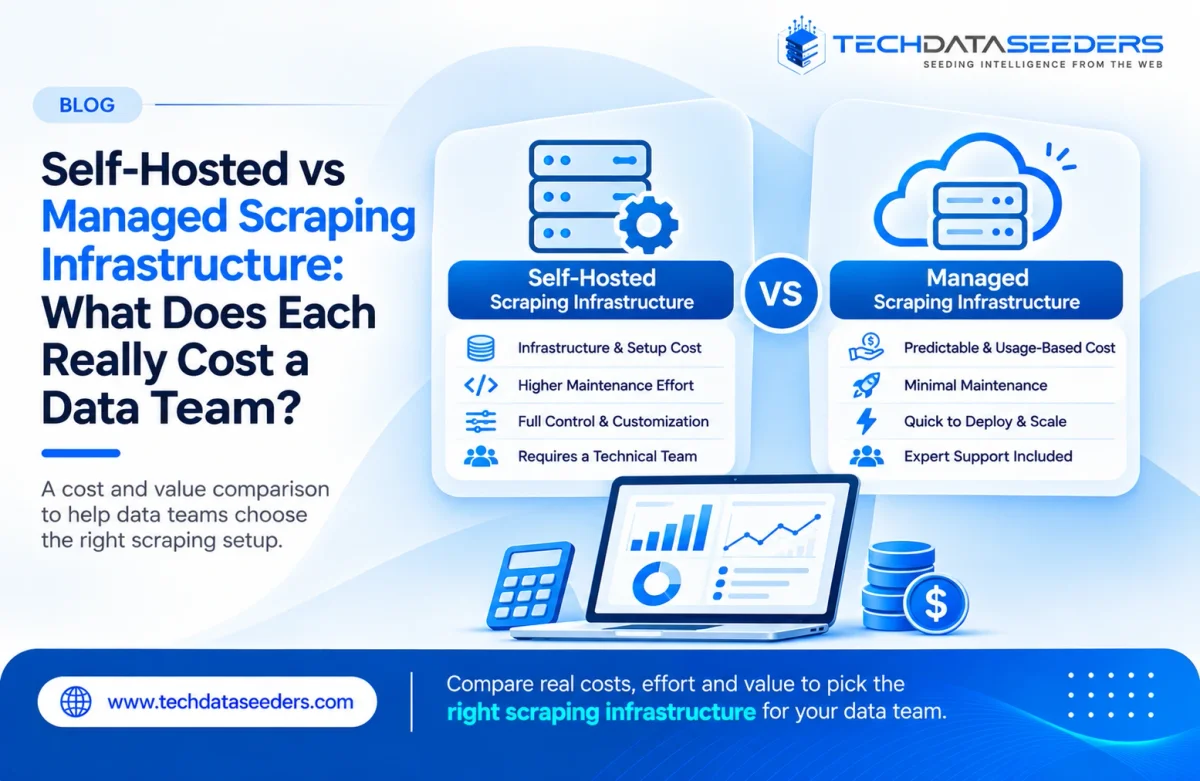
The comparison below uses publicly listed US-dollar prices and US labor benchmarks to make the trade-offs more concrete. All example budgets are estimates, not vendor quotes.
What Is the Difference Between Self-Hosted and Managed Scraping Infrastructure?
Self-hosted scraping infrastructure means your team builds and operates the systems used to collect website data. Managed scraping infrastructure relies on an external provider for some or most of the scraping operations, such as request handling, proxy management, browser rendering, and data extraction. The distinction affects not only costs but also how much operational responsibility stays with your engineering team.
What Does In-House Web Scraping Infrastructure Include?
In-house web scraping infrastructure is the collection of software, servers, network resources, and operational processes a company uses to run its own scrapers. A typical setup may include:
- Scraping scripts and extraction logic
- Browser automation tools
- Residential, datacenter, or ISP proxies
- Cloud servers or container infrastructure
- Scheduling and job orchestration
- Data storage and processing
- Monitoring, logging, and error alerts
- Retry logic and scraper maintenance
A US ecommerce company tracking prices across Amazon, Walmart, and specialist retail websites, for example, might build separate extraction workflows for each source. Its engineering team would then be responsible for keeping those workflows operational as page layouts, product structures, and access conditions change.
What Do Fully Managed Scraping Services Include?
Fully managed scraping services reduce the amount of infrastructure a business must build and maintain internally. Depending on the provider and contract, the service may handle proxy routing, browser rendering, request retries, extraction, monitoring, and structured data delivery.
For example, a US retailer may send product URLs or extraction requirements to a provider and receive structured information such as product titles, prices, availability, and timestamps. The retailer's data team can then focus on pricing analysis instead of maintaining every scraping component.
One important distinction: A scraping API, a managed scraping platform, and a fully managed data collection service are not necessarily the same thing. An API may handle proxy rotation and page retrieval while your team still owns product matching, scheduling, validation, and downstream delivery.
What Makes Up the Cost of Self-Hosted Web Scraping?
The cost of a self-hosted web scraper includes development, proxy usage, cloud infrastructure, storage, monitoring, and ongoing maintenance. Servers are only one part of the budget. For many data teams, engineering time is the largest expense because someone must build, test, repair, and improve the scraping system as source websites change.
1. Developer Salaries and Initial Development
Developer time is usually the largest cost in an in-house scraping project. Engineers need to build extraction logic, handle different page structures, configure scheduling, validate output, and connect collected data to internal systems.
The US Bureau of Labor Statistics reported a median annual wage of $135,980 for software developers in May 2025. That works out to approximately $65.38 per hour using a simple 2,080-hour working year. This is a broad software developer benchmark, not a scraping-engineer salary estimate, and it excludes employer benefits and other employment costs.
For a practical illustration:
| Engineering effort | Estimated labor cost |
|---|---|
| 40 hours of development | $2,615 |
| 120 hours of development | $7,846 |
| 240 hours of development | $15,691 |
| 10 hours of maintenance per week | About $2,830 per month |
These estimates use the BLS median wage as a reference and do not include benefits, recruiting, management overhead, or specialist contractor rates.
A US retailer building a scraper for several thousand product pages may need additional engineering time for product matching, variant handling, price validation, and scheduled updates. Those requirements can make the initial build more involved than a simple page extraction script.
2. Proxy Pricing
Proxy costs depend on the type of proxy, traffic volume, geographic targeting, and the websites being accessed. Residential proxies are often priced by gigabyte, while some datacenter and ISP proxy products are priced per IP or port.
For a public pricing example, Oxylabs lists residential proxy plans at $5 per GB for a 20 GB plan, $4 per GB for a 125 GB plan, and $2.50 per GB for a 1 TB plan.
| Example residential proxy usage | Approximate cost at $4/GB |
|---|---|
| 25 GB per month | $100 |
| 100 GB per month | $400 |
| 250 GB per month | $1,000 |
| 500 GB per month | $2,000 |
These are simple calculations using the published $4/GB tier as a reference, not a quote for those exact quantities. Actual rates depend on the purchased plan and provider terms.
For a US retailer monitoring thousands of product listings across several ecommerce sites, proxy consumption can become a significant recurring expense—particularly when pages require browser rendering or repeated requests.
3. Server and Cloud Infrastructure Costs
A self-hosted scraper needs computing resources to run scheduled jobs, process pages, and store temporary or final results. Cloud costs depend on CPU, memory, runtime, storage, bandwidth, and whether the workload needs browser automation.
AWS lists a Linux EC2 t3.medium instance at $0.0418 per hour in the US East (Northern Virginia) region. Running one instance continuously for an illustrative 730-hour month would cost approximately $30.51, before storage, data transfer, monitoring, taxes, and other services.
A small server may be sufficient for a lightweight scraper, but a larger workload could require multiple instances, queues, browser workers, and separate processing resources.
4. Storage, Monitoring, and Data Processing
Scraping infrastructure also needs somewhere to store collected records, logs, and historical snapshots. Costs can include:
- Object storage for raw HTML, JSON, and extracted files
- Databases for structured product or business records
- Data transfer and retrieval
- Monitoring and logging services
- Backup and retention policies
- Data cleaning and validation pipelines
AWS explains that S3 pricing includes storage, requests, retrieval, data transfer, and optional management features. Therefore, the storage bill depends on more than the number of gigabytes saved.
For a US marketplace intelligence team, retaining historical prices may be important for comparing discount patterns across weeks or months. The team should include retention and processing requirements in its infrastructure budget rather than estimating only the cost of storing the latest records.
5. Web Scraping Maintenance Cost
Web Scraping Maintenance Cost covers the ongoing work required to keep extraction workflows reliable. A scraper that works today may need changes when a website updates its HTML, modifies product page layouts, changes pagination, or introduces new access requirements.
Maintenance work can include:
- Fixing broken selectors and extraction rules
- Updating browser automation workflows
- Investigating failed requests
- Reviewing data quality and missing fields
- Maintaining proxy configurations
- Updating dependencies and security patches
- Monitoring scheduled jobs and retry queues
For example, if a US retailer changes its product page layout before a major holiday sale, its in-house team may need to update the extraction logic quickly to avoid gaps in competitor pricing data.
A useful way to estimate maintenance is to calculate the engineering hours spent each month—not simply assume that a scraper will continue running without intervention.
What Does Managed Scraping Infrastructure Cost?
Managed scraping infrastructure replaces some internal engineering and infrastructure work with a provider's pricing model. Depending on the service, charges may be based on monthly subscriptions, successful requests, data volume, browser-rendered pages, or a custom project agreement. This can make costs easier to forecast, but teams should check exactly which scraping tasks are included.
Public Pricing Examples for Managed Scraping Tools
Public pricing pages provide useful reference points, although different services do not always include the same features.
| Provider | Public pricing example | What to consider |
|---|---|---|
| ScrapingBee | $99/month for 1 million API credits | JavaScript rendering and premium proxy requests consume additional credits |
| Zyte API | From $0.13 per 1,000 HTTP responses | Price varies by website difficulty and response type |
| Zyte API browser rendering | From $1.01 per 1,000 requests | Browser-rendered requests cost more and vary by website tier |
ScrapingBee published Startup plan lists 1 million API credits for $99 per month. Its pricing page also explains that successful JavaScript-rendered requests use five credits, while premium proxy requests can use more.
Zyte publishes tiered pricing for HTTP responses and browser-rendered requests. Its pay-as-you-go rates range from $0.13 to $1.27 per 1,000 HTTP requests and from $1.01 to $16.08 per 1,000 browser-rendered requests, depending on the website tier.
These are examples of managed scraping APIs, not complete quotes for fully managed data collection projects. A service that also handles source discovery, custom extraction, product matching, validation, scheduling, and delivery may use a separate scope-based or enterprise pricing model.
What Is Included in the Managed Service Fee?
Before comparing a subscription with an in-house budget, check whether the provider handles:
- Proxy sourcing and rotation
- Request retries and failure handling
- JavaScript rendering and browser execution
- Website-specific extraction logic
- Data cleaning and validation
- Scheduling and recurring collection
- Structured output and delivery
- Monitoring and support
A low-cost API may handle page retrieval but leave data processing and quality assurance to your team. A more comprehensive service may cover a larger portion of the workflow, which can justify a higher fee.
Self-Hosted vs Managed Scraping Infrastructure: A Realistic Cost Comparison
The most useful comparison includes both direct infrastructure expenses and the value of engineering time. A self-hosted setup may have relatively low server costs, but the people building and maintaining it must be included in the budget. A managed service may have a higher visible subscription fee while reducing internal operational work.
Example: A US Ecommerce Data Team
Consider a hypothetical US retailer that tracks competitor product prices and availability across several ecommerce websites. It collects data regularly, maintains historical records, and needs the results for pricing analysis.
The following self-hosted estimate assumes:
- 100 GB of residential proxy traffic per month
- One continuously running AWS EC2 t3.medium instance
- Ten developer hours per week for maintenance
- The BLS median software developer wage as the labor benchmark
| Self-hosted cost component | Monthly estimate |
|---|---|
| Residential proxies: 100 GB at $4/GB | $400 |
| One EC2 t3.medium instance | $30.51 |
| Developer maintenance: 10 hours/week | $2,830 |
| Estimated monthly total | $3,260.51 |
The estimate uses public proxy and AWS prices, plus a calculated labor estimate based on the BLS wage benchmark. It excludes initial development, storage, data transfer, monitoring subscriptions, benefits, management overhead, and additional infrastructure.
Now compare this with a managed scraping API. A published $99 monthly plan may cover a portion of the request workload, while a usage-based service could charge according to website complexity and whether browser rendering is needed. Neither figure is automatically equivalent to the retailer's full workload or a fully managed data delivery service.
The important takeaway: The managed option should be compared against the complete cost of running the same workload internally—not just the cost of one cloud server.
Side-by-Side Cost Comparison
| Cost factor | Self-hosted infrastructure | Managed scraping infrastructure |
|---|---|---|
| Initial development | Internal engineering time | Often lower internal setup effort; custom integration may still be needed |
| Servers and compute | Paid and managed by your team | Often included in the provider's service |
| Proxies | Purchased and configured separately | May be included or billed through usage |
| Maintenance | Internal team responsibility | Provider handles some or most infrastructure maintenance |
| Extraction logic | Built and updated internally | Depends on API features or service agreement |
| Data validation | Usually built internally | May be included, optional, or left to your team |
| Monthly pricing | Multiple separate cost components | Subscription, usage-based, or contracted pricing |
| Operational control | Greater control over architecture | Depends on provider capabilities and contract |
Should a Data Team Choose Self-Hosted, Managed, or a Hybrid Approach?
There is no single cost model that works for every data team. The right approach depends on how much data you collect, how frequently you need updates, how complex the source websites are, and how much engineering capacity you have. Some companies also benefit from combining internal data processing with managed collection infrastructure.
Self-Hosted Infrastructure Is a Better Fit When:
- Your company has developers experienced in web scraping.
- You collect data from a limited number of relatively stable sources.
- You need detailed control over extraction and processing.
- You have the resources to handle ongoing maintenance.
- Your infrastructure requirements justify the initial development effort.
Managed Scraping Is a Better Fit When:
- Your team needs to collect data from multiple websites.
- You want to reduce infrastructure maintenance.
- Your engineers need to focus on core data projects.
- You need specialized browser rendering or proxy capabilities.
- You want to expand collection without managing every infrastructure component internally.
A Hybrid Approach Can Balance Cost and Control
A hybrid model uses managed infrastructure for complex collection tasks while keeping selected processing and analytics operations in-house.
For example, a US retail analytics company could use a managed scraping service to collect competitor product prices from multiple ecommerce websites. Its internal data team could then handle product matching, historical price analysis, dashboard development, and business reporting.
This approach can reduce infrastructure responsibilities without giving up control over the data workflows that create business value.
How Techdataseeders Helps Businesses Manage Web Scraping Infrastructure
Techdataseeders supports businesses that need structured website data without having to build and operate every part of a scraping workflow internally. Its enterprise web scraping and data extraction capabilities can support projects involving ecommerce product information, competitor pricing, marketplace data, and other business intelligence requirements.
Depending on the project scope, the workflow can include:
- Custom data extraction: Collect product details, prices, reviews, specifications, and other required fields.
- Competitor price monitoring: Gather pricing and promotional information from selected ecommerce sources.
- Structured data delivery: Organize collected information into formats suitable for business applications and analytics.
- Data validation: Review records for missing fields, duplicates, and inconsistencies.
- Scalable collection workflows: Support changing data volumes and collection requirements.
- Custom integrations: Align data delivery with existing databases, APIs, and internal systems.
Conclusion: Evaluate the Total Cost, Not Just the Server Bill
The choice between Self-Hosted vs Managed Scraping Infrastructure comes down to the total cost of collecting and maintaining reliable data. Self-hosted systems offer greater control, but require developer time, proxy budgets, cloud resources, and ongoing maintenance. Managed scraping services can reduce that operational workload, although subscription and usage charges must be evaluated against the actual data requirements.
For a US data team, the right decision should account for engineering salaries, proxy consumption, server costs, data processing, and the time required to keep extraction workflows running. A hybrid approach may also provide a practical balance between internal control and managed infrastructure.
At Techdataseeders, we support business data requirements with 100M+ pages crawled daily and 75+ platforms monitored. Our web scraping and data extraction capabilities help businesses collect and organize structured website data for analytics and competitive intelligence.
Need to evaluate your scraping requirements? Request a free sample dataset or schedule a consultation call with Techdataseeders to discuss a suitable data collection approach for your business.
FAQs
Self-hosted web scraping can be cheaper when a company already has scraping engineers and stable infrastructure. However, the total cost must include developer salaries, proxies, servers, and Web Scraping Maintenance Cost. Managed scraping services may reduce internal engineering expenses, even when they have recurring usage fees.
The cost of in-house web scraping infrastructure depends on development time, proxy usage, cloud resources, storage, and maintenance. For example, a hypothetical setup using 100 GB of residential proxies at $4 per GB, one AWS t3.medium instance, and ten developer maintenance hours per week would cost approximately $3,260.51 monthly before additional expenses.
Web scraping infrastructure cost is influenced by developer salaries, proxy consumption, website complexity, browser rendering, cloud computing, and data storage. For many businesses, engineering time and ongoing maintenance can be more expensive than the servers themselves.
Fully managed scraping services may include proxy management, request handling, browser rendering, extraction logic, monitoring, data validation, and structured delivery. The exact scope varies by provider, so businesses should confirm which tasks are included before comparing managed service pricing.
Businesses should evaluate their internal engineering capacity, long-term data requirements, operational budget, and need for specialized expertise before making this decision. Companies with dedicated development teams may benefit from building internal capabilities, while businesses that want to reduce infrastructure responsibilities can consider external providers. Comparing the expected return on investment and ongoing resource requirements helps identify the more practical approach.
Yes. A self-hosted web scraper can support large-scale data collection when it has sufficient computing resources, proxy capacity, job scheduling, monitoring, and error-handling mechanisms. However, scaling also increases infrastructure management and maintenance responsibilities.
A business should consider switching when its self-hosted web scraper requires excessive maintenance, struggles with multiple websites, or takes engineering time away from core projects. Comparing the full in-house web scraping infrastructure cost with fully managed scraping services can help determine whether a change makes financial sense.