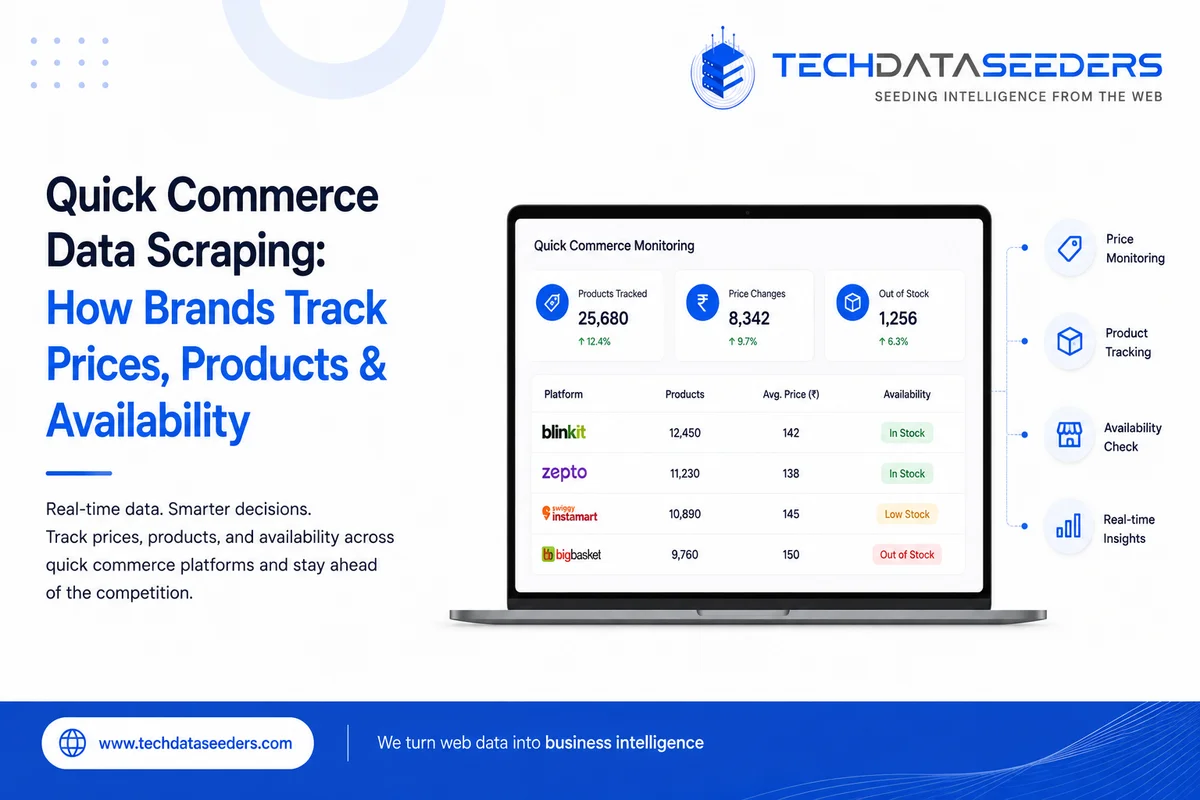
What Is Quick Commerce Data Scraping?
Quick commerce data scraping is the automated collection of relevant information from quick commerce platforms, online grocery stores, delivery marketplaces, and similar digital retail channels.
Depending on the business objective, the collected information can include:
- Product names
- Categories
- Prices
- Discounts
- Product availability
- Stock status
- Product sizes and variants
- Brand names
- Ratings and reviews
- Promotions
- Delivery information
- Store and location information
The data can then be cleaned, structured, matched, and analyzed to identify pricing changes, availability patterns, competitor activity, and market trends.
The goal is not simply to collect large amounts of data. It is to turn frequently changing online information into insights that support better business decisions.
Why Quick Commerce Data Matters for Brands
Quick commerce operates differently from traditional e-commerce because customers often make immediate purchasing decisions. Product availability, delivery speed, pricing, and promotions can directly influence where they buy.
A product that is available on one platform but unavailable on another may have a different sales opportunity. Similarly, even a small price difference can influence customers when several platforms offer the same product.
Brands can use quick commerce data to monitor:
- Price changes
- Product availability
- Competitor discounts
- Product assortment
- Promotions
- Stock levels
- Market trends
This creates better visibility into fast-moving digital retail markets.
How Does Quick Commerce Data Scraping Work?
The process generally starts by defining the platforms, products, locations, and data points that need to be monitored. For example, a brand may want to track 500 products across multiple quick commerce platforms and cities.
A typical workflow includes:
1. Select Relevant Sources
Identify the platforms, categories, products, competitors, and locations that matter to the business.
2. Define Data Fields
Decide what information needs to be collected. Pricing projects may require prices and discounts, while availability projects may focus on stock and delivery coverage.
3. Collect the Data
Automated systems gather the required information at defined intervals.
4. Clean and Standardize
Raw data is processed to remove duplicates and standardize product names, prices, categories, and other fields.
5. Match Products
The same product may appear with different names, descriptions, or pack sizes across platforms. Product matching helps ensure accurate comparisons.
6. Analyze and Deliver
The structured dataset can be analyzed and delivered through files, dashboards, databases, APIs, or other business systems.
This approach allows brands to monitor large product catalogs without relying entirely on manual checks.
What Data Can Be Extracted From Quick Commerce Platforms?
The available data depends on the platform and business requirements. Common data categories include:
Product Information
- Product name
- Brand
- Category
- Subcategory
- Product size
- Pack quantity
- Product variant
- Product description
Pricing Information
- Current price
- Original price
- Discounted price
- Discount percentage
- Promotional price
- Price per unit
Availability Information
- In-stock status
- Out-of-stock status
- Limited availability
- Store-level availability
- Delivery availability
Promotional Information
- Discounts
- Buy-one-get-one offers
- Coupons
- Bundle offers
- Limited-time promotions
Location Information
- City
- Area
- Store
- Delivery zone
- Location-specific availability
Collecting these data points regularly can give brands a more complete view of quick commerce activity.
Quick Commerce Product Data for Market Research
Quick commerce product data can help brands understand how products are positioned across platforms and locations. For example, a beverage company may want to compare competing brands, pack sizes, prices, and availability in a particular city.
This information can support:
- Product assortment analysis
- Market research
- Competitor research
- Product positioning
- Category analysis
- New product planning
Location-level comparisons can also reveal differences in product availability and assortment. A product that is widely available in one city may have limited coverage in another, potentially highlighting distribution or demand differences.
Quick Commerce Price Tracking
Prices on quick commerce platforms can change frequently because of promotions, demand, inventory, and local market conditions. Quick commerce price tracking helps businesses monitor these changes over time.
For example, a brand can compare the same product across multiple platforms and locations.
| Product | Platform | Location | Price | Discount | Availability |
|---|---|---|---|---|---|
| Product A | Platform 1 | City A | $5.50 | 10% | In Stock |
| Product A | Platform 2 | City A | $5.25 | 15% | In Stock |
| Product A | Platform 3 | City A | $5.75 | 5% | Out of Stock |
Historical tracking can help pricing teams understand market ranges, recurring discounts, and significant price movements.
The objective is not to automatically match competitors. Brands should also consider margins, demand, inventory, positioning, and pricing strategy before changing their own prices.
Quick Commerce Availability Tracking Across Locations
Availability is particularly important in quick commerce because customers expect products to be delivered quickly. Quick commerce availability tracking allows brands to monitor where products are available and where stock is limited or unavailable.
Businesses can track availability across:
- Cities
- Neighborhoods
- Stores
- Delivery zones
- Quick commerce platforms
For example, if a product repeatedly goes out of stock in a particular location, the data may indicate an inventory, distribution, or replenishment issue.
Availability information can also help marketing and sales teams avoid promoting products that customers cannot easily purchase in important delivery areas.
Competitor Price Monitoring in Quick Commerce
Competitor price monitoring helps brands understand how their products compare with competing products across quick commerce channels.
Businesses may monitor selected competitors for:
- Prices
- Discounts
- Promotions
- Product availability
- Pack sizes
- New products
- Product assortment
For example, if a competitor introduces a discount on a popular product, a brand can identify the change and evaluate whether its own promotion or pricing strategy needs attention.
Competitor monitoring becomes more useful when pricing data is combined with availability, promotions, and product assortment rather than viewed in isolation.
Grocery Pricing Intelligence
Quick commerce is strongly connected to grocery and everyday essentials. Grocery pricing intelligence helps brands and retailers understand pricing behavior across categories such as:
- Dairy products
- Snacks
- Beverages
- Packaged foods
- Fruits and vegetables
- Personal care
- Household supplies
Prices can vary by platform, location, product size, promotion, and availability. Regular data collection helps businesses identify these differences and understand how competitors position products in local markets.
This information can support pricing research, promotional planning, category management, and competitor analysis.
Quick Commerce Data by Location
Location is one of the most important dimensions of quick commerce data. Unlike traditional e-commerce, product availability and pricing can vary significantly depending on the customer's delivery area.
Brands can compare:
- City-level prices
- Neighborhood-level availability
- Store-level assortment
- Delivery-zone coverage
- Regional promotions
- Local competitor activity
For example, a product may be competitively priced in one city but significantly more expensive in another. Similarly, a promotion may be available in selected locations rather than nationwide.
Location-based data helps brands identify these differences instead of assuming that one market represents the entire quick commerce landscape.
Using E-commerce Data Scraping for Quick Commerce
Quick commerce is part of the wider digital commerce ecosystem. E-commerce data scraping can help businesses compare quick commerce information with data from traditional e-commerce websites and marketplaces.
Brands can compare:
- Quick commerce prices
- Traditional e-commerce prices
- Product availability
- Product assortment
- Promotions
- Ratings and reviews
This broader view can help businesses understand whether a pricing or product trend is specific to quick commerce or reflects a wider market movement.
Role of Product Data Scraping Services
Managing product information across multiple platforms, locations, and categories can require significant technical resources. Product data scraping services can help businesses collect, clean, structure, match, validate, and deliver product information according to their requirements.
A managed process may include:
- Data source identification
- Product discovery
- Automated extraction
- Data cleaning
- Product matching
- Quality checks
- Scheduled collection
- Data delivery
This can be useful for businesses that require recurring data updates but do not want to manage the complete collection infrastructure internally.
Benefits of Quick Commerce Data Scraping
When connected to clear business objectives, quick commerce data scraping can provide several benefits.
Better Price Visibility
Brands can understand how their products are priced across platforms and locations.
Faster Competitive Analysis
Businesses can identify important competitor changes without relying entirely on manual research.
Improved Availability Monitoring
Brands can identify products or locations where availability is consistently low.
Better Assortment Decisions
Product data can reveal differences in categories, brands, pack sizes, and product ranges.
More Informed Promotions
Businesses can compare competitor promotions and understand how discounts are being used across markets.
Stronger Market Intelligence
Regular data collection creates historical information that can reveal trends and recurring market patterns.
Using Quick Commerce Data for Competitive Intelligence
Quick commerce data becomes more valuable when pricing, product, promotion, and availability information is analyzed together.
Retail competitive intelligence can help brands understand broader competitor behavior rather than focusing on individual price changes.
For example, a competitor may launch a new product, reduce its price, and expand availability across several locations. Looking at all three changes together provides more useful context than simply observing the price reduction.
This broader approach can help businesses identify changes that may affect their market position and determine where further analysis is needed.
How Brands Use Quick Commerce Data for Business Decisions
The value of collected data comes from connecting it to real business decisions.
Pricing Decisions
Brands can compare current and historical competitor prices before reviewing their own pricing strategy.
Promotion Planning
Competitor discounts and promotional patterns can help teams understand the competitive environment before launching campaigns.
Inventory Planning
Availability data can highlight products or locations where stock levels may need attention.
Product Assortment
Brands can compare pack sizes, categories, and competing product ranges to identify assortment opportunities.
Distribution Analysis
Location-level availability can reveal differences in market coverage and potential distribution gaps.
Competitor Monitoring
Regular data collection allows teams to identify new products, pricing changes, promotions, and availability shifts more quickly.
The goal is to use data as a decision-support tool rather than simply storing large volumes of information.
Challenges in Quick Commerce Data Collection
Quick commerce data collection can involve several technical and operational challenges.
Product Matching
Different platforms may use different product names, descriptions, pack sizes, or categories for the same product.
Location-Specific Data
A product may be available in one area but unavailable a few kilometers away, making location-based monitoring more complex.
Frequent Changes
Prices, promotions, inventory, and product information can change throughout the day.
Website Changes
Changes to website structures can affect automated collection and require ongoing maintenance.
Large Data Volumes
Monitoring thousands of products across multiple platforms and locations requires scalable collection and processing systems.
Data Quality
Missing, duplicate, inconsistent, or outdated records need to be identified and corrected before analysis.
Businesses should also consider applicable laws, website terms, access restrictions, and responsible data collection practices.
How Techdataseeders Supports Quick Commerce Data Collection
Building a reliable quick commerce data pipeline requires more than extracting product information. Businesses need accurate collection, product matching, data cleaning, validation, and structured delivery.
Techdataseeders helps brands and retailers collect and organize quick commerce and broader e-commerce data according to their specific requirements.
Depending on the project, solutions can include:
- quick commerce data scraping
- quick commerce data extraction
- quick commerce price tracking
- quick commerce availability tracking
- competitor price monitoring
- product data extraction
- retail data collection
- historical price tracking
- structured data delivery
- recurring data updates
- custom data feeds
The solution can be tailored to the required platforms, products, locations, data fields, collection frequency, and delivery format.
Conclusion
Quick commerce is a fast-moving market where prices, products, promotions, and availability can change throughout the day. For brands operating in this environment, timely and structured market data can make it easier to understand competitors and respond to changing conditions.
With quick commerce data scraping, businesses can collect product, pricing, availability, promotional, and location-based information at scale. When this data is cleaned, matched, and analyzed properly, it can support pricing, product, supply chain, distribution, and competitive intelligence decisions.
The goal is not simply to collect more data. It is to build a reliable data foundation that helps teams understand market changes and make better decisions.
Ready to gain better visibility into the quick commerce market? Contact Techdataseeders for scalable data solutions built around your pricing, product, and competitor tracking needs.
FAQs About Quick Commerce Data Scraping
Quick commerce data scraping is the automated collection of relevant product, pricing, availability, promotional, and other publicly available information from quick commerce platforms and digital retail sources.
It involves identifying relevant platforms, products, and locations, defining the required data fields, collecting information at scheduled intervals, cleaning and matching the data, and delivering it in a structured format.
Businesses may collect product names, prices, discounts, categories, pack sizes, availability, promotions, ratings, seller information, and location-specific product data, depending on the source and requirements.
Brands can use automated price tracking to collect product prices across selected platforms and locations at regular intervals. The data can then be compared to identify price changes, discounts, and market trends.
Brands can monitor selected products across platforms and locations to identify stock changes, out-of-stock events, and differences in product availability.
It can help brands understand competitor pricing, monitor product availability, analyze promotions, study product assortments, and make more informed pricing, inventory, and market decisions.
By combining price, product, promotion, and availability information, brands can gain a broader view of competitor activity and identify changes that may affect their market position.