Why Amazon Is a Valuable Source of Market Data
Amazon is more than a marketplace for buying and selling products. Its listings contain a wide range of information that can help businesses understand products, customers, competitors, and market trends.
Prices change, new products appear, reviews accumulate, sellers enter or leave categories, and product availability can shift. Tracking these changes manually becomes difficult when businesses need to analyze hundreds or thousands of listings.
With structured amazon product data collection, businesses can examine a much larger set of listings and identify patterns that may not be visible from individual product pages.
For example, a brand researching a new category can compare:
- Product prices
- Popular features
- Customer ratings
- Review patterns
- Product variations
- Seller activity
- Product availability
The value comes from turning this marketplace information into data that teams can analyze and use for decisions.
What Information Can Be Extracted From Amazon?
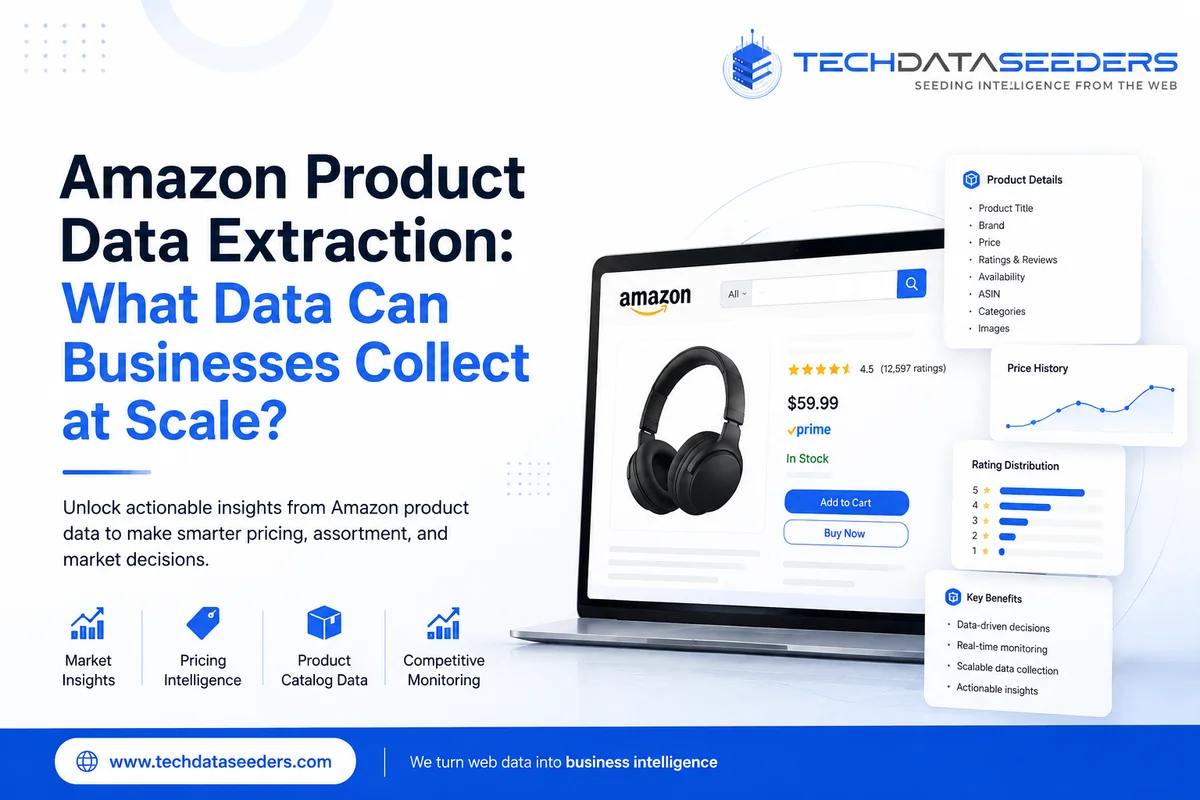
The exact data fields depend on the project and business objective. A typical Amazon dataset may include:
- Product title
- Brand name
- ASIN
- Category and subcategory
- Product URL
- Current price
- Original price
- Discounts
- Product features
- Specifications
- Ratings
- Review count
- Review information
- Seller details
- Availability
- Product variations
For example, a business focused on pricing may prioritize current and historical prices, discounts, sellers, and availability. A product research project may place more emphasis on specifications, features, ratings, and reviews.
This allows businesses to build datasets around their specific research requirements rather than collecting unnecessary information.
Product-Level Data: Specifications, Features & Variants
Product information can reveal how competing products are positioned within a category.
Amazon product data extraction can help businesses compare attributes such as:
- Size
- Color
- Material
- Dimensions
- Technical specifications
- Included accessories
- Packaging
- Product variants
- Key features
Suppose a company is researching fitness equipment. It could compare product dimensions, materials, resistance levels, accessories, ratings, and prices across competing listings.
This type of analysis can help product teams identify commonly offered features and discover areas where competitors may be leaving customer needs unaddressed.
Pricing, Discounts & Availability Signals
Pricing information can change frequently, making it useful for brands, retailers, and sellers that need a current view of the market.
Amazon pricing data can include:
- Current selling prices
- List prices
- Discounted prices
- Discount percentages
- Price ranges
- Promotional pricing
- Historical price changes
- Product availability
A business can use this information to understand typical prices within a category and identify products that are positioned significantly above or below competitors.
Availability is also important. A competitor's product being temporarily unavailable may affect its market position, while recurring stock issues may reveal broader supply or demand patterns.
Using ASINs to Organize Amazon Product Data
Amazon uses ASINs (Amazon Standard Identification Numbers) to identify products within its marketplace. Amazon asin data extraction can help businesses organize product records around these identifiers and connect different data points to the correct listing.
For example, a structured record can associate an ASIN with:
- Product title
- Brand
- Category
- Price
- Rating
- Reviews
- Seller
- Availability
ASIN-based organization is particularly useful when working with large datasets containing similar product names or multiple product variations.
What Amazon Reviews Can Tell Businesses
Product descriptions explain what a product is supposed to offer. Reviews can provide a different perspective by showing how customers actually experience it. Amazon review data extraction can help businesses analyze customer feedback across a large number of products.
Reviews may reveal:
- Frequently praised features
- Common complaints
- Product quality issues
- Packaging problems
- Usability concerns
- Customer expectations
- Reasons for dissatisfaction
For example, if customers repeatedly complain about the battery life of competing products, a brand may use that insight when developing its own product or creating marketing messages.
Review data can also help businesses understand the language customers use when describing product benefits and problems.
Analyzing Competitor Products on Amazon
Amazon provides a useful environment for competitive product research because multiple brands often operate within the same categories.
Businesses can compare competing listings based on:
- Price
- Product features
- Specifications
- Ratings
- Review volume
- Discounts
- Availability
- Product variations
This can help brands understand how competitors position their products and where their own offerings may differ.
For example, a business entering a crowded category could analyze leading products to identify common features, pricing ranges, customer complaints, and potential gaps.
How Amazon Data Helps Pricing Teams
Pricing teams can use Amazon data to understand how products are positioned within a competitive market.
By tracking competitor prices and discounts, businesses can identify:
- Common market price ranges
- Products with significant price differences
- Frequent discount patterns
- Changes in competitor pricing
- Seasonal pricing behavior
- Availability-related pricing changes
This does not mean businesses should automatically match the lowest price. Pricing decisions should also consider margins, demand, inventory, brand positioning, and overall business strategy.
The purpose of Amazon pricing data is to provide better market visibility before making a pricing decision.
Using Amazon Data for Product and Market Research
Amazon product research data can support research before launching a new product or entering a new category.
Businesses can examine:
- Product popularity
- Ratings
- Review volume
- Pricing
- Product features
- Competition
- Category activity
- Customer feedback
For example, imagine several products in a category have strong ratings but customers consistently complain about one particular feature. That pattern could indicate an opportunity for a new product that addresses the issue.
Similarly, businesses can identify categories with growing product activity or compare product assortments to understand where competition is strongest.
Comparing Sellers and Marketplace Competition
Amazon contains multiple sellers, brands, and product offers. This makes seller-level information useful for marketplace research.
Amazon marketplace data extraction can help businesses analyze:
- Seller presence
- Product availability
- Pricing differences
- Product assortment
- Ratings
- Competitive positioning
Brands can use this information to understand how their products appear alongside competing offers.
For marketplace sellers, it can also provide a broader view of the competitive environment before launching or expanding a product range.
How Can Businesses Use Amazon Product Data?
The same dataset can support different teams across an organization.
Product Teams
Product teams can compare features, specifications, variations, customer feedback, and competing products.
Pricing Teams
Pricing teams can analyze competitor prices, discounts, and historical pricing patterns.
Marketing Teams
Marketing teams can examine customer language, frequently mentioned benefits, common complaints, and product positioning.
Market Research Teams
Research teams can study category activity, product trends, competitors, and pricing ranges.
Sellers
Sellers can research competing listings and understand the market before launching products or entering new categories.
This makes Amazon data useful across product, pricing, marketing, research, and sales functions.
How to Collect Amazon Product Data at Scale?
The first step is to define exactly what the business wants to understand. A pricing project requires different fields from a customer review or product research project.
Next, businesses can select the relevant products, categories, keywords, or marketplace areas to monitor.
The collection process can then gather the required information and organize it into a structured dataset. Before analysis, the data should be cleaned, standardized, checked for duplicates, and validated.
For large projects, the final dataset can be delivered through files, databases, dashboards, or APIs, depending on how the business plans to use it.
The collection process should also consider applicable laws, website terms, access restrictions, and responsible data practices.
Amazon Data Scraping vs. Manual Product Research
Manual product research can be useful for small projects, but it becomes difficult to maintain when hundreds or thousands of listings need to be reviewed.
| Manual Research | Automated Amazon Data Collection |
|---|---|
| Time-consuming | Scalable |
| Limited product coverage | Large-scale collection |
| Difficult to repeat frequently | Scheduled collection |
| Higher manual effort | Automated processing |
| Difficult to maintain historical data | Historical tracking can be supported |
| Harder to scale | Easier to expand across categories |
Automation can reduce repetitive work, but the collected data should still go through cleaning and validation before it is used for analysis.
Where Product Data Scraping Services Fit In
Large-scale Amazon data projects can require ongoing collection, product matching, data cleaning, quality checks, and scheduled updates. Product data scraping services can help businesses manage these requirements without relying entirely on manual research.
Depending on the project, a service can support:
- Product discovery
- Data extraction
- Data cleaning
- Product matching
- Data validation
- Scheduled updates
- Structured data delivery
This can be useful for businesses that need product datasets on a recurring basis or want to scale their research across large catalogs.
Connecting Amazon Data With Wider E-commerce Research
Amazon data can become even more useful when combined with information from other marketplaces and retail websites.
E-commerce data scraping can help businesses compare product prices, availability, catalogs, and market activity across multiple sources.
For example, a brand may compare the pricing of similar products across Amazon and other e-commerce stores. This broader dataset can provide a more complete picture of the competitive landscape.
Combining multiple sources can also help businesses identify whether a trend is specific to Amazon or reflects a broader market movement.
From Raw Listings to Business Insights
Collecting thousands of product records does not automatically create business value. The important step is connecting the information to specific business questions.
A company could use Amazon data to answer questions such as:
- Which products dominate a category?
- What price range is most common?
- Which features appear most frequently?
- What problems do customers mention?
- Which products have strong ratings?
- Where are competitors expanding their product range?
- Which categories show potential opportunities?
These answers can support decisions related to product development, pricing, marketing, sales, and market expansion.
Benefits of Scalable Amazon Data Collection
A structured and scalable approach to Amazon data collection can provide several practical benefits.
Broader Market Coverage
Businesses can analyze more products and categories than would be practical through manual research.
Faster Research
Automated collection reduces the time required to gather large amounts of marketplace information.
Regular Updates
Scheduled collection can help businesses maintain current product, pricing, and availability information.
Better Competitive Visibility
Businesses can compare products, sellers, prices, and customer feedback across competing listings.
Reduced Manual Effort
Teams can spend less time copying information from product pages and more time analyzing the data.
More Consistent Analysis
Standardized datasets make it easier to compare products and identify patterns across large catalogs.
Challenges Businesses Should Plan For
Large-scale Amazon data projects can involve technical and operational challenges.
Product Variations
Different sizes, colors, packages, and configurations can make product matching more complex.
Data Quality
Collected information may contain missing, duplicate, inconsistent, or outdated records and should be checked before analysis.
Changing Product Pages
Product page structures and available information can change over time, requiring regular monitoring and maintenance.
Large Data Volumes
Thousands or millions of records require appropriate infrastructure for storage, processing, and delivery.
Collection Frequency
Businesses need to determine how often data should be refreshed based on the purpose of the project.
Responsible Data Collection
Businesses should consider applicable laws, website terms, access restrictions, privacy requirements, and other relevant data-use considerations.
How to Choose an Amazon Product Data Extraction Service
When selecting a provider, businesses should look beyond basic data collection.
Important factors include:
Data Accuracy
The provider should have processes for identifying missing, duplicate, or incorrect information.
Scalability
The solution should be able to handle the required number of products, categories, and data sources.
Update Frequency
Businesses should be able to choose an update schedule that fits their needs.
Product Matching
Accurate matching is important when comparing similar products and variations.
Data Delivery
Check whether data can be delivered through CSV, JSON, APIs, databases, dashboards, or other required formats.
Customization
The ability to select specific fields, products, categories, and collection schedules can make the solution more useful.
Data Validation
Quality checks should be part of the collection workflow rather than an afterthought.
How Techdataseeders Supports Amazon Data Extraction
Building a reliable Amazon data pipeline requires more than collecting product information. Businesses need structured extraction, product matching, data cleaning, validation, and dependable delivery.
Techdataseeders helps businesses collect and organize Amazon and broader e-commerce data according to their specific requirements.
Depending on the project, solutions can include:
- amazon product data extraction
- amazon product data collection
- amazon pricing data
- amazon review data extraction
- amazon asin data extraction
- amazon marketplace data extraction
- product catalog data
- competitor product data
- ecommerce data scraping
- structured data delivery
- recurring data updates
- custom data feeds
The approach can be tailored to the required product categories, data fields, collection frequency, scale, and delivery format.
Conclusion
Amazon provides a rich source of product and marketplace information for businesses that need deeper market visibility. Amazon product data extraction allows companies to collect and organize information about products, prices, reviews, sellers, categories, and availability at scale.
When combined with amazon product data collection, amazon pricing data, amazon review data extraction, and other relevant datasets, businesses can move beyond basic product research and gain a clearer understanding of their competitive environment.
The key is not simply collecting more data. It is building a structured and reliable dataset that answers specific business questions and supports better decisions.
Looking to turn Amazon marketplace data into actionable business insights? Connect with Techdataseeders to build a customized product data extraction solution tailored to your products, categories, competitors, and data requirements.
FAQs About Amazon Product Data
Businesses can collect relevant publicly available listing information such as product titles, prices, ASINs, categories, specifications, ratings, reviews, seller details, availability, discounts, and product features.
Amazon product data can support product research, competitor analysis, pricing research, market intelligence, customer insight, catalog analysis, and product opportunity research.
Businesses can define the required data fields, identify relevant products or categories, automate data collection, clean and validate the dataset, and deliver the structured information through suitable formats or systems.
Review data can reveal customer preferences, common complaints, product strengths, and areas where competing products may need improvement.
ASIN data extraction involves collecting Amazon product information associated with ASIN identifiers. It helps businesses organize and match product records within large datasets.
Yes. Amazon pricing data can help businesses understand competitor price ranges, discounts, pricing changes, and the overall pricing landscape within a product category.
Product data scraping services help businesses collect, clean, structure, validate, and deliver product information from relevant online sources at scale.