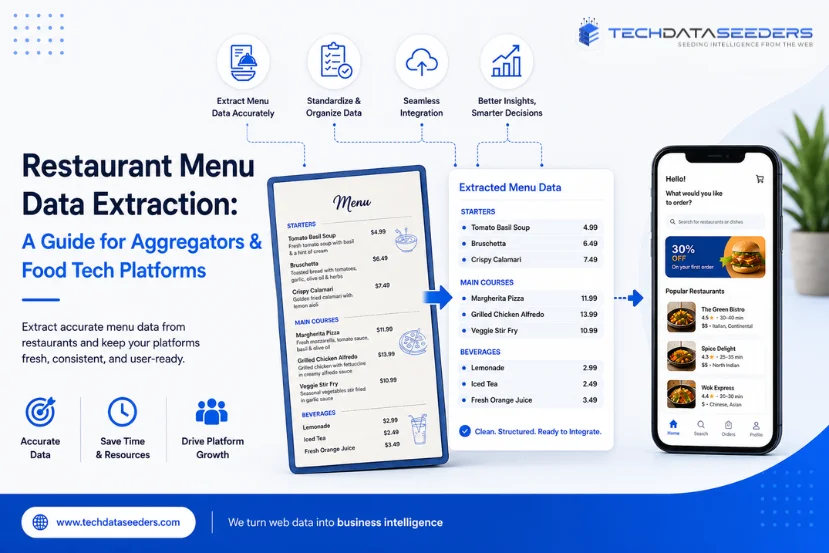
What Is Restaurant Menu Data Extraction?
Restaurant menu data extraction is the process of collecting relevant information from online restaurant menus and converting it into structured data that businesses can search, compare, analyze, and integrate into their systems.
Depending on the project, the collected information may include:
- Restaurant name
- Menu item name
- Food category
- Description
- Price
- Discount
- Ingredients
- Serving size
- Variants
- Add-ons
- Availability
- Cuisine type
- Restaurant location
- Ratings and reviews
The required fields depend on the business objective. A food aggregator may focus on menu items, prices, categories, and availability, while a market research company may also need ratings, reviews, locations, and competitor information.
The goal is not simply to collect more data. It is to create accurate, structured, and useful restaurant data that supports business decisions.
Why Menu Data Matters to Food Aggregators
Food aggregators need accurate restaurant and menu information to provide customers with a reliable browsing and comparison experience.
Customers may compare restaurants based on:
- Menu variety
- Dish prices
- Ratings
- Offers
- Cuisine
- Availability
- Popular dishes
If menu information is outdated or incomplete, customers may see incorrect prices, unavailable dishes, or inaccurate restaurant details.
A structured Restaurant Menu Data dataset helps food platforms organize restaurants, categorize dishes, compare prices, and improve search and discovery features.
What Data Can Be Extracted From Restaurant Menus?
The type of data collected depends on the source and project requirements. A restaurant data project can generally include four main categories.
Restaurant Information
This may include:
- Restaurant name
- Location
- Cuisine
- Restaurant category
- Operating hours
- Delivery information
- Ratings
Menu Information
Menu-level data can include:
- Dish names
- Categories
- Descriptions
- Ingredients
- Sizes
- Variants
- Add-ons
- Meal combinations
For example, a dataset may contain vegetarian dishes such as Paneer Tikka, Palak Paneer, Masala Dosa, Veg Biryani, and Chole Bhature, alongside non-vegetarian dishes such as Chicken Biryani, Butter Chicken, and Chicken Tikka. Beverages and desserts such as Masala Chai, Mango Lassi, Gulab Jamun, and Rasmalai can also be included.
Pricing Information
Businesses may collect:
- Regular price
- Discounted price
- Promotional price
- Combo price
- Variant-specific pricing
- Additional charges
Customer Feedback
Where available and appropriate, businesses may also analyze:
- Ratings
- Review counts
- Customer review text
- Review trends
Combining these fields creates a broader picture of restaurant offerings and customer experience.
How Does Restaurant Menu Data Extraction Work?
A successful extraction project starts with clearly defining the required information and identifying relevant online sources.
A typical workflow includes:
1. Define Data Requirements
Determine which restaurant, menu, pricing, availability, and review fields are required.
2. Identify Relevant Sources
Depending on the project, sources may include restaurant websites, food delivery platforms, directories, and other permitted online sources.
3. Collect the Data
Automated data collection can gather the required information from multiple sources and locations.
4. Clean and Standardize
Raw data may contain duplicate restaurants, inconsistent names, missing fields, or different formats. Cleaning and standardization make the dataset more consistent.
5. Categorize Menu Items
Dishes can be organized into categories such as starters, main courses, beverages, desserts, snacks, and other relevant groups.
6. Match Similar Items
The same dish may appear under different names on different sources. Matching helps identify similar restaurant and menu records.
7. Deliver Structured Data
The final dataset can be delivered through spreadsheets, databases, feeds, or APIs based on the business requirement.
Businesses should also ensure that collection methods comply with applicable laws, platform terms, access restrictions, and responsible data-use practices.
Restaurant Menu Data Scraping for Aggregators
Restaurant Menu Data Scraping can help food aggregators collect menu information from a large number of restaurants without relying entirely on manual research.
This becomes particularly useful when a platform operates across multiple cities and needs to monitor thousands of restaurants and menu items.
For example, an aggregator may need to track:
- Restaurant listings
- Menu categories
- Dish names
- Prices
- Discounts
- Availability
- Locations
- Cuisine types
The collected information can then be cleaned and structured so customers can search and compare restaurants more easily.
Restaurant Menu Data Collection at Scale
Restaurant Menu Data Collection becomes more challenging as the number of restaurants, cities, and sources increases.
A food-tech company may need data across:
- Multiple cities
- Different neighborhoods
- Various cuisines
- Restaurant categories
- Different price ranges
A repeatable collection process makes it easier to maintain consistent datasets rather than treating every restaurant as a separate research project.
For large-scale projects, businesses can also schedule data collection based on how frequently prices, menus, or availability change.
Restaurant Menu Data Normalization and Matching
Restaurant data can look very different across websites and platforms. The same restaurant or dish may have different names, descriptions, categories, or formats.
For example, similar vegetarian dishes may appear as:
- Paneer Tikka
- Tandoori Paneer Tikka
- Paneer Tikka Starter
- Spicy Paneer Tikka
Similarly, a rice-based dish might appear as:
- Veg Biryani
- Vegetable Biryani
- Hyderabadi Veg Biryani
- Special Veg Biryani
Without normalization, these records may be treated as different menu items even when they represent similar dishes.
Data normalization can standardize:
Restaurant → Menu → Category → Item → Variant → Price
Menu matching can also consider factors such as restaurant name, location, cuisine, item name, serving size, and other available attributes.
This creates a more consistent dataset for restaurant search, menu comparison, pricing analysis, and business intelligence.
Restaurant Data Extraction Beyond Menus
Menus are only one part of restaurant intelligence.
Restaurant Data Extraction can also include:
- Restaurant name
- Location
- Cuisine
- Rating
- Review count
- Opening hours
- Delivery availability
- Restaurant category
Combining restaurant-level information with menu data allows food platforms to analyze broader market patterns.
For example, a platform can study how restaurants in a particular area differ in cuisine, menu size, pricing, ratings, and availability.
Food Delivery Data Scraping
Food delivery platforms contain valuable information about restaurants, menus, prices, promotions, and availability.
Food Delivery Data Scraping can support market research and analysis by collecting relevant information such as:
- Restaurant listings
- Menu items
- Prices
- Discounts
- Ratings
- Reviews
- Availability
- Cuisine categories
- Locations
This information can help food-tech companies understand market changes and compare restaurant offerings more efficiently.
Restaurant Pricing Data and Price Comparison
Pricing is one of the most important elements of a digital restaurant menu. Restaurant Pricing Data can help businesses compare similar dishes across restaurants and locations.
For example, a food platform could compare the average price of Paneer Tikka, Masala Dosa, Veg Biryani, or Margherita Pizza across restaurants in a city.
It could also analyze:
- Different serving sizes
- Regular vs. discounted prices
- Individual items vs. combos
- Restaurant-to-restaurant price differences
- Location-based pricing
Historical pricing information can provide even more value by showing how prices change over time.
Tracking Restaurant Menu and Price Changes
Restaurant menus can change frequently. New dishes may be added, existing items may be removed, and prices may change based on season, demand, location, or promotions.
By collecting data at regular intervals, businesses can compare current information with previous datasets and identify:
- New menu items
- Removed dishes
- Price increases
- Price reductions
- New discounts
- Availability changes
- Menu category changes
For aggregators and food-tech companies, this can help keep customer-facing information more current and support market and pricing analysis.
Menu Data Aggregation for Food Tech Platforms
Menu Data Aggregation involves bringing restaurant and menu information from different sources into a centralized and consistent dataset.
Different sources may use different formats for the same item. For example:
- “Paneer Tikka”
- “Tandoori Paneer Tikka”
- “Paneer Tikka Starter”
Normalization helps bring these records into a consistent structure.
A centralized dataset makes menu information easier to search, compare, analyze, update, and integrate into digital platforms.
Restaurant Review Scraping for Customer Insights
Menus show what restaurants offer, while reviews can provide insight into customer experiences. Restaurant Review Scraping can help businesses analyze publicly available customer feedback where permitted.
Review data may reveal recurring opinions about:
- Food quality
- Taste
- Portion size
- Packaging
- Delivery
- Service
- Value for money
For example, repeated positive comments about a particular dish such as Paneer Tikka, Biryani, or Masala Dosa may help identify a restaurant's popular offerings. Recurring complaints can highlight potential areas for improvement.
Review information should be collected and used responsibly, with appropriate consideration for privacy and platform requirements.
Location-Based Restaurant and Menu Data
Restaurant information is often location-specific. The same restaurant brand may have different menus, prices, offers, or availability across different locations.
Location-based restaurant data can help businesses analyze:
- City-level menu differences
- Neighborhood pricing
- Location-specific offers
- Restaurant availability
- Delivery coverage
- Local cuisine trends
For a food aggregator operating across multiple cities, separating location-level information is important for maintaining accurate restaurant and menu records.
How Food-Tech Platforms Can Turn Menu Data Into Business Insights
Restaurant data can support both customer-facing features and internal business decisions.
Customer-Facing Applications
Food platforms can use structured menu information for:
- Restaurant search
- Dish discovery
- Menu comparison
- Price comparison
- Restaurant categorization
- Personalized recommendations
Business Applications
The same data can support:
- Market research
- Pricing analysis
- Competitor analysis
- Restaurant onboarding
- Menu categorization
- Business intelligence
- Location analysis
- Trend monitoring
For example, a platform entering a new city can analyze restaurant density, cuisine types, menu prices, and customer ratings before expanding its operations.
How Data Extraction Services Support Restaurant Data Projects
Large restaurant data projects involve more than collecting information from websites.
Data Extraction Services can support:
1. Data source identification
2. Data collection
3. Data cleaning
4. Data normalization
5. Duplicate removal
6. Menu categorization
7. Quality checks
8. Structured data delivery
This approach can be useful for businesses managing large restaurant datasets across multiple sources and locations.
Benefits of Restaurant Menu Data Extraction
A well-managed restaurant data strategy can provide several benefits.
Save Research Time
Automated collection reduces repetitive manual research.
Scale Data Collection
Businesses can collect information across large numbers of restaurants, locations, and menu categories.
Improve Data Organization
Structured data is easier to search, filter, compare, and analyze.
Monitor Market Changes
Regular updates can reveal menu additions, removals, pricing changes, and availability updates.
Support Market Research
Restaurant data can help businesses understand pricing patterns, cuisine trends, restaurant density, and competitive positioning.
Improve Customer Experience
Accurate menu and restaurant information helps customers make better decisions.
Challenges in Restaurant Menu Data Extraction
Restaurant data is not always consistent. Different sources may use different menu structures, names, pricing formats, and category systems.
Common challenges include:
- Different menu structures
- Duplicate restaurant listings
- Inconsistent dish names
- Missing information
- Frequent price changes
- Location-specific menus
- Changing website structures
- Large data volumes
Data cleaning, normalization, matching, and quality checks are therefore important parts of the process.
Businesses should also consider applicable legal requirements, privacy obligations, website terms, and responsible data collection practices.
Best Practices for Restaurant Menu Data Collection
To create useful restaurant datasets, businesses should focus on quality and consistency rather than simply collecting large volumes of information.
Recommended practices include:
- Define required fields before collection
- Use consistent data formats
- Standardize restaurant and dish names
- Match similar menu items carefully
- Remove duplicate records
- Validate price and availability fields
- Schedule updates according to business needs
- Monitor data quality
- Secure collected information
- Follow applicable laws and platform terms
A clear data strategy makes restaurant information more reliable and easier to use across business systems.
Get Reliable Restaurant Menu Data at Scale
Managing restaurant menus, prices, availability, and location-based information across multiple sources can become difficult as data requirements grow.
Techdataseeders helps food aggregators and food-tech businesses collect, clean, normalize, and structure restaurant and menu data based on their specific requirements.
Whether you need menu information, restaurant details, pricing data, food delivery data, reviews, or regularly updated datasets, the workflow can be designed around your business objectives, required fields, sources, and delivery format.
Looking for structured restaurant data for your platform? Contact Techdataseeders to discuss your requirements and get a customized data solution.
Final Thoughts
Restaurant menus are constantly changing, and food aggregators and food-tech platforms need reliable data to keep pace with those changes.
Restaurant Menu Data Extraction provides a structured way to collect menu items, prices, categories, availability, restaurant information, and other relevant data. When this information is cleaned, normalized, and updated regularly, it can support restaurant discovery, price comparison, market research, competitive analysis, and business intelligence.
For businesses operating at scale, the value comes from more than collecting data. Accurate matching, consistent formatting, location-level information, historical changes, and reliable delivery all contribute to a dataset that teams can actually use.
Techdataseeders can help you build a customized restaurant data collection workflow around your requirements. Contact our team today to discuss your project and get reliable, structured restaurant data for your platform.
FAQs About Restaurant Menu Data Extraction
Restaurant menu data extraction is the process of collecting relevant information from online restaurant menus and organizing it into a structured format. Data may include dish names, categories, descriptions, prices, variants, availability, and other menu-related information.
The process generally involves defining the required data, identifying relevant sources, collecting information, cleaning and standardizing records, matching menu items, and delivering the final dataset in a usable format.
Businesses may collect dish names, categories, descriptions, prices, discounts, sizes, variants, add-ons, availability, restaurant details, cuisine types, ratings, and other relevant information depending on the source and project requirements.
Aggregators can use structured menu data to improve restaurant search, dish discovery, menu comparison, price comparison, categorization, recommendations, and other customer-facing features.
Food-tech platforms can use menu and restaurant data for market research, pricing analysis, competitor analysis, restaurant onboarding, business intelligence, location analysis, and trend monitoring.
Businesses can collect menu information at regular intervals and compare current datasets with historical records. This can help identify new dishes, removed items, price changes, discounts, and availability updates.
Common challenges include inconsistent menu structures, duplicate listings, changing prices, missing information, different dish names, location-specific menus, and changing website structures.
Structured data makes restaurant information easier to search, compare, analyze, update, and integrate into databases, dashboards, applications, and other business systems.