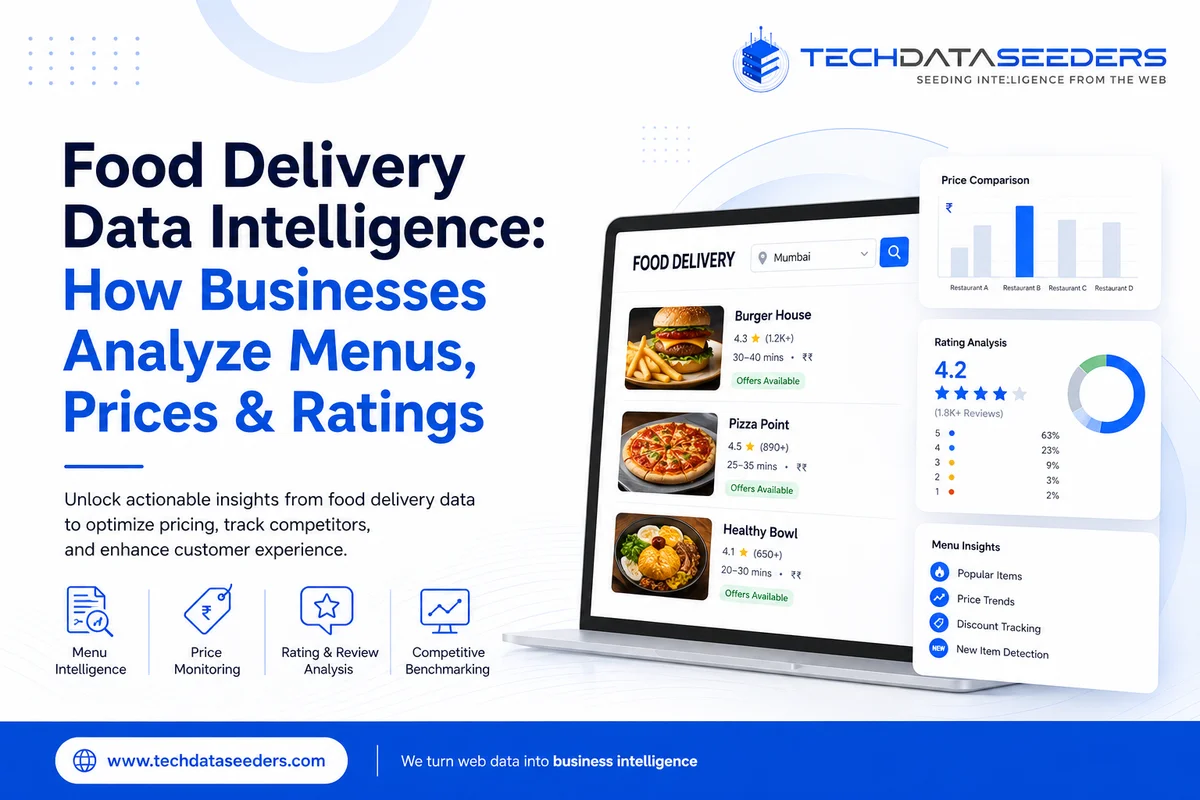
The Data Hidden Inside Food Delivery Platforms
Food delivery platforms contain much more information than restaurant names and menu items. Each listing can provide a snapshot of how a restaurant operates and competes in a particular market.
Depending on the business objective, relevant information may include:
- Restaurant name and location
- Cuisine type
- Menu categories
- Dish names and descriptions
- Menu prices
- Discounts and promotions
- Meal combinations
- Add-ons and variations
- Ratings and review counts
- Customer reviews
- Restaurant availability
- Delivery charges
- Operating hours
When this information is tracked over time, businesses can identify changes that are difficult to spot through occasional manual research.
For example, a restaurant may notice that competitors are gradually increasing prices, introducing more combo meals, or expanding into new cuisine categories. These patterns can influence decisions around its own menu and positioning.
How Restaurant Menus Reveal Market Trends
A restaurant menu is more than a list of dishes. It can provide insights into customer demand, pricing strategy, product positioning, and competitive behavior. Restaurant menu data extraction allows businesses to compare menus across restaurants, cities, cuisines, and price segments.
Businesses can examine:
- Number of menu items
- Popular food categories
- Entry-level and premium products
- Combo meals
- Vegetarian and non-vegetarian options
- Add-ons
- Portion variations
- Seasonal products
- Newly introduced dishes
For instance, if several competing restaurants begin adding healthy meal options, that could indicate a growing customer preference. Similarly, an increase in premium products may suggest that restaurants are targeting higher-value customers.
Menu-level analysis can therefore help restaurants identify changes in consumer preferences without relying only on internal sales data.
Reading Pricing Patterns at Dish Level
Restaurant pricing is often more complex than comparing the average cost of a meal. Two restaurants may offer similar cuisines but price individual dishes very differently. One may compete through low-priced entry products, while another may use premium ingredients and higher prices to position itself differently.
Food delivery price analysis can help businesses compare prices at the dish, category, and restaurant level.
For example:
| Dish | Restaurant A | Restaurant B | Restaurant C |
|---|---|---|---|
| Veg Burger | $7.50 | $8.25 | $6.99 |
| Margherita Pizza | $10.00 | $11.50 | $9.50 |
| Pasta | $9.25 | $10.00 | $8.75 |
Businesses can track these differences over time to understand:
- Average market prices
- Price gaps between competitors
- Discount frequency
- Price increases or reductions
- Premium and budget positioning
- Promotional pricing patterns
This information can support pricing decisions, but businesses should not automatically copy competitor prices. Food costs, portion sizes, customer segments, brand positioning, and margins also need to be considered.
What Ratings and Reviews Reveal About Customers
Pricing shows what businesses charge. Reviews can show how customers respond. Restaurant review data extraction can help businesses analyze customer feedback across large numbers of restaurants and menu items.
Reviews can reveal recurring opinions about:
- Food quality
- Taste
- Portion size
- Packaging
- Delivery experience
- Service
- Value for money
- Specific dishes
For example, a competitor may have strong ratings overall but repeatedly receive complaints about packaging. Another restaurant may receive positive feedback for a particular dish.
These patterns can help businesses identify:
- Product strengths
- Customer frustrations
- Frequently mentioned dishes
- Service problems
- Potential areas for differentiation
Review data becomes especially valuable when businesses analyze recurring themes instead of focusing on individual comments.
Mapping Local Restaurant Competition
Food delivery markets are highly local. A restaurant can face completely different competition depending on its city, neighborhood, or delivery area. This makes location one of the most important dimensions of food delivery data intelligence.
Businesses can analyze:
- Number of restaurants in an area
- Cuisine distribution
- Average menu prices
- Restaurant ratings
- Competitor density
- Product availability
- Local promotions
- Delivery coverage
For example, a restaurant chain considering expansion could compare several neighborhoods to determine where competition is concentrated and where there may be gaps in the market.
Location-level intelligence can also reveal pricing differences. A dish that sells at a premium in one city may have much lower average pricing in another.
Understanding Cuisine Demand by Area
Cuisine data can provide another useful layer of market intelligence. By analyzing restaurant categories across different locations, businesses can identify which cuisines are widely represented and which have relatively limited competition.
For example, a market may have a high concentration of:
- Indian restaurants
- Chinese restaurants
- Pizza outlets
- Burgers
- Desserts
- Healthy food
- Regional cuisines
Comparing cuisine availability with ratings, pricing, and restaurant density can provide a clearer view of local market conditions.
This can help restaurant groups evaluate expansion opportunities and help food brands understand where certain categories may have stronger potential.
Tracking Menu Changes and Promotional Behavior
Restaurant menus are not static. Businesses regularly add new products, remove underperforming dishes, change prices, and introduce promotional offers.
Food delivery data scraping can help businesses monitor these changes over time.
Changes may include:
- New dishes
- Removed dishes
- New combos
- Seasonal menus
- Price changes
- Discount offers
- Buy-one-get-one promotions
- New product variations
Historical tracking makes these changes easier to identify.
For example, if a competitor repeatedly introduces discounts on the same category during weekends, a restaurant may recognize a recurring promotional strategy rather than treating each discount as an isolated event.
This type of monitoring can support promotional planning and competitive analysis.
Finding Market Gaps Through Food Delivery Data
One of the most useful applications of food delivery data is identifying opportunities that may not be obvious from individual restaurant listings.
Businesses can compare products, prices, cuisines, ratings, and customer feedback to identify potential gaps.
For example:
- A popular cuisine may have limited availability in a particular area.
- Customers may frequently complain about the same product feature.
- A price segment may have relatively few competitors.
- Certain meal combinations may be uncommon.
- A product category may be expanding quickly.
These observations do not automatically guarantee a business opportunity, but they can provide useful signals for further research.
How Restaurant Groups Can Benchmark Competitors
Restaurant groups operating across multiple locations can use food delivery data to compare their own performance environment with competitors.
They can benchmark factors such as:
- Menu size
- Average dish prices
- Product categories
- Ratings
- Review volume
- Promotions
- Cuisine positioning
- Availability
For example, one location may perform differently because nearby competitors offer more affordable combinations or a wider menu range.
Benchmarking can help restaurant groups identify differences between locations and determine where menu or pricing strategies may need further review.
Using Food Delivery Data for Pricing Intelligence
Pricing teams can use historical food delivery data to understand how competitors respond to demand, promotions, and market conditions.
Competitor price monitoring can help identify significant changes in:
- Menu prices
- Combo prices
- Discounts
- Delivery charges
- Promotional offers
- Product availability
The goal is not to react to every price change. Instead, businesses can establish thresholds for meaningful changes and investigate those events.
For example, a sudden 20% price reduction on a popular competitor product may require more attention than a small change in a low-volume menu item.
This makes pricing intelligence more focused and useful.
Turning Restaurant Data Into Business Decisions
The same food delivery dataset can support different business teams.
Pricing Teams
Pricing teams can compare competitor prices, discounts, and historical changes to understand market positioning.
Marketing Teams
Marketing teams can use reviews, ratings, menu trends, and promotional data to understand customer preferences and competitor campaigns.
Product Teams
Product teams can analyze new dishes, menu categories, variations, and customer complaints when evaluating product opportunities.
Expansion Teams
Expansion teams can compare restaurant density, cuisine demand, pricing, and competition across locations.
Restaurant Operations
Operations teams can use menu and availability data to identify changes that may affect customer experience or product performance.
The important step is connecting the data to a specific business question. Large datasets are only useful when they help teams make better decisions.
Where Automation Makes Food Delivery Research More Useful
Manually checking hundreds of restaurant listings can consume significant time, particularly when information changes frequently.
Automated data collection can make recurring research more practical by monitoring selected restaurants, dishes, locations, or competitors at defined intervals.
A structured workflow can help businesses:
- Reduce repetitive research
- Monitor larger restaurant sets
- Maintain historical records
- Compare changes over time
- Generate recurring reports
- Support faster analysis
For large projects, data can also be integrated with dashboards, analytics platforms, databases, or internal business systems.
The required level of automation depends on the number of restaurants, locations, data fields, and update frequency.
Challenges With Food Delivery Market Data
Food delivery data can provide valuable insights, but collecting and analyzing it at scale comes with challenges.
Frequent Changes
Menus, prices, promotions, and availability can change regularly, making outdated information less useful.
Restaurant Matching
The same restaurant may appear differently across platforms, making accurate identification important.
Menu Variations
Similar dishes may have different names, descriptions, portions, or add-ons across restaurants.
Location Differences
Prices and availability can vary between cities, neighborhoods, stores, and delivery zones.
Data Quality
Missing, duplicate, inconsistent, or outdated records can affect analysis and should be identified before the data is used.
Platform Changes
Changes to platform structures can affect automated collection processes and require ongoing maintenance.
Businesses should also consider applicable laws, platform terms, access restrictions, and responsible data collection practices when designing their data strategy.
Choosing a Data Partner for Food Delivery Intelligence
Businesses that need recurring food delivery data should evaluate providers based on more than their ability to collect information.
Important considerations include:
Source Coverage
The provider should be able to cover the relevant food delivery platforms, restaurant categories, and locations.
Data Accuracy
Reliable validation and quality checks are important when datasets will be used for pricing or competitive decisions.
Update Frequency
Pricing and availability projects may require more frequent updates than general market research.
Restaurant and Menu Matching
Accurate matching helps businesses compare equivalent restaurants, dishes, and product variations.
Scalability
The solution should be able to handle increasing numbers of restaurants, locations, and data fields.
Delivery Options
Businesses may need data through CSV, JSON, APIs, databases, dashboards, or custom formats.
Customization
A useful solution should allow businesses to define the restaurants, locations, fields, and update frequency that matter to their objectives.
How Techdataseeders Helps Businesses Build Food Delivery Intelligence
Building a useful food delivery dataset requires more than extracting restaurant listings. Businesses need relevant data fields, consistent collection, product and restaurant matching, quality checks, and reliable delivery.
Techdataseeders helps businesses collect and organize food delivery and restaurant data for market research, pricing analysis, competitor monitoring, and broader business intelligence.
Depending on the project, solutions can include:
- Food delivery data scraping
- Restaurant menu data extraction
- Food delivery price tracking
- Restaurant review data
- Competitor monitoring
- Restaurant and cuisine data
- Location-based data collection
- Historical market data
- Structured data delivery
- Recurring data updates
- Custom data feeds
The solution can be designed around the required platforms, restaurants, locations, data fields, collection frequency, and delivery format.
Conclusion
Food delivery platforms provide a constantly changing view of restaurants, menus, prices, promotions, ratings, and customer preferences. When analyzed systematically, this information can help businesses understand local competition, identify market gaps, improve pricing decisions, and make better menu and expansion choices.
The real advantage of food delivery data intelligence is not simply having more information. It is being able to recognize meaningful changes and connect them to the decisions that matter to the business.
Turn restaurant, menu, pricing, and customer data into actionable market intelligence with Techdataseeders. Get in touch to explore a customized food delivery data solution built around your research and competitive intelligence goals.
FAQs About Food Delivery Data Intelligence
Food delivery data intelligence is the process of analyzing restaurant, menu, pricing, rating, review, promotion, and availability data to generate insights for business decisions.
Businesses can collect restaurant information, menu items, prices, discounts, ratings, reviews, cuisine types, availability, locations, delivery information, and other relevant publicly available data.
Businesses can compare competitor menus, prices, ratings, promotions, cuisines, and availability to understand how restaurants are positioned within a market.
Menu data can reveal pricing patterns, popular categories, product variety, new dishes, meal combinations, and potential gaps in the market.
Businesses can use automated data collection to track menu prices and promotional changes at regular intervals, allowing them to compare current information with historical data.
Restaurant review data extraction involves collecting relevant customer feedback and rating information from restaurant listings for analysis of customer preferences, complaints, and product performance.
Businesses can compare restaurant density, cuisine availability, pricing, ratings, and competition across locations to identify markets that may warrant further research.