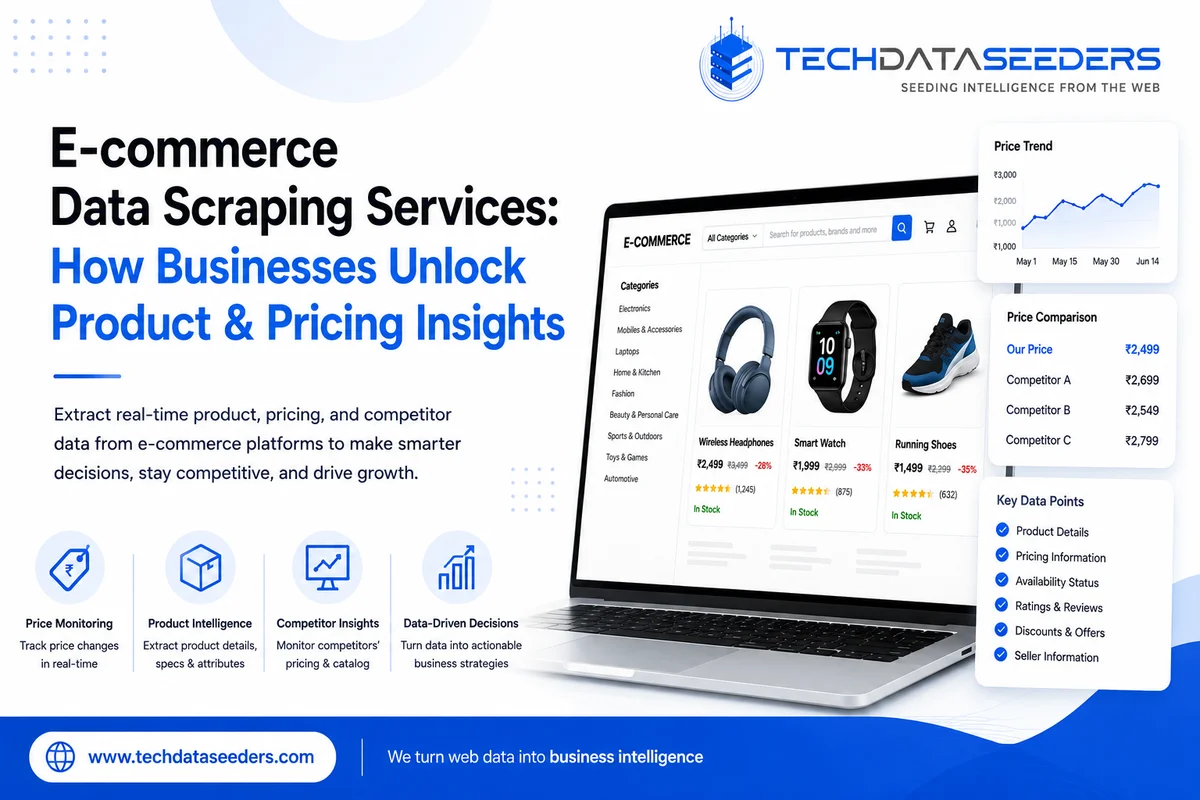
What Is E-commerce Data Scraping?
E-commerce data scraping is the automated process of collecting relevant information from online stores, marketplaces, and other e-commerce websites.
Depending on the business objective, collected information may include:
- Product names and descriptions
- Prices and discounts
- SKUs and specifications
- Product categories
- Ratings and reviews
- Stock availability
- Seller information
- Shipping details
- Product variations
- Brand information
Instead of manually visiting hundreds or thousands of product pages, businesses can use automated systems to collect selected information and organize it into a structured format.
For example, an electronics brand could monitor thousands of competing products to understand pricing, features, availability, and customer feedback.
The real value, however, comes from using the collected data for analysis and business decisions, not simply gathering large volumes of information.
How Does E-commerce Data Scraping Work?
A typical scraping workflow involves several steps.
1. Identify Data Sources
Businesses first select the websites, marketplaces, product categories, and competitors they want to monitor.
2. Define Required Data
The next step is to determine which fields are needed. A pricing project may require prices, discounts, SKUs, and availability, while product research may require specifications, ratings, and reviews.
3. Collect the Data
Automated systems collect the required information from selected sources. The frequency can be adjusted based on how often the business needs updated data.
4. Clean and Structure the Data
Raw data can contain duplicate, incomplete, or inconsistent records. Data processing helps standardize product names, prices, categories, and other fields.
5. Store or Deliver the Data
The final dataset can be delivered through spreadsheets, databases, dashboards, feeds, or APIs and connected with existing business systems.
6. Analyze the Information
The structured data can then be used to identify pricing trends, competitor activity, product opportunities, and changes in market demand.
This workflow allows businesses to replace repetitive manual research with a more scalable data-driven process.
What Data Can Businesses Scrape From E-commerce Websites?
The exact data depends on the website and business objective. Common e-commerce data points include:
- Product names
- Product descriptions
- Categories
- Current and original prices
- Discounts
- SKUs
- Product specifications
- Product images or image URLs
- Ratings
- Customer review information
- Stock availability
- Seller details
- Shipping information
- Promotions
- Product variations
- Brand information
Businesses do not necessarily need to collect everything. Focusing on the data that directly supports the business goal can make the collection process more efficient.
Types of E-commerce Data Scraping
E-commerce scraping can be divided into several common categories.
Product Data Scraping
Collect product names, descriptions, specifications, categories, and other attributes for market or product research.
Price Data Scraping
Track current prices, historical prices, discounts, and promotional offers across competitors.
Product Review Scraping
Collect ratings and review information to understand customer feedback and product perception.
Inventory and Availability Scraping
Monitor whether products are in stock, out of stock, or becoming unavailable.
Product Catalog Scraping
Collect structured product information across large catalogs to compare product assortment and identify market gaps.
Marketplace Data Scraping
Collect relevant product, seller, pricing, and availability information from online marketplaces.
The right approach depends on what the business wants to understand or improve.
Product Data Scraping for Market Research
Product information changes frequently. New products enter the market, specifications are updated, prices change, and inventory moves. Product data scraping services can help businesses collect this information at scale for market research.
For example, a consumer electronics company could monitor competing products to identify:
- New product launches
- Popular product features
- Changes in specifications
- Competitor price ranges
- New brands entering the market
- Changes in availability
This gives product and marketing teams a broader view of the market without relying entirely on manual research.
Product Catalog Data Scraping
A product catalog provides a detailed view of what a retailer or marketplace offers.
Product catalog data scraping can collect structured information such as:
| Data Type | Example |
|---|---|
| Product Name | Wireless Headphones |
| Category | Consumer Electronics |
| Price | $79.99 |
| Brand | Example Brand |
| Rating | 4.5/5 |
| Availability | In Stock |
| SKU | WH-1025 |
| Discount | 20% |
| Specifications | Bluetooth, 40-hour battery |
When this information is collected across multiple websites, businesses can compare catalogs, identify product gaps, and understand how competitors position their offerings.
For example, a brand may discover that several competitors offer a feature that is missing from its own product range. That insight could influence future product development.
E-commerce Data Extraction for Better Business Decisions
E-commerce data extraction is useful when businesses need specific information from large amounts of online content. Manual collection can be slow and difficult to maintain. Automated extraction can make the process more consistent and scalable.
For example, a retailer entering a new category could collect competitor product information from several online stores and analyze pricing ranges, product variety, features, ratings, and availability before deciding how to position its own products.
Amazon Product Data Extraction
Marketplaces can provide valuable information for product and competitive research. Amazon product data extraction can help businesses analyze relevant product listings, prices, ratings, reviews, availability, and other publicly available information.
Businesses may use this data for:
- Competitor research
- Product research
- Price analysis
- Catalog comparison
- Market research
- Product opportunity identification
- Review analysis
For example, a seller preparing to launch a new product can analyze competing listings to understand common price ranges, product features, customer ratings, and customer feedback.
Data collection should always be performed responsibly and with consideration for applicable laws, website terms, access restrictions, and permitted data usage.
Ecommerce Price Tracking and Pricing Analysis
Price is one of the most visible factors in online purchasing decisions. Customers can compare prices across multiple websites quickly, making pricing visibility important for brands and retailers. Ecommerce price tracking allows businesses to monitor price changes across selected online sources.
Businesses may track:
- Current prices
- Previous prices
- Discounts
- Promotional offers
- Price ranges
- Competitor prices
- Product availability
Historical pricing data can reveal patterns that are difficult to identify from a single price snapshot.
For example, a retailer may discover that competitors frequently reduce prices during weekends or specific shopping periods. This information can support its own pricing and promotional planning.
Competitor Price Monitoring
Competitor price monitoring is one of the most common applications of e-commerce data collection. Instead of manually checking competitor websites every day, businesses can automate pricing collection and identify significant changes.
For example, a business may want an alert when:
- A competitor reduces the price of a key product
- A competitor launches a major discount
- A product goes out of stock
- A competitor increases its price
- A new competitor enters the market
These insights help pricing teams focus on meaningful market changes. However, monitoring competitors does not mean copying every price. Pricing decisions should also consider costs, demand, inventory, product quality, brand positioning, and profit margins.
Retail Data Scraping Services for Competitive Research
Retailers often operate across multiple marketplaces, websites, and sales channels. Monitoring all of these sources manually becomes increasingly difficult as the business grows.
Retail data scraping services can collect relevant product and market information from multiple sources and organize it into a consistent format.
Retailers can use this information to analyze:
- Product assortment
- Competitor pricing
- Discounts
- Product availability
- Customer ratings
- New product launches
- Market trends
This creates a broader view of the competitive landscape.
Retail Competitive Intelligence
Data becomes more valuable when it is used to understand competitor behavior. Retail competitive intelligence combines information about competitors, products, prices, promotions, and market activity to support strategic decisions.
For example, a retailer may notice that a competitor has expanded its product range while also lowering prices in a particular category. Looking at these changes together provides more context than monitoring a single price.
This information can support decisions related to:
- Product assortment
- Pricing
- Promotions
- Market expansion
- Product positioning
- Inventory planning
Using Price Intelligence Software
Managing large amounts of pricing information manually can be difficult. Price intelligence software can help automate monitoring, comparison, reporting, and analysis.
Depending on the system, businesses may be able to:
- Monitor competitor prices
- Track historical price changes
- Set price alerts
- Compare products
- Analyze pricing trends
- Generate reports
- Connect data with internal systems
This can make pricing analysis faster and more manageable, particularly when a company monitors many products or competitors.
Ecommerce Web Scraping API for Automated Data Access
An e-commerce web scraping API allows businesses and applications to access structured e-commerce data programmatically.
Instead of manually downloading datasets, businesses can integrate data delivery into existing systems.
For example, a company could connect an API to an internal dashboard and receive updated product and pricing information. The data could then be used by analytics teams, pricing systems, or business intelligence applications.
API-based delivery is particularly useful when businesses need regular updates and want to automate their data workflows.
Who Uses E-commerce Data Scraping?
E-commerce data scraping can support different teams and business types, including:
E-commerce Brands
Brands can monitor competitors, product assortments, pricing, and market trends.
Retailers
Retail teams can track prices, availability, promotions, and product categories across competitors.
Marketplaces
Marketplaces can analyze product catalogs, seller information, pricing, and market activity.
Product Teams
Product managers can research features, product gaps, customer feedback, and emerging trends.
Pricing Teams
Pricing teams can use competitor price data and historical information to support pricing decisions.
Market Research Companies
Research teams can collect structured market information across categories, brands, and retailers.
Common E-commerce Data Scraping Use Cases
Businesses use scraped e-commerce data for many different purposes.
Competitor Research
Understand competitor products, prices, promotions, and market positioning.
Product Research
Analyze product features, specifications, ratings, and customer feedback.
Pricing Intelligence
Track competitor prices and identify pricing changes or market trends.
Inventory Monitoring
Monitor product availability and identify stock changes.
Catalog Intelligence
Compare product assortments across multiple retailers and marketplaces.
Market Research
Identify emerging products, market gaps, pricing ranges, and changing customer preferences.
The best results come from connecting the collected data to a specific business objective.
Benefits of E-commerce Data Scraping Services
When implemented properly, e-commerce data scraping can provide several advantages.
Save Time
Automated collection reduces repetitive manual research.
Monitor Large Product Catalogs
Businesses can track thousands of products more efficiently.
Understand Competitor Pricing
Regular monitoring provides better visibility into competitor pricing behavior.
Identify Market Opportunities
Product and catalog data can reveal gaps, trends, and new opportunities.
Support Better Decisions
Current and historical data can help teams make more informed decisions.
Scale Data Collection
Automated workflows can expand as the number of products, websites, and competitors increases.
E-commerce Data Scraping vs. Manual Data Collection
For small research projects, manual collection may be sufficient. However, larger projects can benefit from automation.
| Manual Data Collection | E-commerce Data Scraping |
|---|---|
| Time-consuming | Automated |
| Limited product coverage | Supports large-scale collection |
| Difficult to update frequently | Scheduled updates |
| Higher risk of manual errors | Standardized processing |
| Difficult to maintain historical data | Historical tracking can be supported |
| Harder to scale | Easier to scale across sources |
Automation does not eliminate the need for quality control. Data still needs to be cleaned, validated, and monitored.
How to Choose an E-commerce Data Scraping Service
Businesses should evaluate several factors before choosing a provider.
Data Accuracy
The collected information should be reliable, consistent, and properly validated.
Scalability
The solution should be able to handle the required number of products, websites, and data points.
Update Frequency
Determine whether the business needs an hourly, daily, weekly, or another update schedule.
Source Coverage
Check whether the provider can collect data from the required websites, marketplaces, and product categories.
Product Matching
Accurate product matching is important when comparing the same products across different sources.
Data Delivery
Consider whether data can be delivered through CSV, JSON, APIs, databases, dashboards, or other required formats.
Historical Data
For pricing and market analysis, historical records can be valuable for identifying trends.
Data Validation
A reliable process should include checks for missing, duplicate, outdated, or incorrect information.
Customization
Businesses may have different data fields, sources, schedules, and delivery requirements. A customizable solution can better support those needs.
Challenges to Consider
E-commerce data scraping can provide valuable information, but businesses also need to manage several challenges.
Changing Website Structures
Websites may change their page layouts or technical structures, which can affect automated collection.
Product Matching
Different websites may use different names, SKUs, descriptions, or variations for the same product.
Data Quality
Collected information may contain missing, duplicate, inconsistent, or outdated records and should be cleaned and validated before use.
Data Volume
Large catalogs and multiple sources may require scalable infrastructure for collection and processing.
Compliance
Businesses should consider applicable laws, website terms, access restrictions, privacy requirements, and responsible data collection practices.
A reliable scraping process should therefore include monitoring, validation, error handling, and regular maintenance.
How to Turn E-commerce Data Into Business Intelligence
Collecting data is only the first step. The real value comes from connecting it to business goals.
Start by defining what the business wants to achieve. This could be improving pricing, monitoring competitors, expanding a product catalog, researching a new market, or identifying product opportunities.
Next, select the most relevant sources and data fields. Collecting unnecessary information can increase processing requirements without providing additional value.
The data should then be cleaned, organized, and analyzed regularly. Dashboards, reports, alerts, and APIs can make the information easier for teams to use.
The final step is action. A price change, new product, or competitor promotion becomes valuable when the business understands what it means and determines how to respond.
How Techdataseeders Supports E-commerce Data Collection
Building a reliable e-commerce data pipeline requires more than simply extracting information from websites. Businesses need accurate collection, data cleaning, product matching, validation, and structured delivery.
Techdataseeders can help e-commerce and retail businesses collect and organize product, pricing, catalog, and competitor data according to their specific requirements.
Depending on the project, solutions can include:
- E-commerce data collection
- Product data scraping
- Competitor price monitoring
- Product catalog extraction
- Retail data collection
- Amazon product data extraction
- Historical price tracking
- API-based data delivery
- Recurring data updates
- Custom data feeds
The approach can be tailored to the required websites, product volume, data fields, update frequency, and delivery format.
Conclusion
E-commerce businesses operate in a market where products, prices, promotions, and competitor activity can change quickly. Manual research alone can make it difficult to maintain an accurate view of the market.
E-commerce Data Scraping Services provide a scalable way to collect product, pricing, catalog, availability, and competitor information from relevant online sources. When properly cleaned, structured, and analyzed, this data can support better pricing decisions, product research, competitive analysis, and market intelligence.
From Product Data Scraping Services and Amazon Product Data Extraction to Ecommerce Price Tracking and Competitor Price Monitoring, businesses can use structured e-commerce data to turn market activity into actionable insights.
Ready to make your e-commerce data more useful? Connect with Techdataseeders to build a customized data collection and delivery solution that fits your products, sources, and business goals.
FAQs About E-commerce Data Scraping
E-commerce data scraping is the automated process of collecting publicly available product, pricing, availability, ratings, reviews, and other relevant information from online stores and marketplaces.
It typically involves identifying relevant sources, defining required data fields, collecting the information, cleaning and structuring it, and delivering it through files, databases, dashboards, or APIs.
Businesses can collect product names, prices, discounts, SKUs, descriptions, specifications, ratings, reviews, availability, seller details, categories, and other publicly available product information.
It can support competitor monitoring, product research, price analysis, market research, catalog comparison, inventory monitoring, and broader competitive intelligence.
Competitor price monitoring uses automated data collection to regularly track competitor prices, discounts, and related information. Businesses can analyze these changes and respond according to their pricing strategy.
Product catalog data scraping is the process of collecting structured product information such as names, categories, prices, specifications, SKUs, ratings, and availability from online catalogs.
Yes. An e-commerce web scraping API can provide structured e-commerce data for integration with internal dashboards, analytics platforms, pricing systems, and other applications.