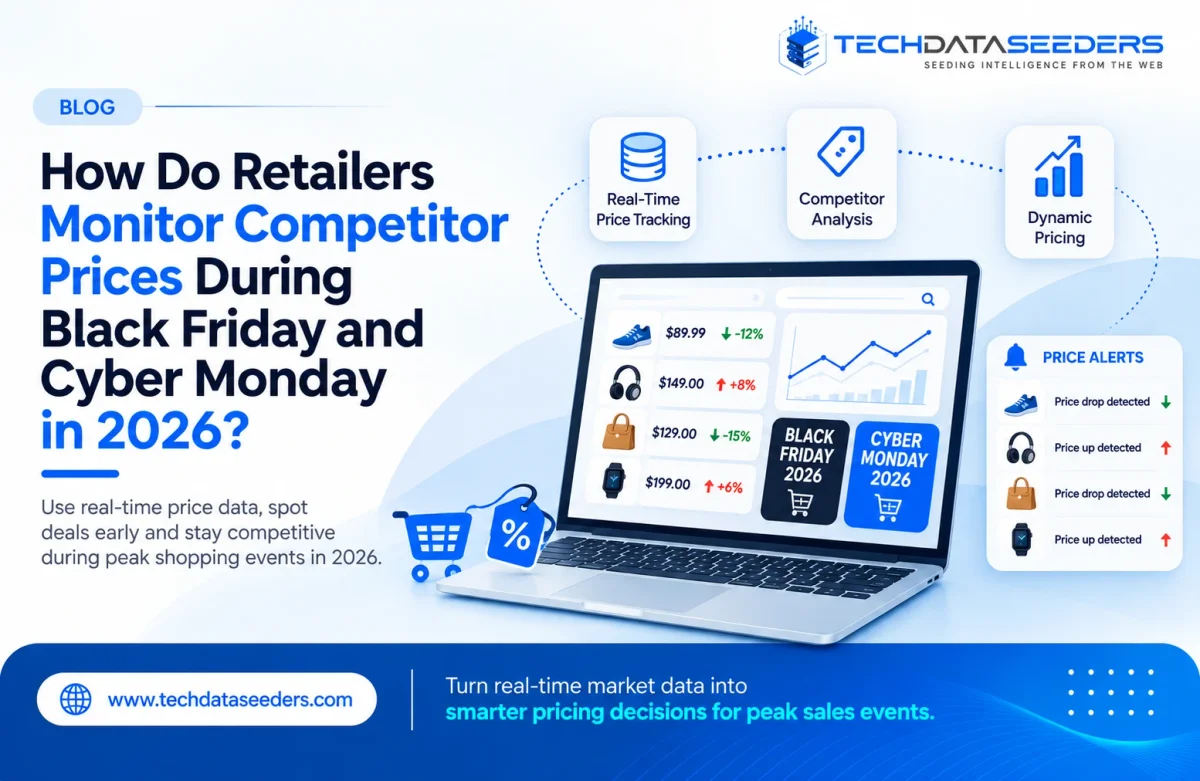
What Is Black Friday and Cyber Monday Competitor Price Monitoring?
Black Friday and cyber Monday Competitor Price Monitoring is the process of collecting and analyzing competitor pricing and promotional information during the Black Friday and Cyber Monday sales period. Retailers use it to compare product prices, track discounts, monitor stock availability, and understand how competing stores position similar products.
Unlike routine price checks, seasonal monitoring often requires more frequent data collection because promotions and prices can change several times within a short period.
What Data Should Retailers Monitor During Black Friday and Cyber Monday?
Retailers can monitor several product and pricing attributes, including:
| Data Attribute | Why It Matters |
|---|---|
| Current product price | Compare live competitor prices |
| Original price | Understand advertised discounts |
| Discount percentage | Compare promotional depth |
| Product availability | Identify stock changes |
| Product variants | Compare equivalent sizes, colors, and models |
| Shipping charges | Understand the overall purchase cost |
| Promotion details | Track coupons, bundles, and limited-time deals |
| Product URL | Verify the source listing |
| Timestamp | Understand when a price was collected |
Collecting these fields creates a more complete picture than tracking the displayed price alone.
Why Is Competitor Price Tracking Important During Black Friday Sales?
Competitor price tracking helps retailers understand how rival stores price similar products during high-demand shopping events. It provides visibility into price changes, discount campaigns, and product availability, allowing pricing teams to respond based on market information rather than assumptions.
Understand Competitor Discount Strategies
Retailers can compare how competitors discount different product categories and brands. For example, one retailer may offer a larger discount on electronics while another focuses on home appliances.
Tracking these patterns helps businesses understand where competitors are investing their promotional efforts.
Identify Products With Significant Price Gaps
Competitor price tracking can reveal when a retailer's product price is considerably higher or lower than comparable listings elsewhere.
This information helps teams review pricing decisions without automatically matching every competitor's offer.
Monitor Product Availability Alongside Prices
A competitor's low price may not be relevant if the product is out of stock or available only in limited quantities. Monitoring availability alongside pricing gives retailers better context when evaluating competitor offers.
Protect Margins During Promotional Periods
Matching every competitor discount can reduce profitability. Historical and current pricing information helps retailers assess whether a price adjustment is necessary and whether the expected sales benefit justifies the margin impact.
How Does Black Friday Price Monitoring Work?
Black Friday price monitoring involves collecting competitor product prices and promotional details at planned intervals throughout the Black Friday sales period. Retailers use the collected data to compare offers, identify price movements, and understand how competitors adjust their pricing as demand changes.
For example, a US electronics retailer preparing for Black Friday may monitor product prices and promotional offers across Walmart, Best Buy, Target, and Amazon. Tracking these changes helps the retailer compare competitor discounts, identify pricing gaps, and adjust its own offers during the holiday shopping season.
For the 2026 shopping season, retailers should pay particular attention to November 27, when Black Friday takes place. Monitoring competitor prices before and throughout this date helps businesses identify early discounts, last-minute price changes, and promotional offers across major US ecommerce platforms.
Track Prices Before Black Friday
Monitoring should begin before the main sales event. Pre-sale pricing provides a reference point for understanding whether a Black Friday discount represents a genuine price reduction or a change from a recently adjusted price.
Retailers can record:
- Regular selling prices
- Previous promotional prices
- Competitor product assortments
- Historical price movements
- Product availability before the sale
This baseline makes it easier to evaluate promotional changes when Black Friday begins.
Monitor Price Changes During the Sale
During Black Friday, retailers can collect competitor pricing information at intervals that reflect how quickly their product categories change.
For example, a highly competitive electronics category may need more frequent checks than a category where prices remain relatively stable.
The monitoring process can identify:
- New discounts
- Price increases or decreases
- Limited-time promotions
- Changes in product availability
- Competitor price matching
- Products entering or leaving promotional campaigns
Compare Actual Offers, Not Just Discount Percentages
A displayed discount percentage does not always tell the full story. Retailers should compare the final selling price, product specifications, shipping charges, and promotional conditions.
This helps ensure that Black Friday price monitoring compares genuinely equivalent offers.
How Does Cyber Monday Price Tracking Differ From Black Friday Monitoring?
Cyber Monday price tracking focuses on competitor pricing and promotional changes during the online sales event following Black Friday. Although the two events overlap in many retailers' promotional strategies, Cyber Monday can introduce new deals, extended discounts, and changes to product availability.
In 2026, Cyber Monday takes place on November 30, three days after Black Friday. Retailers should continue monitoring competitor prices over the weekend because some stores extend their Black Friday promotions, while others introduce new online-exclusive discounts on Cyber Monday.
Monitor Promotions That Continue After Black Friday
Some retailers extend Black Friday offers through the weekend, while others introduce separate Cyber Monday promotions. Tracking these changes helps businesses understand which discounts have continued and which have been replaced.
Identify New Cyber Monday Deals
Retailers may introduce fresh product offers or change discount levels specifically for Cyber Monday. A consistent monitoring process helps identify these new promotions without relying on the assumption that Black Friday prices will remain unchanged.
Compare Weekend and Cyber Monday Pricing
Comparing price records from Black Friday, the weekend, and Cyber Monday can reveal how competitor strategies evolve throughout the sales period.
| Monitoring Period | 2026 Date | What Retailers Should Check |
|---|---|---|
| Before Black Friday | Before November 27 | Regular prices and historical benchmarks |
| Black Friday | November 27 | Initial discounts and rapid price changes |
| Weekend between events | November 28–29 | Extended offers and stock movements |
| Cyber Monday | November 30 | New promotions and revised discounts |
| After Cyber Monday | From December 1 | Price normalization and remaining offers |
What Is Holiday Season Price Monitoring and Why Does It Matter?
Holiday season price monitoring tracks competitor pricing, promotions, and product availability across the broader holiday shopping period, rather than focusing only on Black Friday and Cyber Monday. It helps retailers understand seasonal pricing patterns and maintain a consistent view of competitor activity across multiple promotional events.
Monitor Prices Across Multiple Shopping Events
The holiday season can include several promotional periods, such as:
- Early holiday sales
- Black Friday
- Cyber Monday
- Christmas promotions
- Year-end clearance sales
Monitoring these events together helps retailers understand how competitors adjust prices throughout the season.
Understand Seasonal Demand and Promotional Patterns
Historical pricing information can help retailers identify which products receive repeated discounts, when competitors introduce promotions, and how long offers typically remain available.
These insights can support future promotional planning.
Maintain a Historical Pricing Dataset
Saving timestamped price records allows retailers to compare current offers with earlier seasonal prices. This can help distinguish short-term promotional changes from longer-term pricing patterns.
What Should Retailers Include in a Black Friday Competitor Price Monitoring Strategy?
A useful Black Friday and cyber Monday Competitor Price Monitoring strategy should cover more than price collection. It should define which competitors, products, attributes, and monitoring intervals matter to the business.
1. Select the Right Competitors
Identify direct competitors, major marketplaces, specialist retailers, and other relevant sellers. Prioritize sources that offer comparable products and target similar customers.
2. Build a Product Monitoring List
Create a list of products that matter most during the sales period. This may include high-revenue products, popular brands, seasonal items, and products with strong competitor activity.
3. Define the Required Data Fields
Decide which information the team needs, such as:
- Current and previous prices
- Discounts and promotions
- Product availability
- Shipping charges
- Product identifiers
- Collection timestamps
- Source URLs
4. Set Collection Frequency
Not every product needs to be checked at the same frequency. Collection schedules should reflect category volatility, business requirements, and the expected pace of competitor changes.
5. Establish Pricing Alerts
Set rules to highlight important changes, such as a competitor price falling below a threshold, a product becoming unavailable, or a new promotion appearing.
6. Review and Act on the Data
Collected information should support decisions rather than trigger automatic price matching. Pricing teams should consider product margins, stock levels, demand, and promotional objectives before changing prices.
How Frequently Should Retailers Track Competitor Prices During Black Friday and Cyber Monday?
The ideal frequency for competitor price tracking depends on how quickly prices change within a product category and how quickly the retailer needs to respond. High-volatility products may require more frequent checks, while stable categories can often be monitored on a scheduled basis.
| Product or Situation | Suggested Monitoring Approach |
|---|---|
| Highly competitive electronics | Frequent scheduled checks |
| Popular gaming products | Frequent checks during major promotions |
| Home and kitchen products | Regular scheduled monitoring |
| Low-volatility categories | Less frequent scheduled checks |
| Products with limited-time deals | Checks aligned with offer periods |
These are planning examples, not universal collection intervals. Retailers should choose a schedule based on observed price volatility, operational needs, and permitted access to source data.
How Techdataseeders Supports Black Friday and Cyber Monday Competitor Price Monitoring
Techdataseeders supports Black Friday and cyber Monday Competitor Price Monitoring through web data collection, product data extraction, competitor price tracking, and structured data delivery. These capabilities can help retailers collect pricing and product information from relevant ecommerce sources and prepare it for analysis.
Depending on project requirements, the workflow can include:
- Competitor price tracking: Collect product prices and promotional information across selected ecommerce websites.
- Automated competitor price monitoring: Set up repeatable collection workflows for ongoing monitoring.
- Product matching: Organize comparable products using identifiers, titles, brands, and specifications.
- Historical data collection: Maintain timestamped records for analyzing price movements.
- Data validation: Check collected records for missing fields, duplicates, and inconsistent values.
- Structured data delivery: Provide information in formats suitable for dashboards, databases, and internal analytics systems.
Conclusion
Black Friday and Cyber Monday Competitor Price Monitoring gives retailers better visibility into competitor prices, promotional changes, and product availability during critical shopping events. By combining competitor price tracking, Black Friday price monitoring, Cyber Monday price tracking, and broader holiday season price monitoring, businesses can make more informed pricing decisions.
The key is to collect accurate product-level data, compare equivalent offers, maintain historical records, and use pricing insights alongside internal margin and inventory information. With automated competitor price monitoring, retailers can reduce repetitive manual checks and build a more consistent approach to seasonal competitive intelligence.
At Techdataseeders, we support retail data intelligence with 100M+ pages crawled daily and 75+ platforms monitored. Our competitor price monitoring and ecommerce data extraction capabilities help businesses collect structured pricing information from relevant online platforms.
Preparing your retail business for the next major sales season? Contact Techdataseeders for a free sample of competitor pricing data or schedule a consultation call to explore automated competitor price monitoring.
FAQs
Retailers should begin Black Friday and cyber Monday Competitor Price Monitoring before the main sales events to establish regular price benchmarks. Early competitor price tracking makes it easier to identify genuine discounts and compare promotional changes during Black Friday and Cyber Monday.
Retailers can use Black Friday price monitoring to compare promotional prices against historical price records, regular selling prices, and competitor offers. Maintaining timestamped data through automated competitor price monitoring helps identify price changes that may otherwise be difficult to evaluate.
Yes. Cyber Monday price tracking helps retailers identify new offers, extended promotions, and price changes introduced after Black Friday. Combining both events under Black Friday and cyber Monday Competitor Price Monitoring provides a more complete view of seasonal competitor activity.
Businesses should prioritize high-demand products, popular brands, bestsellers, seasonal items, and products with frequent competitor price changes. Holiday season price monitoring can also include products with strong promotional activity or significant revenue contribution.
Yes. Automated competitor price monitoring can be designed to collect product prices, discounts, availability, and other attributes from multiple ecommerce sources. Combined with competitor price tracking, it helps retailers organize large amounts of pricing information into structured datasets.
Product matching helps retailers compare equivalent products across different websites using SKUs, model numbers, brands, identifiers, and specifications. It improves Black Friday price monitoring by reducing inaccurate comparisons between products that look similar but have different features or variants.
Historical records help retailers compare current offers with earlier prices and promotional periods. Using Cyber Monday price tracking alongside historical holiday season price monitoring can reveal recurring discount patterns, competitor strategies, and changes in product availability.