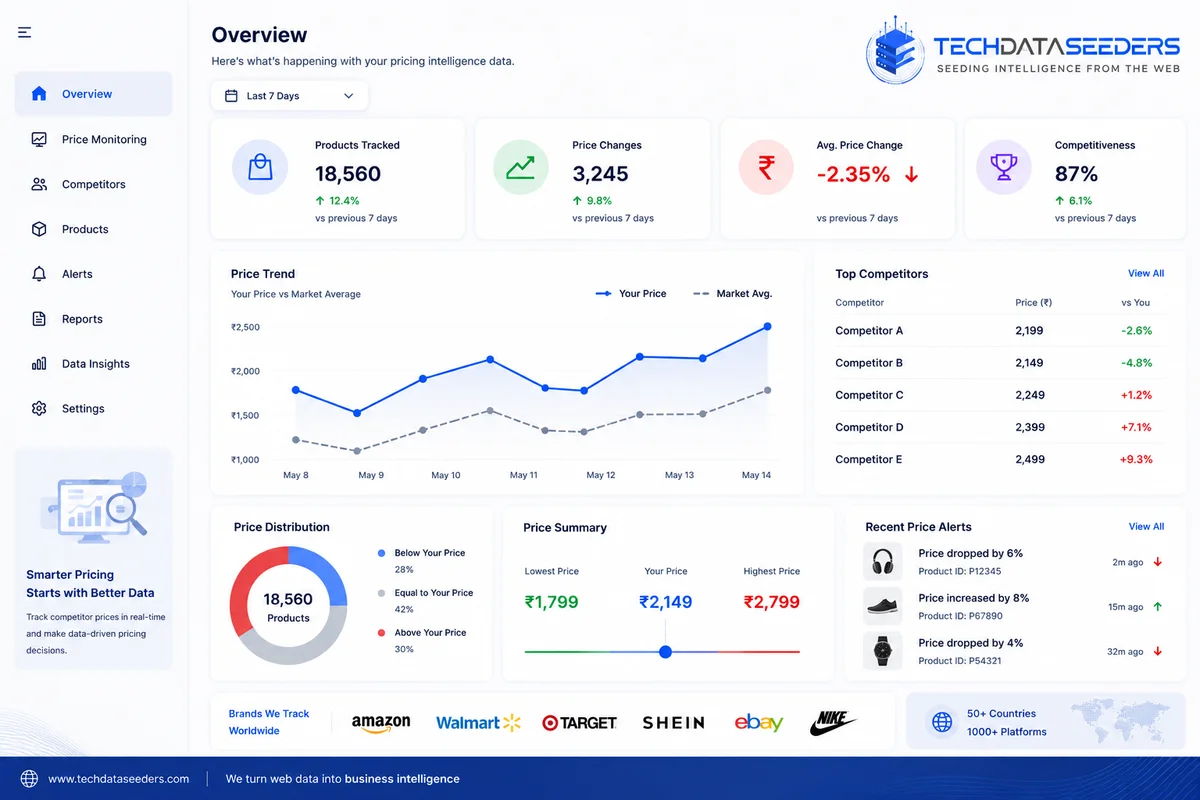
What Is E-commerce Pricing Intelligence?
E-commerce pricing intelligence is the process of collecting, monitoring, and analyzing pricing information from competitor websites, online marketplaces, retailers, and other digital sources.
The goal is not simply to know what competitors charge. Brands can use pricing data to understand:
- How competitor prices change over time
- Which products are becoming more or less expensive
- Where their prices differ from the market
- How frequently competitors change prices
- Whether competing products are in stock
- How discounts and promotions affect prices
- How market conditions influence pricing
For example, an online electronics retailer selling headphones for $80 may discover that several competitors have reduced their prices to $70. The retailer could lower its price, offer a promotion, bundle the product, or maintain the current price if it provides additional value.
Pricing intelligence provides the information needed to make that decision.
Types of Pricing Data Brands Should Monitor
Effective pricing intelligence involves more than collecting a single product price. Depending on the business and category, brands may monitor:
- Current product prices
- Original and discounted prices
- Historical prices
- Competitor promotions
- Product availability
- Seller information
- Shipping costs
- Product ratings and reviews
- Product variations
- Stock changes
Tracking these signals together provides more context. For example, a competitor's low price may be part of a short-term promotion or clearance sale rather than a permanent pricing strategy.
How Does Pricing Intelligence Work?
A common question businesses ask is, "How does pricing intelligence work?" The process generally involves four stages: data collection, data processing, analysis, and action.
First, pricing information is collected from relevant online sources, including competitor websites, marketplaces, product pages, and retail platforms.
Next, the information is cleaned and organized. Product names, SKUs, prices, availability, discounts, and other details may need to be standardized so equivalent products can be compared accurately.
The data is then analyzed to identify pricing patterns, market changes, and products that require attention.
Finally, pricing teams use these insights to make decisions about prices, promotions, inventory, and broader competitive strategy.
Automation makes this process more practical because online prices can change several times a day. Manually checking hundreds or thousands of products is difficult to maintain consistently.
How to Monitor Competitor Prices?
So, how to monitor competitor prices effectively? The first step is to identify the competitors and products that matter most. Not every competitor needs to be monitored at the same frequency.
Next, determine which data points are important. These may include:
- Product name
- Product URL
- Current price
- Original price
- Discount
- Stock status
- Seller information
- Product rating
- Review count
- Product specifications
- Shipping information
Businesses can then use automated data collection, APIs, or web scraping to gather publicly available information from relevant sources.
The collected data can be stored in databases or delivered through APIs, dashboards, spreadsheets, analytics systems, or other internal tools.
The final step is turning the information into action. Monitoring alone does not improve pricing. Businesses need clear rules for deciding which changes require attention.
Why Real-Time Pricing Data Matters
Online markets can move quickly. A competitor might launch a discount in the morning, change the price in the afternoon, and remove the promotion later the same day. This makes real-time pricing data valuable for many e-commerce businesses.
Fresh pricing information allows brands to identify important market changes sooner instead of relying on outdated reports.
For example, if a competitor reduces the price of a high-selling product by 15%, a retailer with frequent price monitoring can identify the change quickly and decide whether it needs to respond.
Real-time does not necessarily mean collecting data every second. The appropriate update frequency depends on product category, competition, price volatility, sales volume, and business objectives.
How Does Real-Time Data Improve Pricing Decisions?
How does real-time data improve pricing decisions? It reduces the gap between a market change and the business's response.
Current pricing data can help brands:
- Identify sudden competitor price changes
- Detect new discounts and promotions
- Understand current market prices
- Monitor product availability
- Identify potential margin opportunities
- Respond faster to market movements
- Reduce reliance on manual research
However, real-time information does not mean businesses should automatically match every competitor price. Instead, it gives pricing teams better information before deciding what action makes sense.
The Role of Ecommerce Price Tracking
Ecommerce price tracking goes beyond checking a competitor's price once. It creates a historical view of how prices change over time. Historical data can reveal patterns that are difficult to identify from a single snapshot.
For example, a retailer may discover that competitors usually reduce prices on weekends or that a particular product category receives significant discounts during major shopping events.
With historical pricing data, businesses can understand:
- Average market prices
- Lowest and highest prices
- Price fluctuations
- Discount patterns
- Seasonal pricing changes
- Competitor pricing behavior
This information can support both immediate pricing decisions and long-term planning.
How Ecommerce Data Scraping Supports Pricing Intelligence
Ecommerce data scraping can help businesses collect large volumes of publicly available product and pricing information from relevant online sources.
Instead of manually visiting hundreds of product pages, automated systems can extract selected information and organize it for analysis.
Depending on the project, businesses may collect:
- Product prices
- Product descriptions
- Discounts
- Availability
- Ratings
- Reviews
- Seller information
- Product variations
- Shipping information
The collected data can then become part of a broader pricing intelligence system.
Product matching is particularly important. Different websites may use different product names, SKUs, descriptions, or variations for the same item. Accurate matching helps ensure that businesses are comparing equivalent products rather than unrelated listings.
E-commerce data collection should also include appropriate cleaning, validation, and compliance processes.
Dynamic Pricing Intelligence and E-commerce Price Optimization
Prices do not always need to remain fixed. Some e-commerce businesses adjust prices based on demand, inventory, competition, seasonality, and other factors. This is where dynamic pricing intelligence becomes useful.
Dynamic pricing combines market information with business rules to help determine when and how prices may need to change.
For example, a retailer might consider:
- Competitor prices
- Current demand
- Inventory levels
- Historical sales
- Seasonal patterns
- Profit margins
- Promotions
- Product availability
A retailer may increase a price when demand is strong and inventory is limited, or reduce it when demand falls and competition becomes more aggressive.
However, dynamic pricing should be used carefully. Constant price changes can confuse customers or negatively affect brand perception.
The goal of E-commerce Price Optimization is not to change prices as frequently as possible. It is to find a balance between competitiveness, demand, revenue, and profitability.
Pricing Intelligence vs. Price Monitoring
Price monitoring and pricing intelligence are closely related, but they are not exactly the same.
Price monitoring focuses on tracking what prices are doing. It answers questions such as:
- Did a competitor change its price?
- What is the current market price?
- When did a price change occur?
Pricing intelligence goes further by analyzing that information and helping businesses understand what the change means.
For example, a monitoring system may report that a competitor reduced a product by 10%. A pricing intelligence system can combine that information with historical prices, promotions, availability, and market trends to help determine whether the change requires action.
In simple terms:
Price monitoring tells you what changed. Pricing intelligence helps explain why it matters.
Competitive Pricing Analysis: Turning Data Into Insights
Collecting pricing data is only the beginning. Businesses also need to understand what the information means. Competitive pricing analysis helps brands compare their pricing with competitors and identify potential opportunities or risks.
A business might discover that its products are consistently priced higher than similar products. It can then investigate whether the difference is justified by product quality, shipping, customer service, brand reputation, or other factors.
Similarly, a retailer may discover that it is pricing certain products too aggressively and leaving potential profit on the table.
This analysis helps businesses balance two important goals: remaining competitive while maintaining healthy margins.
Retail Competitive Intelligence Beyond Pricing
Pricing is only one part of the competitive landscape. Retail competitive intelligence provides a broader view of what competitors are doing.
Businesses can also monitor changes in:
- Product assortment
- New product launches
- Promotions
- Stock availability
- Discounts
- Product ratings
- Customer reviews
- Delivery information
Combining these signals with pricing data provides better context.
For example, a competitor lowering its price may not always represent a direct threat. The retailer could be clearing old inventory, running a temporary promotion, or selling a different product variation.
The more context businesses have, the better they can interpret pricing changes.
Key Pricing Metrics to Track
Businesses can use several metrics to understand their competitive position and measure pricing performance.
Useful metrics include:
- Average competitor price: The average price of comparable products in the market.
- Price gap: The difference between your price and a competitor or market average.
- Price index: A measure of how your prices compare with the overall market.
- Discount percentage: The reduction from the original or list price.
- Price change frequency: How often competitors adjust their prices.
- Lowest and highest market price: Helps identify the current market range.
- Competitive position: Shows whether products are priced above, below, or close to competitors.
- Margin impact: Helps connect pricing changes with profitability.
Tracking these metrics over time can provide a clearer picture than looking at individual price changes.
Using Price Intelligence Software
Managing thousands of pricing records manually can be difficult. Price intelligence software can help businesses automate data collection, comparison, reporting, and alerts.
Depending on the platform, features may include:
- Automated competitor monitoring
- Price comparison dashboards
- Historical pricing data
- Price change alerts
- Product matching
- Market trend analysis
- Automated reports
- Data exports
- API access
For larger retailers, pricing software can also integrate with e-commerce platforms, ERP systems, analytics tools, and business intelligence systems.
The right solution depends on the number of products, competitors, data sources, update frequency, and business requirements.
Retail Price Monitoring Software for Large Catalogs
Large retailers may have thousands of products across multiple categories and marketplaces. Monitoring all of them manually is rarely practical. Retail price monitoring software can automate this process and help pricing teams focus on products that matter most.
For example, businesses can prioritize:
- High-selling products
- Products with strong competition
- Products with narrow profit margins
- Frequently discounted products
- Products with significant price changes
Instead of reviewing every price change manually, teams can receive alerts about significant events and spend more time on strategic decisions.
Key Benefits of Pricing Intelligence for E-commerce Brands
A well-planned pricing intelligence strategy can provide several benefits.
Faster Pricing Decisions
Teams can access current market information instead of waiting for manual competitor research.
Better Competitive Positioning
Brands can understand where their prices stand compared with competing products.
Improved Profit Margins
Businesses can identify opportunities to avoid unnecessary price reductions while remaining competitive.
Reduced Manual Work
Automated data collection can replace repetitive price-checking tasks.
Better Market Understanding
Historical data can reveal pricing trends, seasonal patterns, and competitor behavior.
More Consistent Pricing Strategy
Businesses can establish clear pricing rules based on data rather than making decisions based only on assumptions.
Common Challenges in Pricing Intelligence
Pricing intelligence can deliver valuable insights, but businesses also need to manage several challenges.
Product Matching
Different websites may use different product names, SKUs, descriptions, or variations. Accurate matching is essential for meaningful comparisons.
Data Quality
Incorrect, missing, duplicated, or outdated information can lead to poor pricing decisions.
Changing Websites
E-commerce websites can change their layouts and technical structures. Automated collection systems need regular monitoring and maintenance.
Data Volume
Retailers with large catalogs and many competitors may need scalable infrastructure to collect and process pricing information efficiently.
Price Context
A product's listed price may not represent the final customer cost. Shipping fees, coupons, membership discounts, bundles, and promotions can affect the actual price.
Compliance
Businesses should ensure that their data collection methods respect applicable laws, website terms, privacy requirements, and other relevant restrictions.
How Techdataseeders Supports E-commerce Pricing Intelligence
Building a reliable pricing intelligence system requires more than collecting competitor prices. Brands need accurate data extraction, product matching, data cleaning, historical tracking, and structured delivery to turn raw market information into useful insights.
Techdataseeders helps e-commerce and retail businesses collect and organize competitive market data for pricing and business intelligence. Our solutions can be tailored to the number of products, competitors, data sources, and required update frequency.
Our capabilities can include:
- E-commerce data collection
- Competitor price monitoring
- Product data extraction
- Retail price monitoring
- Historical price tracking
- Structured data delivery
- Recurring data updates
- Custom data feeds
By combining scalable data collection with structured and reliable data delivery, businesses can spend less time manually tracking competitors and more time making informed pricing decisions.
Conclusion
E-commerce pricing is no longer a decision that can rely only on occasional competitor checks. E-commerce pricing intelligence gives brands a structured way to monitor competitors, understand market movements, analyze historical trends, and make more informed pricing decisions.
From competitor price monitoring and e-commerce price tracking, dynamic pricing intelligence and real-time analytics, businesses can use market data to build a more responsive and profitable pricing strategy.
The goal is not to automatically match every competitor. It is to understand what is happening in the market and determine when a pricing change actually makes business sense.
Want better visibility into competitor pricing and market movements? Partner with Techdataseeders to build a reliable e-commerce pricing data solution tailored to your products, competitors, and business goals.
FAQs About E-commerce Pricing Intelligence
E-commerce pricing intelligence is the process of collecting, monitoring, and analyzing pricing and competitive information to help online businesses make better pricing decisions.
Pricing intelligence typically involves identifying products and competitors, collecting pricing data, cleaning and matching products, analyzing price differences, and delivering insights or alerts to pricing teams.
Businesses can monitor competitor prices manually for small catalogs or use automated data collection, APIs, and e-commerce scraping systems for larger catalogs. Automated monitoring can provide regular updates and historical price information.
Real-time or frequently updated pricing data helps businesses identify market changes sooner. This allows pricing teams to evaluate competitor movements and respond according to their pricing, margin, inventory, and business strategies.
Dynamic Pricing Intelligence combines competitor pricing and market information with factors such as demand, inventory, historical sales, and margins to support more flexible pricing decisions.
Price monitoring primarily tracks price changes, while pricing intelligence analyzes those changes and provides broader insights that can support pricing strategy and optimization.
Yes. E-commerce data scraping can help collect product and pricing information from relevant online sources at scale. The collected data should then be cleaned, matched, validated, and used in accordance with applicable legal and website requirements.