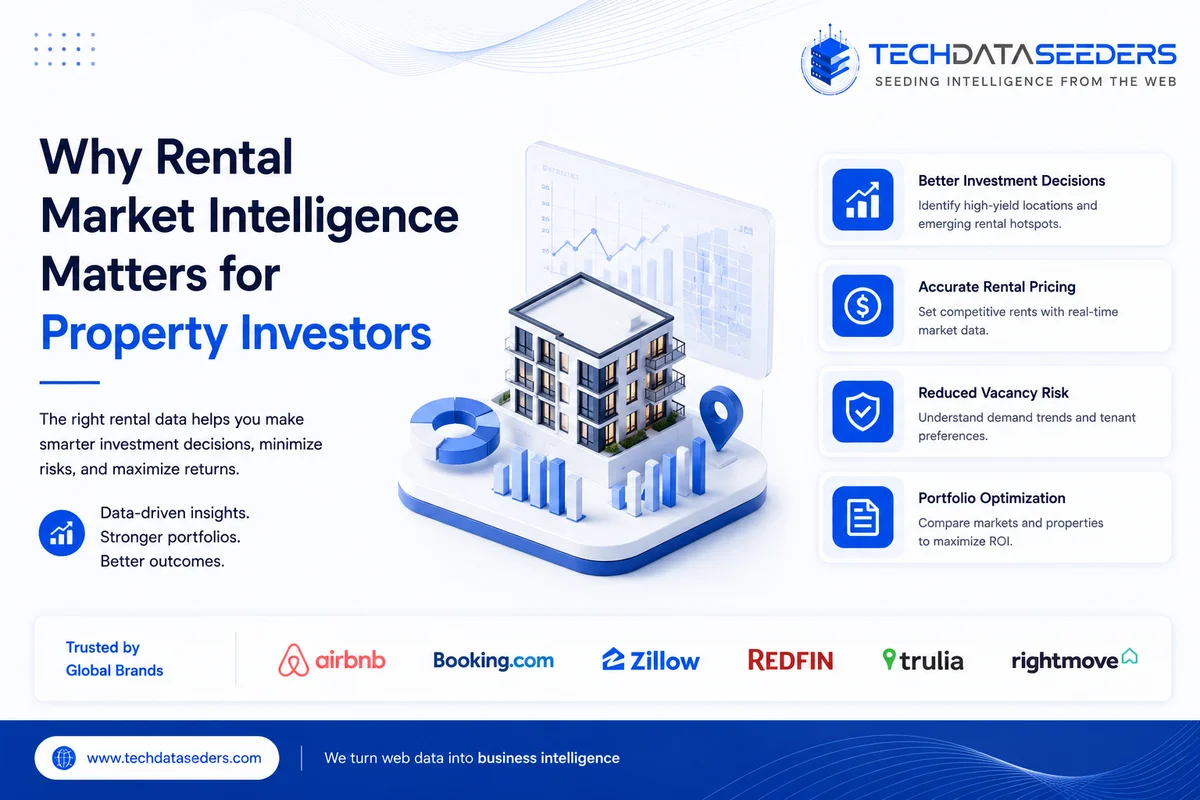
"A property's true performance is often determined by its rental potential, not just its purchase price."
Why Rental Data Is Important
Strong rental demand can indicate:
- Population growth
- Economic activity
- Limited housing supply
- Attractive neighborhood characteristics
Understanding these trends helps investors evaluate long-term opportunities.
Key Metrics Investors Analyze
Rental Prices
Track changes across neighborhoods and property types.
Occupancy Trends
Understand demand and vacancy levels.
Tenant Preferences
Identify features attracting renters.
Supply Dynamics
Monitor new rental inventory entering the market.
Regional Performance
Compare markets and locations.
How Techdataseeders Helps
Techdataseeders supports:
- Rental market analysis
- Property intelligence
- Demand forecasting
- Market research
- Real estate analytics
- Portfolio intelligence
Real-World Example
A residential investor evaluating multiple cities found that one market offered lower property prices but significantly stronger rental demand.
The resulting rental yield made the investment more attractive despite slower appreciation expectations.
Conclusion
Rental market intelligence helps investors look beyond purchase prices and understand the income potential of a property.
Organizations that monitor rental trends can make more strategic investment decisions and improve portfolio performance.
FAQs About Rental Market Intelligence for Property Investors
Rental market intelligence is data about rental prices, demand, vacancies, tenant preferences, and market trends. It helps property investors understand where rental opportunities exist, estimate potential income, compare locations, and make decisions based on market evidence rather than assumptions.
Rental market intelligence helps investors compare properties based on rental demand, average rent, vacancy rates, tenant profiles, and local market trends. This information can reveal whether a property has strong income potential and help investors avoid locations where rental demand is weak or declining.
The main benefits include better property selection, more accurate rental income estimates, improved location analysis, reduced investment risk, and stronger pricing decisions. Investors can also identify emerging rental markets and understand changing tenant demand before committing significant capital to a property.
Investors can compare a property's expected rent with rental prices for similar properties in the same area. They should also consider occupancy rates, property size, amenities, location, and historical rental trends. This provides a more realistic estimate of potential rental income than relying only on asking prices.
Rental market intelligence can make traditional research more precise by adding current and structured market data. Traditional research may provide general information about an area, while rental intelligence can show rental demand, pricing patterns, vacancies, and comparable properties that directly support investment decisions.
Investors should review average rents, vacancy rates, rental demand, tenant demographics, comparable properties, rent growth, and local market trends. They should also assess purchase price, operating expenses, taxes, financing costs, and expected rental yield to understand the property's overall investment potential.
Techdataseeders provides data-driven market intelligence that can help property investors understand rental markets, compare opportunities, and identify useful market trends. Investors can use relevant rental data to support property research, evaluate potential locations, and make more informed investment decisions.
Rental market intelligence is most useful when it comes from accurate, current, and well-structured data sources. Investors should check the data's coverage, update frequency, methodology, and source quality. It should support investment research rather than replace financial analysis, property inspections, and professional advice.