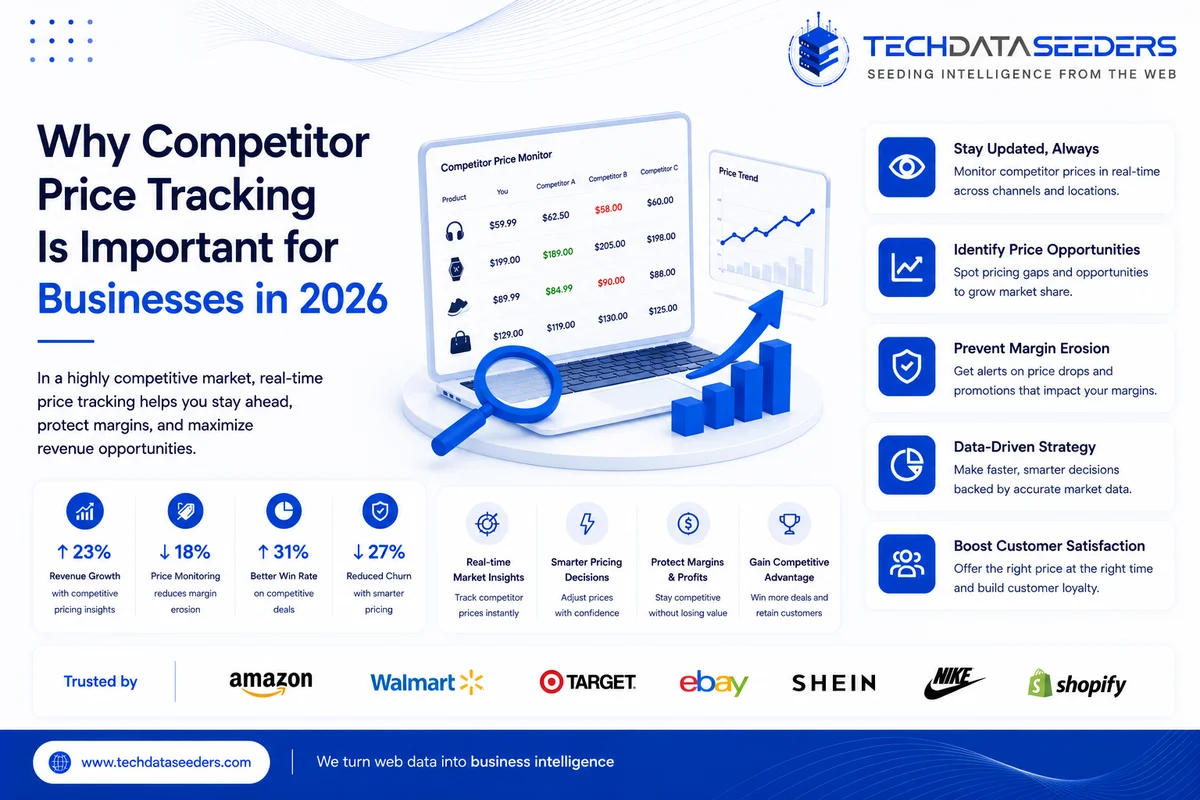
"Your competitors are telling you a story through their pricing. The question is whether you're paying attention."
The Hidden Signals Behind Every Price Change
Most businesses view pricing as a number.
Successful businesses view it as a market signal.
When a competitor suddenly reduces prices, several things could be happening:
- Excess inventory
- Seasonal demand shifts
- New product launches
- Aggressive customer acquisition efforts
- Market share expansion strategies
Similarly, when competitors increase prices, it may indicate:
- Strong demand
- Supply constraints
- Premium positioning
- Reduced market competition
Price changes often reveal what's happening behind the scenes long before official reports become available.
Why Businesses Lose Revenue Without Realizing It
One of the biggest challenges in modern commerce is invisible revenue loss.
Imagine a company selling 5,000 products online.
If competitors quietly adjust pricing on a handful of high-volume products, the business may not notice immediately.
Over time, this can lead to:
- Lower conversion rates
- Reduced visibility
- Declining market share
- Customer migration to competitors
By the time sales reports reveal the problem, the market has already moved.
Competitor price tracking helps businesses identify these shifts early.
It's Not About Being the Cheapest
A common misconception is that price tracking exists to support discounting.
In reality, constantly lowering prices can damage profitability and brand perception.
The smartest companies use competitive intelligence to answer questions such as:
Which products require pricing adjustments?
Which products can support premium pricing?
Where are competitors becoming aggressive?
Which categories are experiencing demand growth?
How sensitive are customers to pricing changes?
The goal is smarter positioning, not price wars.
How Different Industries Use Competitor Pricing Intelligence
Retail & E-Commerce
Monitor SKU-level pricing, promotions, and marketplace activity to improve competitiveness.
Travel & Hospitality
Track hotel rates, airline fares, and accommodation pricing to optimize revenue management.
Food Delivery
Analyze menu prices, delivery fees, and restaurant promotions across delivery platforms.
Car Rentals
Monitor rental rates by location, season, and demand conditions.
Consumer Goods
Benchmark products against competing brands across online and offline channels.
Competitor intelligence has become relevant far beyond traditional retail.
How Techdataseeders Helps Businesses Stay Ahead
At Techdataseeders, we help organizations collect and analyze large-scale pricing intelligence from websites, marketplaces, booking platforms, and digital commerce channels.
Our solutions help businesses monitor:
- Competitor prices
- Promotional campaigns
- Product availability
- Market trends
- Pricing fluctuations
- Category performance
- Regional pricing differences
- Marketplace activity
Rather than overwhelming businesses with data, we focus on delivering intelligence that supports better decisions.
A Real-World Example
A consumer electronics distributor noticed declining sales for a category that had historically performed well.
Initial assumptions pointed toward weaker customer demand.
However, a deeper analysis revealed something different.
Several competitors had begun bundling complementary products while maintaining nearly identical prices.
Customers perceived these bundles as offering greater value, despite minimal pricing differences.
The company adjusted its offer structure rather than lowering prices.
The result was improved competitiveness without sacrificing margins.
This highlights an important lesson:
Sometimes the issue isn't the price itself it's the context surrounding it.
What Will Change in 2026 and Beyond?
Businesses are moving away from static pricing models.
Key trends include:
Faster Pricing Cycles
Prices can change multiple times within a day.
AI-Powered Pricing Strategies
Companies increasingly use automation and analytics to guide decisions.
Greater Customer Transparency
Consumers have more pricing information available than ever before.
Cross-Platform Competition
Businesses compete across websites, marketplaces, apps, and aggregators simultaneously.
Data-Driven Decision Making
Pricing strategies are becoming increasingly dependent on market intelligence rather than intuition.
The Questions Every Business Should Be Asking
Instead of asking:
"Are our prices competitive?"
Businesses should ask:
Where are competitors gaining traction?
Which products are most vulnerable?
Which categories offer margin opportunities?
What pricing patterns indicate changing demand?
How quickly can we respond to market shifts?
These questions often provide more valuable answers than pricing alone.
The Business Impact of Better Visibility
Organizations that actively monitor competitor pricing often improve their ability to:
- ✔ Protect profit margins
- ✔ Improve pricing confidence
- ✔ React faster to market changes
- ✔ Identify competitive threats
- ✔ Discover growth opportunities
- ✔ Support revenue optimization
- ✔ Improve forecasting accuracy
- ✔ Strengthen market positioning
Conclusion
In 2026, competitor price tracking is no longer just a pricing exercise it's a market intelligence strategy.
Every pricing decision made by competitors provides clues about customer demand, inventory conditions, market trends, and business priorities.
Organizations that understand these signals gain a significant advantage over those relying solely on internal data.
At Techdataseeders, we help businesses transform pricing data into meaningful competitive intelligence through advanced extraction, monitoring, and analytics solutions.
Because in today's market, understanding competitor behavior is often just as important as understanding your own.
FAQs About Competitor Price Tracking for Businesses in 2026
Competitor price tracking is the process of monitoring competitors' product prices, discounts, promotions, and pricing changes. Businesses use this data to compare market prices, identify pricing trends, and make informed decisions about their own pricing strategy without relying on outdated or manually collected information.
Competitor price tracking helps businesses respond quickly to changing market conditions, competitor discounts, and customer expectations. In 2026, automated pricing intelligence can help companies identify opportunities, protect profit margins, improve competitiveness, and make faster decisions using current market data.
Key benefits include better pricing decisions, improved market visibility, faster response to competitor changes, stronger profit-margin control, and identification of promotional opportunities. Businesses can also use competitor pricing data to understand market positioning and determine whether their products are priced competitively for their target customers.
Businesses can use competitor pricing data to compare products, monitor price changes, analyze discounts, identify pricing patterns, and adjust their pricing strategy. E-commerce companies can also use the information to support dynamic pricing, promotional planning, product positioning, and competitive market analysis.
Yes. Manual monitoring can be slow, inconsistent, and difficult to scale across many websites or products. Automated competitor price tracking can collect and organize pricing information regularly, helping businesses monitor larger product catalogs and react faster when competitors change prices, promotions, or availability.
Businesses should evaluate data accuracy, update frequency, website coverage, scalability, product matching, reporting capabilities, and data quality. It is also important to choose a provider that can deliver structured, reliable competitor pricing data that fits the company's market, products, and business objectives.
Techdataseeders helps businesses collect and organize competitor pricing information for market analysis and pricing decisions. Its data-focused approach can support businesses that need competitor price insights at scale, helping teams reduce manual research and gain a clearer view of market pricing and competitive movements.
Yes. Small and growing businesses can use competitor price tracking to understand market pricing before launching products, changing prices, or running promotions. Reliable competitor data helps them make evidence-based decisions, avoid pricing too high or low, and compete more effectively without depending entirely on manual research.