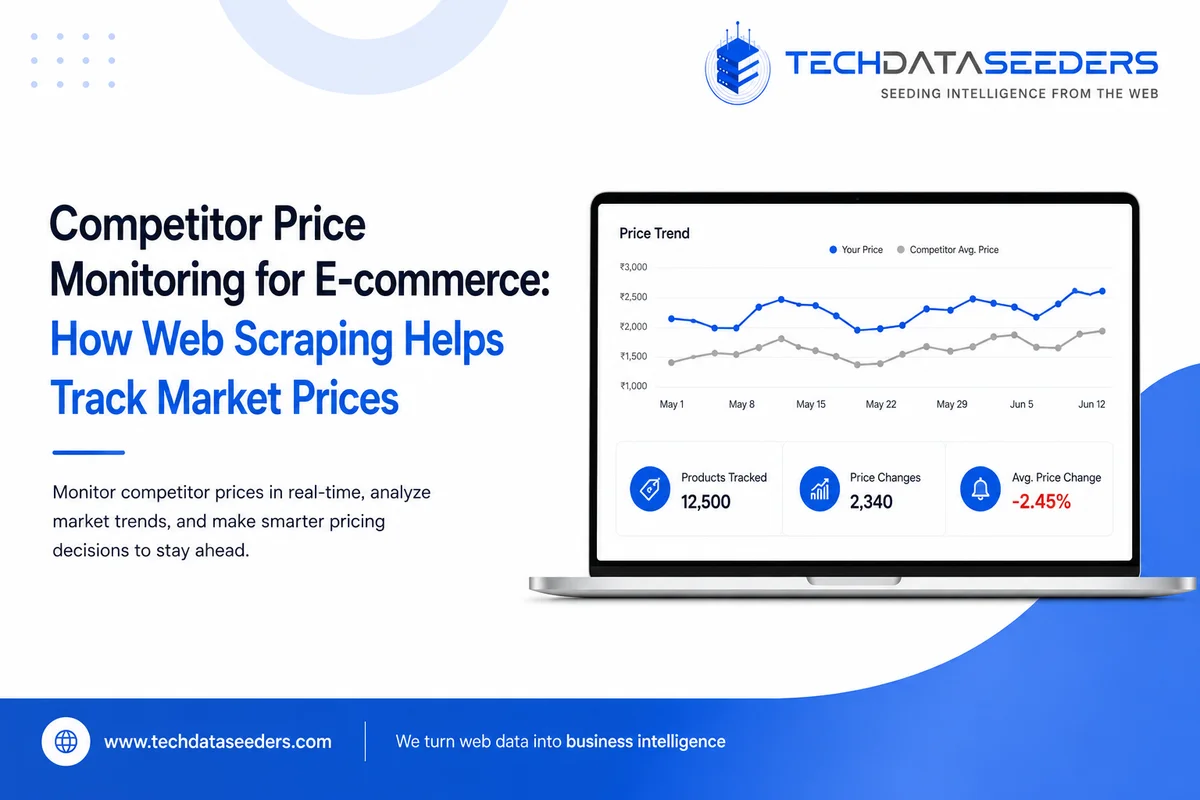
What Is Competitor Price Monitoring?
Competitor price monitoring is the process of regularly tracking product prices, discounts, promotions, availability, seller information, and other pricing-related data from competing businesses.
For an e-commerce brand, this can mean monitoring hundreds or thousands of products across multiple competitor websites and marketplaces.
For example, imagine an online electronics retailer selling wireless headphones. Its competitors may change prices several times during a month. One marketplace may offer the product at $89, another seller may list it at $84, and a third marketplace may offer a coupon that reduces the effective price further.
If one competitor reduces the price by 10%, the retailer may need to decide whether to match the price, maintain its current price, protect its margin, or introduce a targeted promotion.
A structured monitoring system can provide visibility into:
- Current competitor prices
- Historical price changes
- Original and discounted prices
- Promotions and coupons
- Product availability
- Product variations
- Seller information
- Marketplace differences
- Shipping or delivery information
- Price differences between competitors
- Product listing changes
The objective is not simply to know what competitors charge. It is to understand how the market is changing and what those changes mean for pricing decisions.
Why Is Competitor Price Monitoring Important for E-commerce?
Price is one of the most visible factors influencing online purchasing decisions. Customers can compare products from multiple retailers within minutes, making competitive pricing increasingly important.
Effective ecommerce price monitoring helps brands understand where their prices stand compared with similar products across competitors and marketplaces.
1. Understand Your Competitive Position
A business cannot properly evaluate its pricing strategy without knowing what competitors are charging.
Regular monitoring provides a broader view of the market and helps identify products that are priced significantly higher or lower than competing offers.
For example, a retailer may discover that 15% of its monitored products are consistently priced above the market average. That insight can help the pricing team determine whether those products require adjustment or whether the higher price is justified by brand value, availability, shipping, or other factors.
2. Identify Pricing Opportunities
Competitor prices can reveal opportunities to adjust pricing.
If competitors consistently charge more for a particular product, a business may have room to maintain its current price and protect margin.
If competitors are significantly cheaper, the business can investigate whether it needs to adjust its price, improve its promotion, or understand why the competitor is able to offer the lower price.
The goal is not to automatically match every competitor. Instead, pricing data provides evidence that can support better decisions.
3. Monitor Discounts, Promotions, and Coupons
The listed price does not always represent the effective price paid by customers.
Competitors may use:
- Percentage discounts
- Coupon codes
- Flash sales
- Limited-time offers
- Bundle promotions
- Buy-one-get-one offers
- Marketplace promotions
- Seller-specific discounts
For example, a product may be listed at $100 but have a $10 coupon available. Another marketplace may list the same product at $95 without a coupon.
A pricing intelligence system should capture relevant pricing signals so businesses can understand the broader promotional environment instead of comparing only the headline price.
4. Improve Pricing Decisions
Instead of relying entirely on assumptions, pricing teams can use current competitor pricing data to support their decisions.
Market data can be combined with internal information such as:
- Sales volume
- Inventory
- Product margins
- Demand
- Conversion rates
- Promotional performance
- Customer behavior
This creates a stronger basis for deciding when to maintain, increase, or reduce prices.
5. Detect Market Changes Faster
A competitor may suddenly reduce the price of a high-volume product, introduce a new seller, run a major promotion, or change product availability. Regular monitoring helps businesses identify these changes earlier. This can be particularly valuable in categories where prices change frequently and competitors actively adjust their offers.
Real-World Pricing Challenges in E-commerce
Competitor price monitoring becomes significantly more complex when businesses move from monitoring a few products to tracking thousands of products across multiple marketplaces.
Dynamic Pricing
Some e-commerce businesses change prices based on demand, inventory, competition, time, or other market conditions.
A competitor's price at 10 AM may not be the same price at 6 PM.
For businesses operating in highly competitive categories, collecting pricing data only once a week may therefore provide an incomplete picture.
Monitoring frequency should be based on how quickly prices change and how important the monitored products are to the business.
Frequent Price Changes
Prices can change multiple times during a day, especially during sales events or periods of high demand.
A useful monitoring system should maintain timestamps with collected pricing records so businesses can determine:
- What the price was
- When it changed
- Which competitor changed it
- How large the change was
- Whether the change was temporary or persistent
This transforms price monitoring from a static snapshot into historical pricing intelligence.
Marketplace Differences
The same product may appear across Amazon, Walmart, eBay, a brand's own website, regional marketplaces, and other e-commerce platforms.
Each marketplace can have different:
- Product structures
- Seller information
- Pricing formats
- Promotions
- Availability signals
- Product identifiers
- Page layouts
Comparing marketplace data therefore requires normalization before meaningful analysis can take place.
Seller-Level Pricing
Marketplaces can have multiple sellers offering the same product. The lowest listed price may belong to one seller, while another seller may offer faster delivery, different fulfillment, or a different condition.
For this reason, competitor monitoring may need to capture seller-level information alongside the product price.
Product Variations
Products often have multiple sizes, colors, quantities, models, or specifications.
A 500 ml product should not be compared directly with a 1-liter version simply because the product names are similar.
Accurate pricing intelligence requires the monitoring system to understand and distinguish relevant product variations.
Promotions and Coupons
Promotions can make price comparison more difficult.
A product may have a standard price, sale price, coupon, bundle offer, or marketplace promotion.
Capturing these pricing attributes gives businesses a better understanding of the actual competitive offer.
Accurate Product Matching
One of the most important challenges is determining whether two listings actually represent the same product. Similar product names do not necessarily mean identical products.
Product matching may need to consider:
- Brand
- Model number
- SKU
- UPC or other identifiers
- Product attributes
- Size
- Color
- Quantity
- Specifications
- Pack count
Accurate matching prevents businesses from making pricing decisions based on incorrect competitor comparisons.
How to Monitor Competitor Prices at Scale
One of the most common questions businesses have is how to monitor competitor prices when they have hundreds or thousands of products.
Manual monitoring may work for a small product catalog, but it becomes increasingly difficult as the number of products and competitors grows.
A scalable process generally involves:
Identify competitors → Identify products → Collect pricing data → Match products → Validate data → Compare prices → Store history → Analyze → Take action
First, businesses identify the competitor websites, marketplaces, and products they want to monitor.
Next, product information is collected at a defined frequency.
The collected information is then cleaned, normalized, and matched so that similar or identical products can be compared accurately.
Price records can be stored historically, allowing the business to compare the latest observation against previous observations.
Finally, the information can be delivered through dashboards, reports, alerts, databases, or APIs.
The monitoring frequency depends on the market.
Some businesses may need daily updates, while highly competitive categories may benefit from multiple collection cycles per day.
How to Track Competitor Prices Using Web Scraping
Another common question is how to track competitor prices efficiently without manually checking every product page.
Web scraping can automate the collection of publicly available information from websites and marketplaces.
A scraping workflow can visit relevant product pages, identify required fields, and return the information in a structured format.
A typical price monitoring using web scraping workflow can look like this:
Competitor Websites & Marketplaces → Product Collection → Data Extraction → Data Cleaning → Product Matching → Price Validation → Historical Storage → Price Comparison → Reporting/API
The system can be configured to collect fields such as:
- Product name
- Product URL
- Current price
- Original price
- Discount
- Coupon information
- Product availability
- Brand
- SKU or product identifier
- Category
- Product variation
- Rating
- Review count
- Seller information
- Marketplace
- Shipping information
- Collection timestamp
Once collected, the information can be stored in a database or delivered through another preferred format.
This approach allows businesses to replace repetitive manual checks with an automated data pipeline.
Practical Example: Monitoring 5,000 Products Across 5 Competitors and 3 Marketplaces
Consider an e-commerce brand with 5,000 products that wants to monitor 5 competitors across 3 major marketplaces. If every product needs to be checked against every competitor on every marketplace, the monitoring scope would be:
5,000 products × 5 competitors × 3 marketplaces = 75,000 product-competitor-marketplace combinations.
This means the business could potentially need to monitor 75,000 individual comparison points per monitoring cycle.
Manually checking this volume of data would require significant time and would make it difficult to maintain consistent historical records. An automated competitor price monitoring workflow can make this process more manageable.
Step 1: Create the Product List
The business first defines the 5,000 products it wants to monitor using identifiers such as SKU, brand, model number, UPC, product URL, or other relevant attributes.
Step 2: Identify Competitor Listings
The system identifies matching competitor listings across the 5 competitors and 3 marketplaces.
This step is important because the same product may have different titles, URLs, descriptions, or listing structures across marketplaces.
Step 3: Collect Pricing and Availability Data
The extraction workflow collects relevant information such as:
- Current price
- Original price
- Discount
- Coupon or promotion
- Seller
- Availability
- Product variation
- Marketplace
- Timestamp
Step 4: Validate and Normalize
The collected records are cleaned and standardized. Prices can be converted into a consistent format, product variations can be separated, and duplicate records can be identified.
Step 5: Store Historical Records
Instead of replacing yesterday's price with today's price, each observation can be stored with its collection timestamp.
For example:
| Product | Marketplace | Date | Seller | Price | Availability |
|---|---|---|---|---|---|
| Product A | Marketplace 1 | Aug 1 | Seller X | $99 | In Stock |
| Product A | Marketplace 1 | Aug 2 | Seller X | $95 | In Stock |
| Product A | Marketplace 1 | Aug 3 | Seller X | $89 | In Stock |
| Product A | Marketplace 2 | Aug 3 | Seller Y | $92 | In Stock |
This historical data allows the business to identify when prices changed, which competitor changed them, and how those changes developed over time.
Step 6: Identify Price Changes
The system can compare the latest price with previous records.
For example: $99 → $95 → $89
This shows a $10 reduction from the original monitored price. The business can use this information to review its own pricing, promotion, or competitive position.
Step 7: Turn the Data Into Pricing Intelligence
The collected data can then support:
- Competitor price comparisons
- Price-change alerts
- Pricing dashboards
- Historical trend analysis
- Promotional monitoring
- Margin analysis
- Competitive intelligence
- Pricing strategy
What Data Should E-commerce Brands Monitor?
Price is important, but it is not the only information that can influence competitive analysis. A useful monitoring strategy may include several data points.
Product Price
The current selling price provides the foundation for price comparison.
Original and Discounted Price
Tracking both values can help businesses understand how aggressively competitors are using discounts.
Promotions and Coupons
Promotions can significantly change the effective customer price. Capturing available discounts and coupon information helps businesses understand competitive offers more accurately.
Product Availability
A competitor may have a lower price but limited stock. Monitoring availability provides additional context when comparing offers.
Seller Information
Multiple sellers may offer the same product at different prices. Seller-level information helps businesses understand which seller is driving the lowest observed price.
Product Variations
Different sizes, colors, quantities, models, or specifications can have different prices. Matching the correct variation is essential for accurate comparison.
Marketplace
The same product can have different prices and promotional conditions across marketplaces. Recording the marketplace allows businesses to analyze these differences separately.
Product Ratings and Reviews
Pricing decisions can sometimes be influenced by perceived product value. Ratings and review counts provide additional competitive context.
Shipping and Delivery Information
Delivery costs and speed can influence the overall attractiveness of an offer. Where relevant, these fields can be incorporated into competitive monitoring.
Collection Timestamp
A timestamp is particularly important for historical pricing.
Without knowing when a price was collected, it becomes difficult to analyze price movements accurately.
Key Advantages of Using Web Scraping
Web scraping makes competitor price monitoring more scalable by automating repetitive data collection across websites and marketplaces. Instead of manually checking individual product pages, businesses can collect pricing, availability, seller, promotion, and product information on a defined schedule.
The collected data can then be cleaned, matched, stored, and analyzed to identify price changes and competitive trends. This makes web scraping particularly useful for businesses managing large product catalogs or monitoring multiple competitors.
The Value of Pricing Intelligence Beyond Price Tracking
Competitor price monitoring becomes much more valuable when the collected data is connected to broader business decisions.
Pricing Decisions
Pricing teams can compare their current prices against competitors and identify products that may require review.
The data can be used as one input into a broader pricing strategy rather than as an instruction to automatically match competitors.
Competitor Intelligence
Historical pricing data can reveal how competitors behave.
For example, a business may identify competitors that frequently discount products, competitors that maintain premium prices, or competitors that react quickly to market changes.
Margin Analysis
Price intelligence can be compared with internal costs and margins. If a competitor is selling below the company's current price, the business can evaluate whether matching that price would still provide an acceptable margin. This helps avoid blindly entering price wars.
Promotional Planning
Competitor promotions can provide useful market context when planning:
- Seasonal campaigns
- Holiday promotions
- Product launches
- Clearance sales
- Limited-time offers
Historical data can also show when competitors typically increase promotional activity.
Market Intelligence
Pricing data can reveal broader market movements. For example, if multiple competitors reduce prices for the same category, this may indicate increased competition, declining demand, excess inventory, or a seasonal market shift.
This turns pricing data into a broader source of market intelligence.
What Makes a Good Competitor Price Monitoring Strategy?
Technology alone does not create an effective pricing strategy. Businesses also need to define what they want to measure, how often they need the information, and how the data will be used.
A good strategy should answer questions such as:
- Which competitors should be monitored?
- Which products matter most?
- How frequently should prices be checked?
- Which marketplaces should be included?
- Which pricing attributes should be collected?
- How should similar products be matched?
- How should product variations be handled?
- What price changes require an alert?
- How long should historical data be retained?
- How will the collected information be analyzed?
- Who will use the resulting insights?
For example, a business may decide to monitor its top 1,000 products across five competitors every day. Another company operating in a highly dynamic category may monitor a smaller group of products several times a day. The monitoring strategy should match the business objective, product category, pricing volatility, and decision-making requirements.
Challenges of Competitor Price Monitoring
Although automated collection can make price monitoring much easier, there are still important challenges to consider.
Changing Website Structures
Websites regularly change page layouts, HTML structures, URLs, and product templates. Extraction workflows may need maintenance when these changes occur.
Dynamic Pricing
Competitor prices may change frequently based on demand, inventory, promotions, or market conditions.
A single daily snapshot may not always capture every meaningful price movement.
Dynamic Content
Some product information is loaded dynamically through JavaScript or other technologies. Extracting this information may require additional processing.
Data Quality
Missing values, duplicate records, incorrect product matches, and inconsistent formats can reduce the usefulness of collected data.
Product Matching
Similar product names can represent different models, sizes, quantities, or variations. Accurate matching is therefore critical before calculating price differences.
Marketplace and Seller Differences
Different marketplaces and sellers may present the same product under different conditions. A useful monitoring system needs to retain marketplace and seller context rather than treating every price as directly equivalent.
Large Data Volumes
Monitoring thousands of products across many websites requires an architecture that can process, validate, store, and deliver data efficiently.
Historical Data Management
Historical records can become large over time. Businesses need appropriate data storage and structuring processes so that historical pricing information remains usable for analysis.
Ongoing Maintenance
Competitor price monitoring is usually an ongoing activity rather than a one-time project. Data sources, product catalogs, pricing structures, and website layouts can change over time.
For these reasons, businesses should consider data quality, product matching, scalability, monitoring, historical storage, and maintenance when building a long-term pricing intelligence solution.
How Techdataseeders Helps With Competitor Price Monitoring
For e-commerce businesses, collecting competitor pricing data is only useful when the information is accurate, structured, timely, and connected to business decisions.
Techdataseeders provides web data collection and extraction capabilities designed around specific e-commerce and pricing intelligence requirements. The workflow can be structured around the competitors, products, marketplaces, data fields, monitoring frequency, and delivery requirements that matter to the business.
Competitor Price Monitoring
Techdataseeders can help businesses automate recurring competitor price monitoring instead of relying on manual product-by-product checks.
Monitoring can be structured around selected competitors, products, marketplaces, and collection schedules.
Pricing Intelligence
Collected pricing data can be organized into structured datasets that help businesses analyze current market prices, price movements, discounts, and competitive positioning.
This allows pricing teams to work with market data rather than relying only on manual observations.
Product Matching
Accurate comparison depends on matching the right products. Techdataseeders can structure extraction and matching workflows around relevant product identifiers and attributes, helping businesses distinguish between different products and variations.
Historical Price Tracking
Instead of only delivering the current price, recurring data collection can maintain historical pricing records. This allows businesses to analyze price movements over time and identify patterns such as repeated discounts, sudden price reductions, or changes in competitive positioning.
Marketplace Data Extraction
E-commerce brands may need pricing and product information from multiple marketplaces. Techdataseeders can structure data extraction across relevant marketplaces and organize the collected information into a consistent dataset for comparison and analysis.
Recurring Monitoring
Pricing intelligence becomes more valuable when it is updated consistently.
Monitoring workflows can be designed around the required frequency, whether the business needs daily data or more frequent collection for highly dynamic markets.
Structured Data and API Delivery
Collected data can be cleaned, normalized, and structured for business use. Depending on the project requirements, data can be delivered through structured files, databases, data feeds, or APIs so it can connect with internal systems, dashboards, analytics platforms, or pricing workflows.
From Price Data to Business Intelligence
The objective is not simply to provide a list of competitor prices. The collected data can help businesses build datasets for:
- Pricing decisions
- Competitor intelligence
- Margin analysis
- Promotional planning
- Historical pricing analysis
- Market intelligence
- Product and marketplace analysis
This approach turns web data into a recurring source of pricing intelligence that can support broader e-commerce decision-making.
Conclusion
E-commerce markets can change quickly, and pricing teams need reliable information to understand those changes.
Competitor price monitoring gives businesses a structured way to track market prices, promotions, availability, sellers, product variations, and other competitive signals. For small product catalogs, manual research may be sufficient. But as the number of products, competitors, and marketplaces grows, automated data collection becomes increasingly valuable.
Using web scraping, businesses can collect publicly available pricing information at scale, organize it into structured datasets, maintain historical records, and use it for pricing decisions and competitive analysis.
The most effective approach goes beyond simply finding the lowest competitor price. It combines accurate product matching, historical pricing, promotions, seller information, availability, marketplace data, and other market signals to create meaningful competitor price intelligence.
With the right data strategy and technology, e-commerce brands can spend less time collecting information manually and more time using market data to make smarter pricing, margin, promotional, and competitive decisions.
Automate Competitor Price Monitoring With Techdataseeders
Staying competitive requires more than checking prices manually. Techdataseeders can help e-commerce businesses automate competitor price monitoring across products, competitors, and marketplaces through customized web data extraction workflows.
Whether you need to monitor thousands of products, track historical price changes, compare marketplace pricing, identify competitor promotions, or receive structured pricing data through an API, the workflow can be designed around your business requirements.
Want to automate competitor price monitoring and build a reliable pricing intelligence pipeline? Contact Techdataseeders to discuss your products, competitors, monitoring frequency, and required data fields.
FAQs About Competitor Price Monitoring
Competitor price monitoring is the process of regularly collecting and analyzing competitor prices, discounts, promotions, availability, seller information, and other pricing-related data.
The ideal frequency depends on how quickly prices change. Some businesses may need daily monitoring, while highly competitive categories may require multiple updates per day.
Yes. Automated web scraping can be structured to monitor large product catalogs across multiple competitors and marketplaces. The required architecture depends on the number of products, sources, fields, and monitoring frequency.
Common fields include product name, product URL, current price, original price, discount, coupon information, availability, seller, marketplace, SKU, product variation, rating, reviews, shipping information, and collection timestamp.
Yes. Recurring data collection can store each price observation with its timestamp, allowing businesses to analyze price changes and historical pricing patterns.
Web scraping automates the collection of publicly available product and pricing information from websites and marketplaces, reducing repetitive manual research and making large-scale monitoring more practical.
Accurate product matching is required. Product identifiers such as SKU, model number, UPC, brand, size, quantity, and other attributes can help determine whether listings represent the same product or variation.
Yes. Pricing data can be combined with historical prices, promotions, availability, seller information, and internal business data to support pricing decisions, competitive intelligence, margin analysis, promotional planning, and market intelligence.